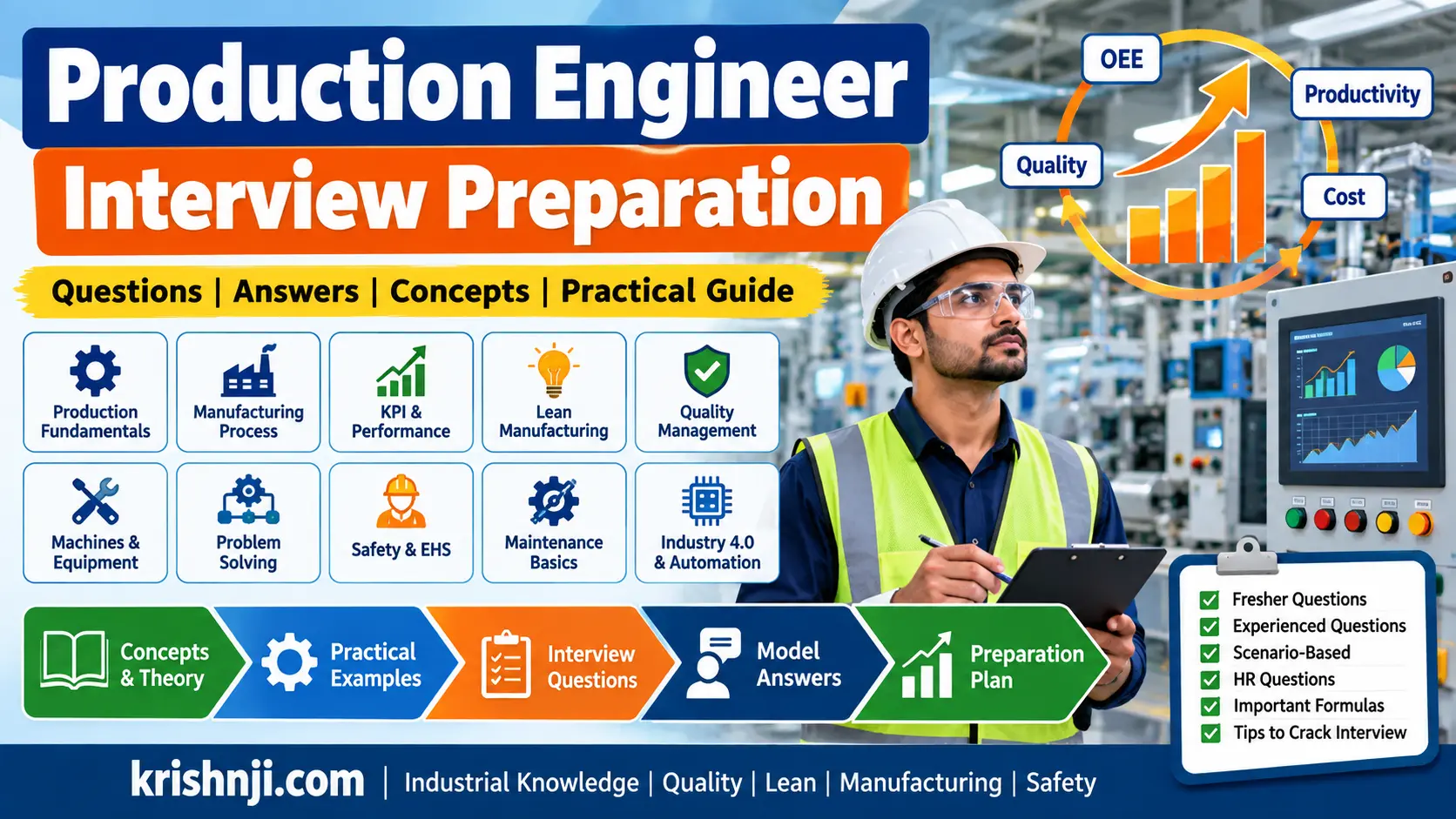
Production Engineer Interview Preparation — Quick Answer:
Production Engineer Interview की तैयारी में Production Fundamentals, OEE, Cycle Time, Takt Time, Productivity, Lean Manufacturing, Quality, Machine Basics, RCA, Safety और HR Questions पर focus करना चाहिए। इस guide में Fresher और Experienced Engineers के लिए Technical Questions, Practical Scenarios, Model Answers, Interview Tips, Mock Interview और 30-Day Preparation Plan शामिल हैं।
इस Guide में क्या मिलेगा?
इस complete Production Engineer Interview Preparation Guide में आपको interview के लिए जरूरी technical concepts, practical problem-solving और HR preparation एक ही जगह मिलेगी।
- Technical Questions — Production, Process, Manufacturing और Engineering fundamentals
- Practical Questions — Production target, breakdown, rejection, bottleneck और downtime जैसे real-world scenarios
- KPI Questions — OEE, Cycle Time, Takt Time, UPH, UPPH, FPY, Rejection और PPM
- Lean Manufacturing — 5S, Kaizen, Kanban, JIT, SMED, Poka-Yoke, Jidoka और Heijunka
- Quality — RCA, 5 Why, Fishbone, Pareto, SPC, CAPA और FMEA
- Maintenance — Machine breakdown, preventive maintenance, sensors, PLC, pneumatic और basic troubleshooting
- Safety — PPE, LOTO, machine safety, interlock, Near Miss और safe working practices
- HR Questions — Tell Me About Yourself, strengths, weakness, job change और career goals
- Fresher Preparation — Beginners के लिए fundamentals, technical और HR interview preparation
- Experienced Engineer Preparation — KPI, improvement projects, RCA, productivity, manpower और leadership-based questions
- Mock Interview — Interviewer के संभावित follow-up और scenario-based questions
- 30-Day Preparation Plan — Step-by-step interview preparation roadmap
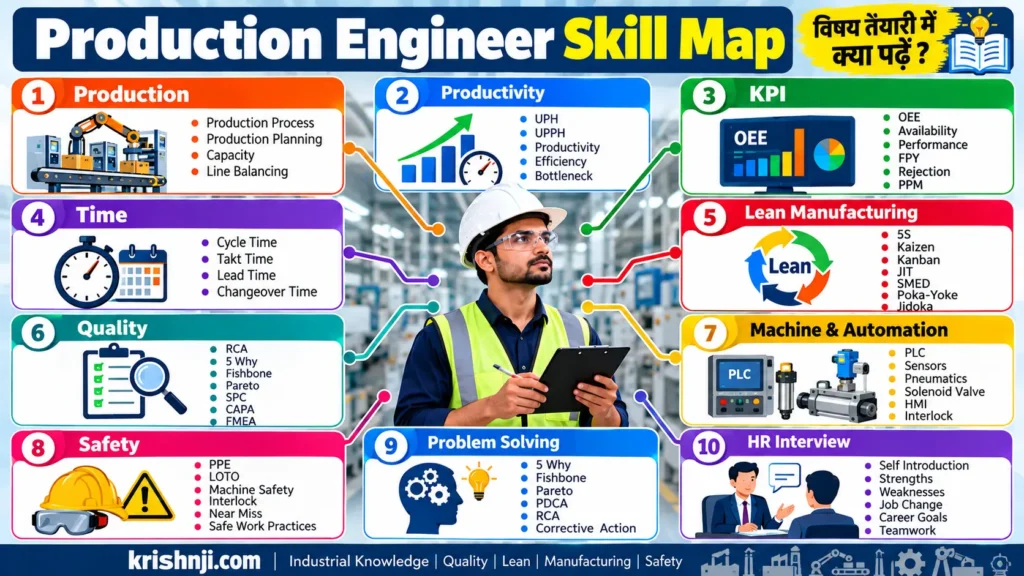
एक नजर में — Production Engineer Interview Preparation
| विषय | तैयारी में क्या पढ़ें |
|---|---|
| Production | Production Process, Production Planning, Capacity और Line Balancing |
| Productivity | UPH, UPPH, Productivity, Efficiency और Bottleneck |
| KPI | OEE, Availability, Performance, FPY, Rejection और PPM |
| Time | Cycle Time, Takt Time, Lead Time और Changeover Time |
| Lean Manufacturing | 5S, Kaizen, Kanban, JIT, SMED, Poka-Yoke और Jidoka |
| Quality | RCA, 5 Why, Fishbone, Pareto, SPC, CAPA और FMEA |
| Machine & Automation | PLC, Sensors, Pneumatics, Solenoid Valve, HMI और Interlock |
| Safety | PPE, LOTO, Machine Safety, Interlock, Near Miss और Safe Work Practices |
| Problem Solving | 5 Why, Fishbone, Pareto, PDCA, RCA और Corrective Action |
| HR Interview | Self Introduction, Strengths, Weaknesses, Job Change, Career Goals और Teamwork |
Production Engineer क्या होता है?
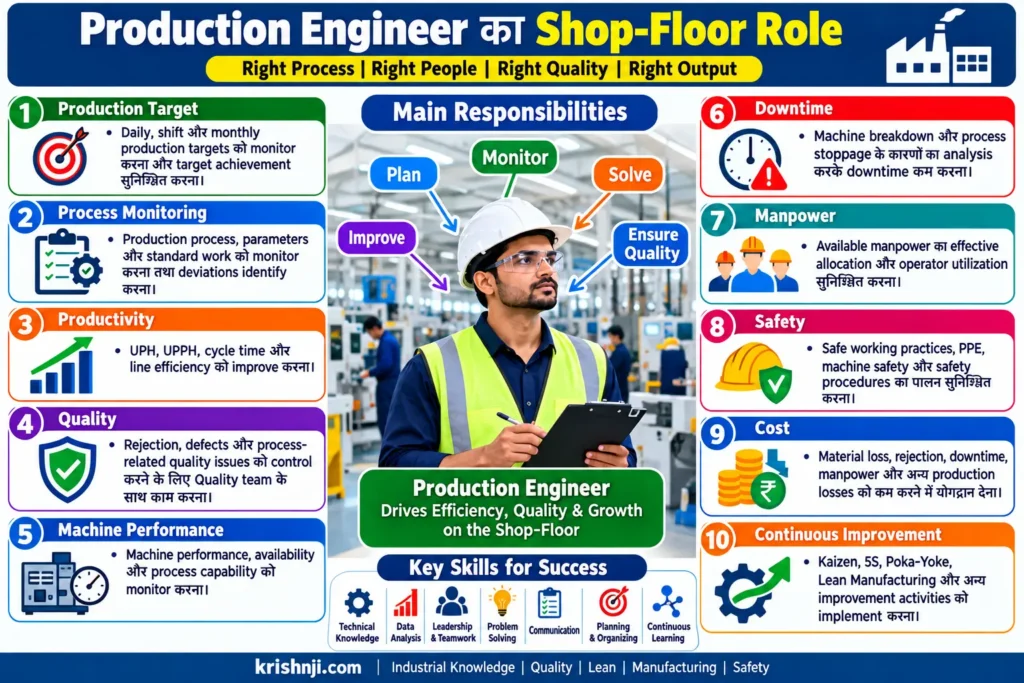
Production Engineer एक manufacturing professional होता है जो production process को plan, monitor और improve करने का काम करता है। उसका मुख्य उद्देश्य निर्धारित production target को quality, safety और cost requirements के अनुसार पूरा करना होता है। इसके लिए वह productivity, machine performance, downtime, manpower, process parameters और continuous improvement activities को नियमित रूप से monitor करता है।
Production Engineer की मुख्य Responsibilities
Production Engineer का काम केवल production target पूरा करना नहीं होता। उसे Productivity, Quality, Machine Performance, Safety और Cost के बीच संतुलन बनाकर production process को stable और efficient रखना होता है।
| Responsibility | Production Engineer का मुख्य कार्य |
|---|---|
| Production Target | Daily, shift और monthly production targets को monitor करना और target achievement सुनिश्चित करना |
| Process Monitoring | Production process, parameters और standard work को monitor करना तथा deviations identify करना |
| Productivity | UPH, UPPH, cycle time और line efficiency को improve करना |
| Quality | Rejection, defects और process-related quality issues को control करने के लिए Quality team के साथ काम करना |
| Machine Performance | Machine performance, availability और process capability को monitor करना |
| Downtime | Machine breakdown और process stoppage के कारणों का analysis करके downtime कम करना |
| Manpower | Available manpower का effective allocation और operator utilization सुनिश्चित करना |
| Safety | Safe working practices, PPE, machine safety और safety procedures का पालन सुनिश्चित करना |
| Cost | Material loss, rejection, downtime, manpower और अन्य production losses को कम करने में योगदान देना |
| Continuous Improvement | Kaizen, 5S, Poka-Yoke, Lean Manufacturing और अन्य improvement activities को implement करना |
Production Engineer किन Departments के साथ काम करता है?
Production Engineer को अकेले production manage नहीं करना होता। Manufacturing plant में production performance कई departments के coordination पर निर्भर करती है। इसलिए Production Engineer को Quality, Maintenance, PPC, Stores, Process Engineering, HR और Safety जैसे departments के साथ लगातार coordinate करना पड़ता है।
| Department | मुख्य Coordination |
|---|---|
| Quality | Defect, Rejection, Quality Issues और Corrective Action |
| Maintenance | Machine Breakdown, Preventive Maintenance और Downtime |
| PPC | Production Planning, Production Schedule और Target |
| Stores | Raw Material, Components और Material Availability |
| Process Engineering | Process Improvement, Parameters और Process Optimization |
| HR | Manpower Planning, Attendance और Operator Allocation |
| Safety / EHS | Workplace Safety, PPE, Machine Safety और Safety Compliance |
Practical Factory Example
मान लीजिए एक automotive assembly line का daily target 800 units है, लेकिन पिछले कुछ दिनों से line केवल 700–720 units ही produce कर रही है।
Production Engineer सबसे पहले केवल operators पर pressure डालने के बजाय production loss को अलग-अलग categories में analyze करेगा।
उदाहरण के लिए analysis में पता चलता है:
- Machine downtime: 45 minutes
- Material shortage: 20 minutes
- High cycle time: 30 minutes
- Quality rejection: 18 units
- Manpower shortage: 1 operator
Production Engineer इसके बाद संबंधित departments के साथ actions coordinate करेगा:
- Maintenance के साथ machine downtime का RCA करेगा।
- Stores/PPC के साथ material availability issue resolve करेगा।
- Process Engineering के साथ high cycle time analyze करेगा।
- Quality के साथ rejected units का root cause identify करेगा।
- HR/Production Supervisor के साथ manpower allocation करेगा।
- Improvement के बाद UPH, downtime, rejection और OEE को compare करके result verify करेगा।
इस तरह Production Engineer का role केवल “production बढ़ाना” नहीं है। उसका काम data के आधार पर production losses identify करना, सही department के साथ root cause solve करना और process को दोबारा stable बनाना है।
Interview Tip: अगर interviewer पूछे, “आप production target achieve नहीं होने पर क्या करेंगे?” तो केवल “मैं operators को motivate करूंगा” न कहें। बेहतर answer है: “मैं पहले target gap को downtime, cycle-time loss, material shortage, manpower और quality loss में break down करके data-based root cause analysis करूंगा और फिर corrective action की effectiveness verify करूंगा।”
एक Production Engineer का मुख्य उद्देश्य क्या होता है?
Production Engineer का practical objective केवल “ज्यादा production करना” नहीं है। सही objective है:
Right Quantity + Right Quality + Right Time + Right Cost + Safe Production
यानी production target को पूरा करते हुए quality defects, downtime, waste और unnecessary cost को नियंत्रित करना और process को लगातार improve करना है।
Production Engineer Interview में कौन-कौन से Questions पूछे जाते हैं?
Production Engineer interview में questions केवल production target या machine operation तक सीमित नहीं होते। Interviewer आमतौर पर production fundamentals, technical knowledge, manufacturing process, KPIs, Lean Manufacturing, quality, maintenance, problem solving, safety और HR skills को assess करता है। Freshers से fundamentals और experienced engineers से practical situations, improvement projects और KPI-based questions अधिक पूछे जा सकते हैं।
Production Engineer Interview Questions की मुख्य Categories
| Category | Interview में मुख्य Focus | Sample Question |
|---|---|---|
| Basic Production | Production, productivity, capacity, SOP और standard work | Production और Productivity में क्या difference है? |
| Technical Production | Cycle Time, Takt Time, UPH, UPPH, line balancing और bottleneck | Cycle Time और Takt Time में क्या अंतर है? |
| Manufacturing Process | Process flow, parameters, capacity और process control | अगर किसी process का Cycle Time standard से ज्यादा हो जाए तो आप क्या करेंगे? |
| Production KPI | OEE, Availability, Performance, FPY, Rejection और Downtime | OEE क्या है और इसे कैसे improve करेंगे? |
| Lean Manufacturing | 5S, Kaizen, Kanban, JIT, SMED और Poka-Yoke | Production line में Kaizen का practical example बताइए। |
| Quality | RCA, 5 Why, Fishbone, Pareto, SPC और CAPA | Production line पर rejection अचानक बढ़ जाए तो आप क्या करेंगे? |
| Maintenance | Breakdown, preventive maintenance, downtime, PLC और sensors | Machine बार-बार breakdown हो रही हो तो आप root cause कैसे identify करेंगे? |
| Problem Solving | RCA, data analysis, PDCA, corrective और preventive action | 5 Why Analysis का उपयोग किसी production problem में कैसे करेंगे? |
| Safety | PPE, LOTO, machine guarding, interlock और Near Miss | Production target और safety requirement में conflict हो तो आप क्या करेंगे? |
| Practical Scenario | Target miss, bottleneck, downtime, manpower और material shortage | अगर shift का production target पूरा नहीं हो रहा हो तो आपका पहला action क्या होगा? |
| HR Interview | Introduction, strengths, weakness, teamwork, pressure और career goals | Tell me about yourself. |
| Fresher-Specific | Engineering fundamentals, projects, internship और basic manufacturing | आप Production Engineer के रूप में career क्यों शुरू करना चाहते हैं? |
| Experienced-Specific | KPI ownership, improvement projects, RCA, cost reduction और leadership | आपने अपनी previous company में productivity कैसे improve की? |
इन Questions की तैयारी कैसे करें?
हर category के लिए केवल answer याद करना पर्याप्त नहीं है। एक strong Production Engineer candidate को प्रत्येक important question के लिए चार चीजें तैयार रखनी चाहिए:
Concept → Method/Formula → Practical Example → Interview Answer
उदाहरण के लिए, “OEE क्या है?” के जवाब में केवल Overall Equipment Effectiveness बताना पर्याप्त नहीं है। Candidate को OEE के Availability, Performance और Quality components, formula, practical example और low OEE होने पर improvement approach भी समझानी चाहिए।
Production Engineer Interview Preparation Roadmap Flow
Interview की तैयारी को एक साथ पूरा करने के बजाय Basic → Technical → Analytical → Practical → HR → Mock Interview के क्रम में करना अधिक effective रहेगा।
| चरण | Preparation Area | क्या पढ़ें/Practice करें | Recommended Focus |
|---|---|---|---|
| Step 1 | Production Fundamentals | Production, Productivity, Capacity, SOP, Work Instruction, Line Balancing | Basic Concepts |
| Step 2 | Production Calculations | Cycle Time, Takt Time, UPH, UPPH, Efficiency | Formulas + Examples |
| Step 3 | Production KPI | OEE, Availability, Performance, FPY, Rejection, PPM, Downtime | KPI Calculation + Analysis |
| Step 4 | Manufacturing Process | Process Flow, Parameters, Standard Work, Bottleneck | Process Understanding |
| Step 5 | Lean Manufacturing | 5S, Kaizen, Kanban, JIT, SMED, Poka-Yoke, Jidoka | Practical Application |
| Step 6 | Quality | RCA, 5 Why, Fishbone, Pareto, SPC, CAPA, FMEA | Problem Analysis |
| Step 7 | Machine & Maintenance | Breakdown, PM, Sensors, PLC, Pneumatics, Interlock | Basic Troubleshooting |
| Step 8 | Problem Solving | RCA, PDCA, Corrective Action, Preventive Action | Scenario Practice |
| Step 9 | Safety | PPE, LOTO, Machine Safety, Near Miss, EHS | Safety Questions |
| Step 10 | Practical Scenarios | Target Loss, Rejection, Downtime, Bottleneck, Manpower | Real Factory Situations |
| Step 11 | HR Preparation | Self Introduction, Strength, Weakness, Job Change, Career Goals | Communication |
| Step 12 | Mock Interview | Technical + Practical + HR Questions | Full Interview Simulation |
| Step 13 | Final Revision | Formulas, KPIs, Lean, RCA, Safety और personal projects | Quick Revision |
Fresher के लिए Preparation Priority
Fundamentals → Technical Concepts → Lean & Quality Basics → Safety → Project/Internship → HR → Mock Interview
Experienced Engineer के लिए Preparation Priority
Current Role → KPIs → Improvement Projects → RCA → Productivity → Quality → Cost Reduction → Team Handling → Scenario Questions → HR
एक Simple Preparation Formula
Learn the Concept → Understand the Factory Application → Practice the Question → Prepare Your Own Example → Practice Follow-up Questions
इस approach से candidate केवल interview questions याद नहीं करता, बल्कि interviewer के “Why?”, “How?” और “What would you do?” जैसे follow-up questions के लिए भी तैयार होता है।
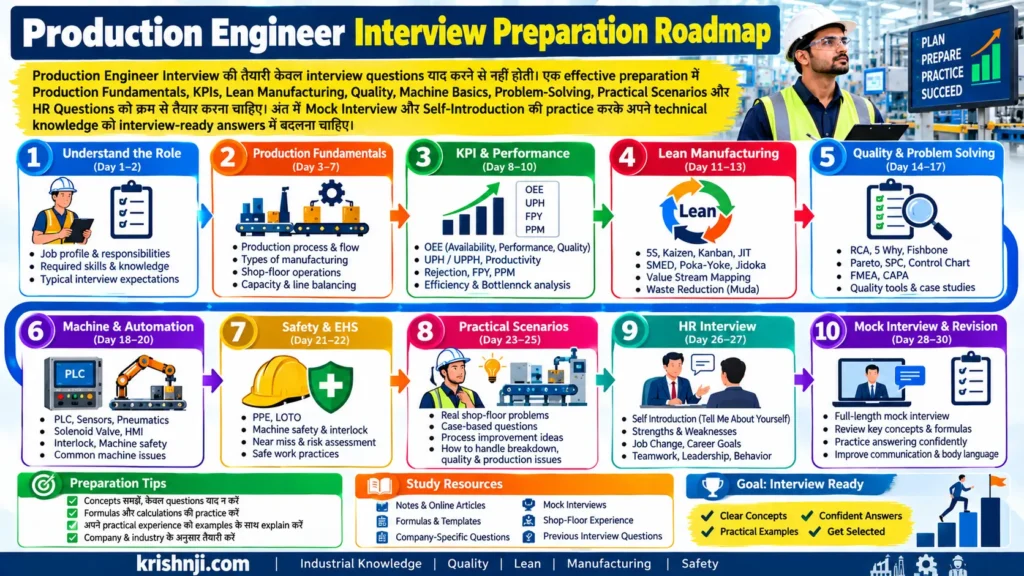
Production Engineer Interview की तैयारी कैसे करें?
Production Engineer Interview की तैयारी केवल interview questions याद करने से नहीं होती। एक effective preparation में Production Fundamentals, KPIs, Lean Manufacturing, Quality, Machine Basics, Problem-Solving, Practical Scenarios और HR Questions को क्रम से तैयार करना चाहिए। अंत में Mock Interview और Self-Introduction की practice करके अपने technical knowledge को interview-ready answers में बदलना चाहिए।
Step 1 — Understand Production Fundamentals
सबसे पहले Production Engineering के basic concepts को मजबूत करें। Interviewer अक्सर यह देखता है कि candidate को manufacturing process और shop-floor operations की fundamental understanding है या नहीं।
इन topics को पढ़ें:
- Production और Productivity
- Production Planning
- Production Process
- Process Flow
- Capacity
- Production Target
- SOP और Work Instruction
- Standard Work
- Line Balancing
- Bottleneck
Practice Question:
Production और Productivity में क्या difference है?
Preparation Tip: Definition याद करने के बजाय किसी real manufacturing process का example देकर explain करने की practice करें।
Step 2 — Learn Production KPIs
Production Engineer को production performance को numbers के माध्यम से समझना आना चाहिए। इसलिए important KPIs के meaning, formula और practical application को अच्छी तरह समझें।
Important KPIs:
- OEE
- Availability
- Performance
- Quality
- Cycle Time
- Takt Time
- UPH
- UPPH
- FPY
- Rejection Rate
- PPM
- Downtime
- Productivity
Practice Question:
अगर किसी production line का OEE लगातार कम हो रहा है, तो आप improvement की शुरुआत कहाँ से करेंगे?
Preparation Tip: हर KPI के लिए Definition → Formula → Example → Improvement Approach तैयार रखें।
Step 3 — Revise Lean Manufacturing
Production Engineer के लिए Lean Manufacturing की basic understanding बहुत उपयोगी है, क्योंकि production improvement में waste reduction, process optimization और continuous improvement महत्वपूर्ण होते हैं।
इन concepts को revise करें:
- 5S
- Kaizen
- Kanban
- JIT
- SMED
- Poka-Yoke
- Jidoka
- Heijunka
- Visual Management
- 7 Wastes of Lean
Practice Question:
आपने किसी production process में Kaizen या Poka-Yoke का उपयोग कैसे किया है?
Preparation Tip: हर Lean concept के साथ कम से कम एक practical factory example तैयार रखें।
Step 4 — Prepare Quality Concepts
Production और Quality एक-दूसरे से closely connected हैं। Production Engineer को defect और rejection बढ़ने पर initial analysis और corrective action process समझना चाहिए।
Important Topics:
- Defect और Defective
- Rejection
- FPY
- RCA
- 5 Why
- Fishbone Diagram
- Pareto Analysis
- SPC
- CAPA
- FMEA
- Control Plan
Practice Question:
Production line पर rejection अचानक बढ़ जाए तो आप क्या करेंगे?
एक अच्छा answer framework:
Containment → Data Collection → Root Cause → Corrective Action → Verification → Preventive Action
Step 5 — Understand Machine Basics
Production Engineer को हर machine का detailed maintenance expert होना जरूरी नहीं है, लेकिन machine के basic operation और common failure conditions को समझना महत्वपूर्ण है।
इन topics को revise करें:
- PLC
- Sensors
- Proximity Sensor
- Photoelectric Sensor
- Pneumatic Cylinder
- Solenoid Valve
- HMI
- Interlock
- Actuator
- Machine Parameters
- Preventive Maintenance
- Breakdown
Practice Question:
अगर production machine अचानक stop हो जाए तो आप troubleshooting कैसे शुरू करेंगे?
Preparation Tip: अपने actual plant experience से machine-related examples तैयार करें, लेकिन company की confidential information share न करें।
Step 6 — Practice Problem-Solving
Production Engineer के interview में interviewer केवल यह नहीं देखता कि आपको problem का नाम पता है या नहीं। वह यह भी देखना चाहता है कि आप problem को systematically कैसे solve करते हैं।
इसलिए इन tools की practice करें:
- 5 Why
- Fishbone
- Pareto
- PDCA
- RCA
- CAPA
- Loss Analysis
- Data Analysis
Practice Question:
अगर production target लगातार miss हो रहा है, तो आप root cause कैसे identify करेंगे?
एक structured approach रखें:
Problem → Data → Analysis → Root Cause → Action → Result → Prevention
Step 7 — Prepare Practical Scenarios
यह preparation का सबसे महत्वपूर्ण हिस्सा है। वास्तविक interview में interviewer hypothetical shop-floor situations देकर आपकी decision-making और problem-solving ability check कर सकता है।
इन scenarios की practice करें:
- Production target achieve नहीं हो रहा
- Machine बार-बार breakdown हो रही है
- Rejection अचानक बढ़ गया
- Cycle Time बढ़ गया
- Line में bottleneck है
- Manpower shortage है
- Material shortage है
- OEE कम हो गया है
- Operator SOP follow नहीं कर रहा
- Production और Quality team में disagreement है
Practice Question:
आपकी shift का target 1,000 units है, लेकिन 850 units ही produce हुए। आप अगले दिन क्या analysis करेंगे?
Preparation Tip: Answer में सीधे किसी व्यक्ति या operator को blame न करें। पहले data और loss categories analyze करें।
Step 8 — Prepare HR Questions
Technical knowledge के साथ HR round की तैयारी भी जरूरी है। HR interviewer आपकी communication, attitude, teamwork और career motivation को समझने की कोशिश कर सकता है।
Important HR Questions:
- Tell me about yourself.
- Why do you want to become a Production Engineer?
- Why should we hire you?
- What are your strengths?
- What is your weakness?
- Why do you want to change your job?
- How do you handle pressure?
- How do you handle conflict?
- Where do you see yourself in 5 years?
- Why do you want to join our company?
Preparation Tip: Answers को word-to-word memorize न करें। मुख्य points याद रखें और natural तरीके से बोलने की practice करें।
Step 9 — Practice Self Introduction
“Tell me about yourself” अक्सर interview के शुरुआती questions में से एक हो सकता है, इसलिए इसका clear और professional answer तैयार रखें।
एक experienced Production Engineer के लिए structure:
Current Role → Experience → Technical Skills → Major Achievement → Future Goal
उदाहरण के लिए:
“मैं manufacturing industry में Production Engineer के रूप में काम कर रहा हूँ। मेरी primary responsibilities production target monitoring, process improvement, productivity, quality और machine-related issues को coordinate करना हैं। मैंने Lean Manufacturing और problem-solving tools जैसे RCA और Kaizen पर भी काम किया है। अब मैं अपने existing experience को larger production responsibilities और continuous improvement projects में apply करना चाहता हूँ।”
अपने वास्तविक experience के अनुसार इसे customize करें और केवल वही achievements या skills बताएं जिन्हें आप interview में detail में explain कर सकते हैं।
Step 10 — Take a Mock Interview
अंत में अपनी preparation को Mock Interview के माध्यम से test करें।
एक complete mock interview में questions का sequence इस प्रकार रखें:
Basic Production → Technical → KPI → Lean → Quality → Machine → Scenario → HR
हर answer के बाद खुद से पूछें:
- क्या मैंने question का direct answer दिया?
- क्या मेरा answer technically correct है?
- क्या मैं practical example दे सकता हूँ?
- क्या interviewer के “Why?” या “How?” का जवाब दे सकता हूँ?
- क्या मेरा answer बहुत लंबा है?
- क्या मैंने कोई confidential company information तो नहीं बताई?
Final Preparation Formula
Concept Knowledge
↓
Formula & Technical Understanding
↓
Practical Factory Example
↓
Scenario-Based Practice
↓
HR Preparation
↓
Mock Interview
↓
Final Revision
याद रखें, एक strong Production Engineer interview preparation का उद्देश्य केवल questions के answers याद करना नहीं, बल्कि interviewer को यह demonstrate करना है कि आप production problem को समझ सकते हैं, data analyze कर सकते हैं, root cause identify कर सकते हैं और practical improvement action ले सकते हैं।
30-Day Production Engineer Interview Preparation Plan
अगर आपके पास Production Engineer interview की तैयारी के लिए 30 दिन हैं, तो preparation को Fundamentals → Technical Skills → KPI → Lean → Quality → Problem Solving → Machine → Practical Scenarios → HR → Mock Interview के क्रम में करना उपयोगी रहेगा। रोज़ लगभग 1.5–2 घंटे focused study और practice के लिए रखें।
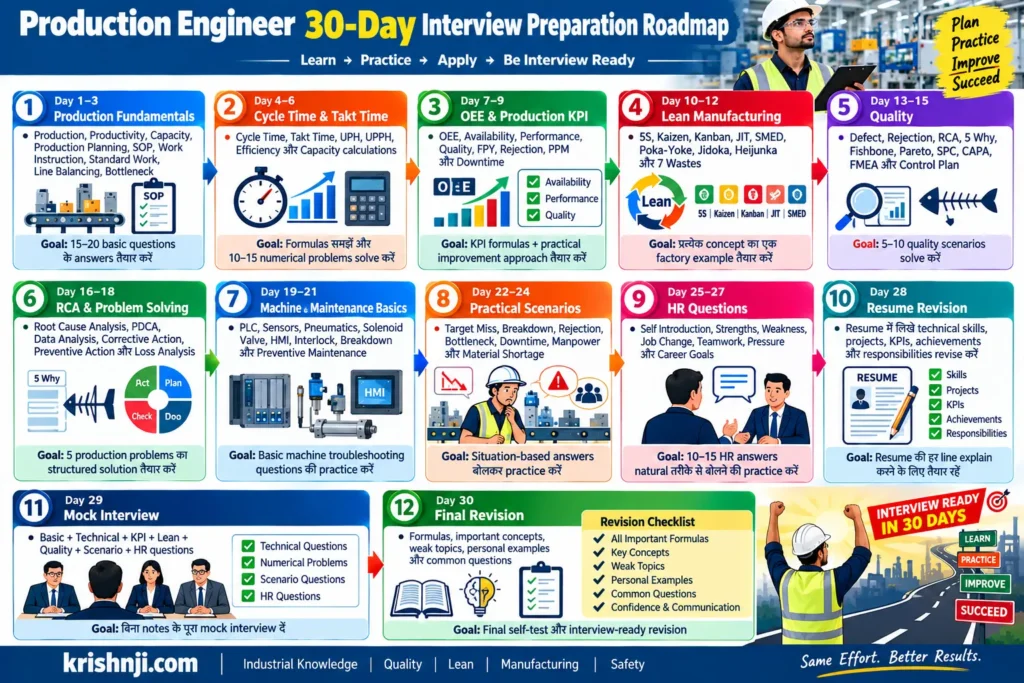
30-Day Preparation Roadmap
| Days | Preparation Area | क्या पढ़ें और Practice करें | आपका Goal |
|---|---|---|---|
| Day 1–3 | Production Fundamentals | Production, Productivity, Capacity, Production Planning, SOP, Work Instruction, Standard Work, Line Balancing और Bottleneck | 15–20 basic questions के answers तैयार करें |
| Day 4–6 | Cycle Time & Takt Time | Cycle Time, Takt Time, UPH, UPPH, Efficiency और Capacity calculations | Formulas समझें और 10–15 numerical problems solve करें |
| Day 7–9 | OEE & Production KPI | OEE, Availability, Performance, Quality, FPY, Rejection, PPM और Downtime | KPI formulas + practical improvement approach तैयार करें |
| Day 10–12 | Lean Manufacturing | 5S, Kaizen, Kanban, JIT, SMED, Poka-Yoke, Jidoka, Heijunka और 7 Wastes | प्रत्येक concept का एक factory example तैयार करें |
| Day 13–15 | Quality | Defect, Rejection, RCA, 5 Why, Fishbone, Pareto, SPC, CAPA, FMEA और Control Plan | 5–10 quality scenarios solve करें |
| Day 16–18 | RCA & Problem Solving | Root Cause Analysis, PDCA, Data Analysis, Corrective Action, Preventive Action और Loss Analysis | 5 production problems का structured solution तैयार करें |
| Day 19–21 | Machine & Maintenance Basics | PLC, Sensors, Pneumatics, Solenoid Valve, HMI, Interlock, Breakdown और Preventive Maintenance | Basic machine troubleshooting questions की practice करें |
| Day 22–24 | Practical Scenarios | Target Miss, Breakdown, Rejection, Bottleneck, Downtime, Manpower और Material Shortage | Situation-based answers बोलकर practice करें |
| Day 25–27 | HR Questions | Self Introduction, Strengths, Weakness, Job Change, Teamwork, Pressure और Career Goals | 10–15 HR answers natural तरीके से बोलने की practice करें |
| Day 28 | Resume Revision | Resume में लिखे technical skills, projects, KPIs, achievements और responsibilities revise करें | Resume की हर line explain करने के लिए तैयार रहें |
| Day 29 | Mock Interview | Basic + Technical + KPI + Lean + Quality + Scenario + HR questions | बिना notes के पूरा mock interview दें |
| Day 30 | Final Revision | Formulas, important concepts, weak topics, personal examples और common questions | Final self-test और interview-ready revision |
Day 1–3: Production Fundamentals
सबसे पहले manufacturing और production की foundation मजबूत करें।
Focus Topics:
- Production vs Productivity
- Production Planning
- Capacity
- Production Target
- Process Flow
- SOP
- Work Instruction
- Standard Work
- Line Balancing
- Bottleneck
Practice Task:
कम से कम 15 basic questions के answers अपने शब्दों में तैयार करें।
Day 4–6: Cycle Time, Takt Time & Productivity
अब production calculations पर focus करें।
Focus Topics:
- Cycle Time
- Takt Time
- UPH
- UPPH
- Efficiency
- Capacity
- Customer Demand
Practice Task:
कम से कम 10–15 numerical examples solve करें और Cycle Time तथा Takt Time का difference किसी practical production example से explain करें।
Day 7–9: OEE & Production KPIs
Production Engineer को production performance को data के माध्यम से explain करना आना चाहिए।
Focus Topics:
- OEE
- Availability
- Performance
- Quality
- FPY
- Rejection
- PPM
- Downtime
- Productivity
Practice Question:
“अगर आपकी production line का OEE लगातार कम हो रहा है, तो आप analysis कहाँ से शुरू करेंगे?”
Practice Task:
हर KPI के लिए:
Definition → Formula → Example → Improvement Action
तैयार करें।
Day 10–12: Lean Manufacturing
इन तीन दिनों में Lean concepts को केवल definitions की तरह नहीं, बल्कि shop-floor application के साथ पढ़ें।
Focus Topics:
- 5S
- Kaizen
- Kanban
- JIT
- SMED
- Poka-Yoke
- Jidoka
- Heijunka
- 7 Wastes
Practice Task:
हर Lean concept के लिए एक practical factory example तैयार करें।
Day 13–15: Quality
Production Engineer को quality problems के initial analysis और corrective action process की understanding होनी चाहिए।
Focus Topics:
- Defect
- Rejection
- FPY
- RCA
- 5 Why
- Fishbone
- Pareto
- SPC
- CAPA
- FMEA
- Control Plan
Practice Question:
“Production line पर rejection अचानक बढ़ जाए तो आप क्या करेंगे?”
Answer framework:
Containment → Data → RCA → Corrective Action → Verification → Prevention
Day 16–18: RCA & Problem Solving
यह section experienced candidates के लिए विशेष रूप से important है।
Focus Topics:
- Root Cause Analysis
- 5 Why
- Fishbone
- Pareto
- PDCA
- Data Analysis
- Corrective Action
- Preventive Action
- Production Loss Analysis
Practice Task:
कम से कम 5 real-world production problems चुनें और प्रत्येक का answer इस format में तैयार करें:
Problem → Data → Analysis → Root Cause → Action → Result → Prevention
Day 19–21: Machine & Maintenance Basics
Production Engineer को machine maintenance expert होना जरूरी नहीं है, लेकिन basic machine operation और troubleshooting समझना महत्वपूर्ण है।
Focus Topics:
- PLC
- Sensors
- Proximity Sensor
- Photoelectric Sensor
- Pneumatics
- Solenoid Valve
- HMI
- Interlock
- Machine Parameters
- Breakdown
- Preventive Maintenance
Practice Question:
“अगर production machine अचानक stop हो जाए तो आप troubleshooting कैसे शुरू करेंगे?”
Day 22–24: Practical Scenario Questions
अब तक सीखी हुई knowledge को real factory situations पर apply करें।
Practice करें:
- Production target miss
- Machine breakdown
- High rejection
- Low OEE
- High Cycle Time
- Bottleneck
- Manpower shortage
- Material shortage
- Operator error
- Quality-Production conflict
Practice Task:
हर scenario का answer 1–2 मिनट में बिना notes देखे बोलने की practice करें।
Day 25–27: HR Interview Preparation
Technical preparation के बाद communication और HR round पर focus करें।
Prepare:
- Tell me about yourself
- Why Production Engineering?
- Why should we hire you?
- Strengths
- Weakness
- Job Change
- Work Pressure
- Team Conflict
- Career Goals
- Biggest Achievement
Practice Task:
Answers को word-by-word memorize न करें। केवल key points तैयार करें और natural तरीके से बोलने की practice करें।
Day 28: Resume Revision
Interview से पहले अपने resume को line-by-line review करें।
अपने resume में लिखी प्रत्येक चीज के लिए तैयार रहें:
What? → How? → Why? → Result?
अगर आपने लिखा है:
“Improved productivity by 10%”
तो interviewer पूछ सकता है:
- पहले productivity कितनी थी?
- Improvement कैसे किया?
- कौन-सा problem था?
- आपने क्या action लिया?
- 10% कैसे calculate किया?
- Improvement sustainable कैसे बनाया?
Day 29: Mock Interview
अब पूरी preparation को test करें।
एक complete mock interview का sequence रखें:
Basic Production → Technical → KPI → Lean → Quality → Machine → Practical Scenario → HR
Mock interview के बाद तीन चीजें identify करें:
- मुझे कौन-से questions नहीं आते?
- किन answers में confidence कम है?
- कौन-से answers बहुत theoretical हैं?
Day 30: Final Revision
आखिरी दिन नया topic शुरू करने के बजाय केवल high-value topics revise करें।
Final Revision Checklist:
☐ OEE
☐ Cycle Time
☐ Takt Time
☐ UPH
☐ FPY
☐ RCA
☐ 5 Why
☐ Fishbone
☐ 5S
☐ Kaizen
☐ Poka-Yoke
☐ SMED
☐ CAPA
☐ Machine Basics
☐ Safety
☐ Self Introduction
☐ Resume Projects
☐ Practical Scenarios
30-Day Preparation Flow
Learn → Understand → Practice → Apply → Explain → Mock Interview → Revise
अगर candidate इस पूरे roadmap को follow करता है, तो उसका focus केवल “Questions याद करने” से आगे बढ़कर “Production Engineer की तरह problems को समझकर answer देने” पर आ जाता है।
Production Engineer Interview Answer Frameworks
Production Engineer interview में अच्छा answer केवल सही definition देने से नहीं बनता। Technical और practical questions के लिए answer को Concept + Application + Example + Result के साथ explain करना बेहतर होता है। नीचे दिए frameworks को अलग-अलग प्रकार के interview questions के अनुसार इस्तेमाल किया जा सकता है।
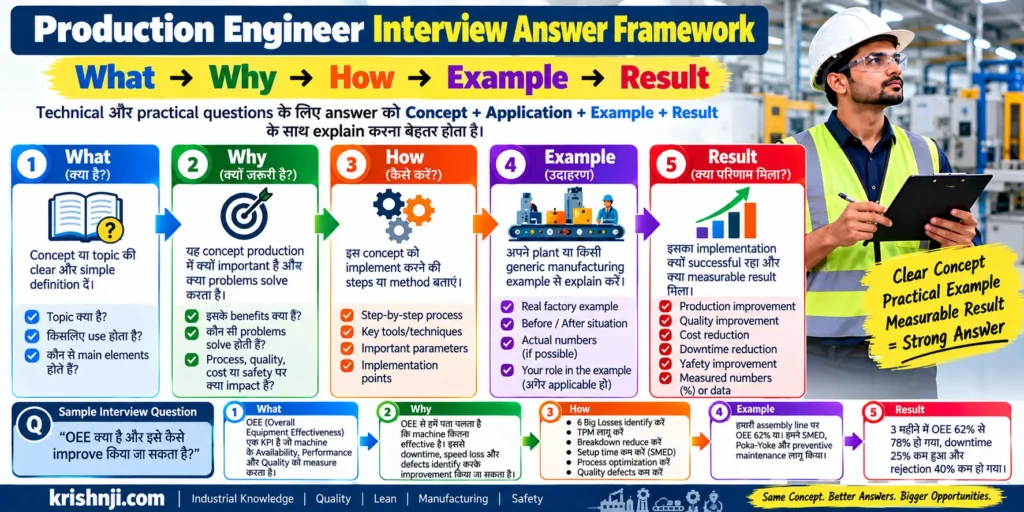
1. Technical Definition Questions
जब interviewer पूछे:
इस framework का उपयोग करें:
Definition → Purpose → Formula/Key Elements → Practical Example
Example:
“OEE यानी Overall Equipment Effectiveness एक KPI है जिसका उपयोग equipment effectiveness measure करने के लिए किया जाता है। यह Availability, Performance और Quality को combine करता है। OEE कम होने पर इन तीनों components के losses को analyze करके improvement opportunities identify की जा सकती हैं।”
2. Formula-Based Questions
जब interviewer calculation या formula पूछे:
Formula → Variables → Calculation → Interpretation
उदाहरण:
पहले formula बताएं:
Takt Time = Available Production Time ÷ Customer Demand
फिर variables explain करें और एक छोटा numerical example दें।
अंत में बताएं कि calculated Takt Time production process की required production pace को represent करता है।
3. Practical Problem-Solving Questions
जब interviewer पूछे:
“Production target achieve नहीं हो रहा हो तो क्या करेंगे?”
इस framework का उपयोग करें:
Problem → Data → Loss Identification → RCA → Corrective Action → Verification → Prevention
उदाहरण:
“सबसे पहले मैं actual output और target के बीच gap identify करूंगा। फिर downtime, cycle-time loss, manpower, material shortage और quality rejection जैसे losses को data के आधार पर अलग करूंगा। इसके बाद major loss का RCA करके corrective action implement करूंगा और improvement को verify करने के बाद standardize करूंगा।”
4. Scenario-Based Questions
जब interviewer hypothetical situation दे:
“अगर machine बार-बार breakdown हो रही है तो क्या करेंगे?”
Framework:
Immediate Action → Safety → Containment → Data → Root Cause → Corrective Action → Verification
सबसे पहले safety और immediate production impact control करें। फिर breakdown history और failure pattern analyze करें।
5. Experience-Based Questions
जब interviewer पूछे:
“आपने previous company में productivity कैसे improve की?”
यहाँ STAR Framework इस्तेमाल करें:
S — Situation
समस्या या background क्या था?
T — Task
आपकी responsibility क्या थी?
A — Action
आपने क्या action लिया?
R — Result
क्या measurable improvement आया?
Manufacturing Version
Production interviews में इसे और practical बनाया जा सकता है:
Problem → Baseline → Root Cause → Action → Result → Standardization
6. Improvement Project Questions
जब interviewer पूछे:
“आपने कोई Kaizen project किया है?”
Framework:
Current State → Problem → Data → Root Cause → Improvement → Result → Control
Example structure:
“पहले process का cycle time ___ seconds था। Analysis में ___ major loss identify हुआ। हमने ___ improvement implement किया, जिसके बाद cycle time ___ seconds हुआ और output में ___ improvement आया। Improvement को standard work में incorporate करके sustain किया गया।”
Candidate को अपने वास्तविक data के अनुसार numbers बताने चाहिए।
7. Quality Problem Questions
जब interviewer पूछे:
“Rejection अचानक बढ़ जाए तो क्या करेंगे?”
Framework:
Containment → Defect Segregation → Data Analysis → RCA → Corrective Action → Verification → CAPA
सबसे पहले suspect/defective parts को contain करें ताकि defective output आगे न जाए। फिर defect pattern और process data analyze करके root cause identify करें।
8. Low OEE Questions
जब interviewer पूछे:
“OEE 60% है। इसे improve कैसे करेंगे?”
सिर्फ यह न कहें कि “OEE improve करूंगा।”
Framework:
OEE → Availability → Performance → Quality → Major Loss → RCA → Action → Result
पहले identify करें कि OEE loss मुख्य रूप से:
- Availability
- Performance
- या Quality
में से कहाँ से आ रहा है।
फिर Pareto/Loss Analysis के आधार पर highest-impact loss को prioritize करें।
9. Conflict Questions
जब interviewer पूछे:
“Production और Quality team में disagreement हो जाए तो क्या करेंगे?”
Framework:
Understand Both Sides → Data → Common Objective → Discussion → Action → Follow-up
Answer में किसी department को blame करने से बचें।
Focus रखें:
Quality + Production + Customer Requirement + Safety
10. Manpower Shortage Questions
जब interviewer पूछे:
“अगर shift में manpower कम हो तो production कैसे manage करेंगे?”
Framework:
Check Requirement → Critical Process → Skill Matrix → Redistribution → Bottleneck Control → Target Review
पहले critical operations identify करें और available skilled manpower को priority processes पर allocate करें।
अगर target realistically achieve नहीं हो सकता, तो data के आधार पर revised plan communicate करें।
11. “Tell Me About Yourself” Framework
Experienced Production Engineer के लिए:
Current Role → Experience → Core Skills → Major Achievement → Career Goal
Example:
“मैं manufacturing industry में Production Engineer के रूप में काम कर रहा हूँ। मेरी responsibilities production target, productivity, quality और process improvement से जुड़ी हैं। मुझे OEE, RCA, Lean Manufacturing और shop-floor problem solving का practical experience है। मैंने production improvement projects पर काम किया है और अब मैं larger production responsibilities और continuous improvement initiatives में अपने experience को आगे apply करना चाहता हूँ।”
अपने वास्तविक experience के अनुसार इसे customize करें।
12. “Why Should We Hire You?” Framework
Relevant Skills → Experience → Problem-Solving Ability → Value to Company
Answer में केवल:
“I am hardworking.”
जैसी generic statement से बचें।
Production-specific value बताएं:
- Production monitoring
- KPI analysis
- Problem solving
- Quality coordination
- Lean improvement
- Cross-functional teamwork
13. “What Is Your Weakness?” Framework
Realistic Weakness → Improvement Action → Current Progress
ऐसी weakness चुनें जो genuine हो लेकिन आपकी core job responsibility को directly undermine न करे।
उदाहरण:
“Earlier, I used to spend more time than necessary validating data before presenting an improvement proposal. अब मैंने data validation के लिए a standard checklist बनाया है, जिससे analysis अधिक structured और timely हो गया है।”
14. Follow-Up Question Framework
Production Engineer interview में एक answer के बाद interviewer पूछ सकता है:
Why? → How? → What was the result? → How did you measure it?
इसलिए हर major answer के लिए इन चार follow-ups की तैयारी करें।
उदाहरण:
Candidate:
“मैंने productivity improve की।”
Interviewer:
- Productivity कितनी थी?
- आपने improvement कैसे किया?
- Root cause क्या था?
- Improvement कितने समय में आया?
- आपने result कैसे measure किया?
- इसे sustain कैसे किया?
इसलिए किसी भी improvement claim के साथ:
Baseline + Action + Result + Measurement
तैयार रखें।
Interview Answer का Effective Rule
हर technical या practical answer को जहाँ संभव हो इस sequence में दें:
What → Why → How → Example → Result
और problem-solving questions के लिए:
Problem → Data → Root Cause → Action → Result → Prevention
याद रखें:
Interview में केवल यह बताना पर्याप्त नहीं है कि आपको concept पता है। अपने answer से यह भी दिखाएँ कि आप उस concept को actual manufacturing environment में apply कर सकते हैं।
Basic Production Engineer Interview Questions & Answers
Production Engineer interview में basic questions यह check करने के लिए पूछे जाते हैं कि candidate को production system, manufacturing process, productivity, capacity, standard work और shop-floor operations की fundamental understanding कितनी है। नीचे दिए गए questions के answers को केवल याद करने के बजाय अपने practical experience और factory examples से जोड़कर समझना चाहिए।
Q1. Production Engineering क्या है?
Answer:
Production Engineering engineering की वह field है जिसमें raw material को finished product में बदलने की production process को efficient, economical, safe और quality-focused बनाने के लिए engineering principles का उपयोग किया जाता है। इसमें production planning, process improvement, machine utilization, productivity, quality, cost reduction, manpower और continuous improvement जैसे areas शामिल होते हैं।
Practical Example:
अगर किसी manufacturing line में एक process का cycle time अधिक है, तो Production Engineer process data analyze करके bottleneck identify कर सकता है और method improvement, machine parameter optimization या line balancing के द्वारा productivity improve कर सकता है।
Interview Tip:
Answer में केवल “production करने की engineering” न कहें। Productivity + Quality + Cost + Safety + Process Improvement का connection बताना बेहतर है।
Possible Follow-up:
- Production Engineering और Industrial Engineering में क्या difference है?
- Production Engineer की main responsibilities क्या होती हैं?
Q2. Production Engineer कौन होता है?
Answer:
Production Engineer वह professional होता है जो manufacturing process को plan, monitor और improve करने का काम करता है ताकि निर्धारित production target को right quality, right time, right cost और safe working conditions के साथ achieve किया जा सके। वह production, quality, maintenance, PPC, stores और other departments के साथ coordination करता है।
Production Engineer की प्रमुख responsibilities:
- Production target monitoring
- Process monitoring
- Manpower planning
- Machine utilization monitoring
- Cycle Time और UPH monitoring
- Downtime analysis
- Quality issue reduction
- Line balancing
- Bottleneck identification
- Kaizen और continuous improvement
- Safety compliance
Practical Example:
यदि shift target 1,000 units है लेकिन actual production 900 units हुआ, तो Production Engineer downtime, cycle time, manpower, material shortage और rejection जैसे losses को analyze करके target gap का root cause identify करेगा।
Q3. Production और Productivity में क्या Difference है?
Answer:
Production का मतलब है किसी निश्चित समय में बनाए गए products या output की quantity, जबकि Productivity यह बताती है कि उस output को प्राप्त करने के लिए available inputs जैसे manpower, machine, material और time का कितना effective utilization हुआ।
Simple Example:
अगर एक shift में 1,000 units बनाए गए, तो 1,000 units Production है।
लेकिन अगर वही 1,000 units कम manpower, कम time और कम resources में बनाए गए, तो productivity बेहतर हो सकती है।
Basic Productivity Formula:
Productivity = Output ÷ Input
Input manpower, machine hours, material या किसी specific resource के रूप में define किया जा सकता है।
Interview Tip:
एक अच्छा answer यह दिखाता है कि production बढ़ाना हमेशा productivity बढ़ने के बराबर नहीं होता।
Possible Follow-up:
“अगर production बढ़ रहा है लेकिन productivity कम हो रही है तो इसका क्या कारण हो सकता है?”
Q4. Production Planning क्या है?
Answer:
Production Planning एक systematic process है जिसमें यह decide किया जाता है कि क्या बनाना है, कितना बनाना है, कब बनाना है और उपलब्ध manpower, machine, material और capacity का उपयोग कैसे करना है। इसका उद्देश्य customer demand को available resources के अनुसार efficiently पूरा करना होता है।
Production Planning में सामान्यतः शामिल होते हैं:
- Production quantity
- Production schedule
- Material availability
- Machine capacity
- Manpower requirement
- Process sequence
- Delivery requirement
- Production priority
Practical Example:
यदि किसी customer order के लिए 10,000 units बनानी हैं और delivery deadline 5 दिन है, तो Production Planning में daily requirement, machine capacity, manpower, material availability और shift planning को consider किया जाएगा।
Possible Follow-up:
- Production Planning और PPC में क्या difference है?
- अगर material available नहीं है तो production plan कैसे manage करेंगे?
Q5. Process Flow क्या है?
Answer:
Process Flow किसी product को बनाने के लिए होने वाले सभी manufacturing steps का logical sequence होता है। इसमें raw material से लेकर finished product तक material और process का flow दिखाया जाता है।
Example:
Raw Material → Cutting → Assembly → Testing → Inspection → Packing → Finished Product
Process Flow को समझने से Production Engineer को यह identify करने में मदद मिलती है कि कौन-सा process पहले, कौन-सा बाद में और किस process पर quality inspection या control आवश्यक है।
Practical Use:
- Process sequence समझना
- Bottleneck identify करना
- Material movement समझना
- Quality checkpoints define करना
- Line balancing करना
- Process improvement करना
Possible Follow-up:
“अगर Process Flow में एक process का cycle time बहुत ज्यादा हो तो आप क्या करेंगे?”
Q6. SOP क्या है?
Answer:
SOP का full form Standard Operating Procedure है। यह किसी task या process को perform करने के लिए निर्धारित standard method और procedure को document करता है। SOP का उद्देश्य यह सुनिश्चित करना है कि काम निर्धारित safety, quality और process requirements के अनुसार consistently किया जाए।
एक SOP में सामान्यतः शामिल हो सकते हैं:
- Purpose
- Scope
- Responsibility
- Required equipment/material
- Process steps
- Safety precautions
- Quality requirements
- Acceptance criteria
- Important parameters
Practical Example:
किसी machine को start और stop करने की standard procedure, safety checks और operating conditions को SOP में define किया जा सकता है।
Interview Tip:
SOP को केवल “काम करने का तरीका” न बताएं। इसमें standardization, safety, quality और consistency का purpose भी बताएं।
Q7. Work Instruction क्या है?
Answer:
Work Instruction किसी specific operation को कैसे perform करना है, इसकी detailed step-by-step instruction होती है। यह operator या technician को actual workplace पर task perform करने के लिए practical guidance देती है।
Example:
अगर किसी assembly station पर component fitting करनी है, तो Work Instruction में बताया जा सकता है:
- Component identify करें।
- Component orientation check करें।
- Part को fixture में रखें।
- निर्धारित sequence में assembly करें।
- Required parameter verify करें।
- Final inspection करें।
SOP और Work Instruction में basic difference:
| SOP | Work Instruction |
|---|---|
| Procedure को define करता है | Task को कैसे करना है बताता है |
| Process-level guidance | Operation-level detailed guidance |
| What/When/Responsibility पर focus | How पर ज्यादा focus |
Possible Follow-up:
“Work Instruction में visual images का क्या benefit है?”
Q8. Standard Work क्या है?
Answer:
Standard Work किसी process को perform करने का सबसे वर्तमान और agreed best-known method है, जिसमें work sequence, required time और standard conditions को define किया जाता है। इसका उद्देश्य process variation कम करना, consistent output प्राप्त करना और continuous improvement के लिए baseline बनाना है।
Standard Work के important elements हो सकते हैं:
- Takt Time
- Work Sequence
- Standard Work-in-Process (SWIP)
Practical Example:
Assembly line पर operator को तीन operations करने हैं। Standard Work define करेगा कि operations किस sequence में होंगे, प्रत्येक operation का required time क्या है और कितना WIP maintain करना है।
Interview Tip:
Standard Work को “काम करने का fixed तरीका” कहकर खत्म न करें। यह बताएं कि standard work improvement का baseline भी बनाता है।
Q9. Production Target क्या होता है?
Answer:
Production Target किसी निश्चित time period में produce किए जाने वाले required output की निर्धारित quantity होती है। यह hourly, shift-wise, daily, weekly या monthly हो सकता है।
Example:
अगर किसी production line का shift target 800 units है, तो shift के दौरान required output 800 units होगा।
Production Target निर्धारित करते समय consider किए जा सकते हैं:
- Customer demand
- Available working hours
- Machine capacity
- Manpower
- Cycle Time
- Takt Time
- Material availability
- Planned downtime
- Quality requirements
Target Monitoring:
Target → Actual Production → Gap → Loss Analysis → Corrective Action
अगर target miss हो जाए तो केवल operator को blame करने के बजाय loss categories analyze करनी चाहिए।
Q15. Manufacturing Process क्या है?
Answer:
Manufacturing Process वह systematic sequence है जिसमें raw material या components को machines, tools, manpower और defined processes की सहायता से finished या semi-finished product में transform किया जाता है।
Manufacturing Process के examples:
- Machining
- Casting
- Forging
- Welding
- Stamping
- Injection Molding
- Assembly
- Testing
- Packaging
Example: Electronics/Battery Manufacturing
एक simplified process flow हो सकता है:
Component Preparation → Assembly → Welding → Inspection → Testing → Final Assembly → Packing
हर process में defined parameters, quality requirements, equipment और work instructions हो सकते हैं।
Interview Tip:
अगर interviewer आपके current industry के बारे में पूछता है, तो generic example देने के बजाय अपने actual manufacturing process का example देकर explain करें। इससे आपका practical exposure बेहतर तरीके से demonstrate होता है।
Quick Revision — 15 Basic Questions
| Q | Topic | Interview में क्या याद रखें |
|---|---|---|
| 1 | Production Engineering | Engineering + Process + Productivity |
| 2 | Production Engineer | Target + Quality + Cost + Safety + Improvement |
| 3 | Production vs Productivity | Output vs Input Efficiency |
| 4 | Production Planning | What + How Much + When + Resources |
| 5 | Process Flow | Process का logical sequence |
| 6 | SOP | Standard procedure |
| 7 | Work Instruction | Task को कैसे perform करना है |
| 8 | Standard Work | Best-known standardized method |
| 9 | Production Target | Required output in defined time |
| 10 | Bottleneck | Flow को limit करने वाला constraint |
| 11 | Capacity | Production capability |
| 12 | Capacity Utilization | Capacity का actual utilization |
| 13 | Line Balancing | Workload distribution |
| 14 | Production Efficiency | Actual vs expected performance |
| 15 | Manufacturing Process | Raw Material → Finished Product transformation |
Basic Interview Answer Rule
इन questions के answers देते समय केवल definition बोलकर रुकना नहीं चाहिए। जहाँ possible हो, answer को इस structure में रखें:
Definition → Purpose → Practical Example → Production Impact
उदाहरण:
“Bottleneck वह process है जिसकी capacity production flow को limit करती है। इसे identify करने के लिए cycle time और process capacity compare कर सकते हैं। उदाहरण के लिए अगर एक line में बाकी processes 100 UPH दे रहे हैं लेकिन एक process केवल 70 UPH दे रहा है, तो वह bottleneck हो सकता है। इसे improve करने के लिए cycle time reduction, line balancing या capacity improvement किया जा सकता है।”
यही approach Production Engineer interview में आपके answer को theoretical से practical बनाती है।
Production Engineer Technical Interview Questions & Answers
Production Engineer के Technical Interview में interviewer यह देखता है कि candidate को केवल manufacturing terms की definition पता है या वह उन्हें calculation, production planning, capacity improvement और shop-floor problem solving में भी apply कर सकता है। इसलिए नीचे दिए गए questions में concept के साथ formula, practical example और interview में बोलने योग्य answer शामिल हैं।
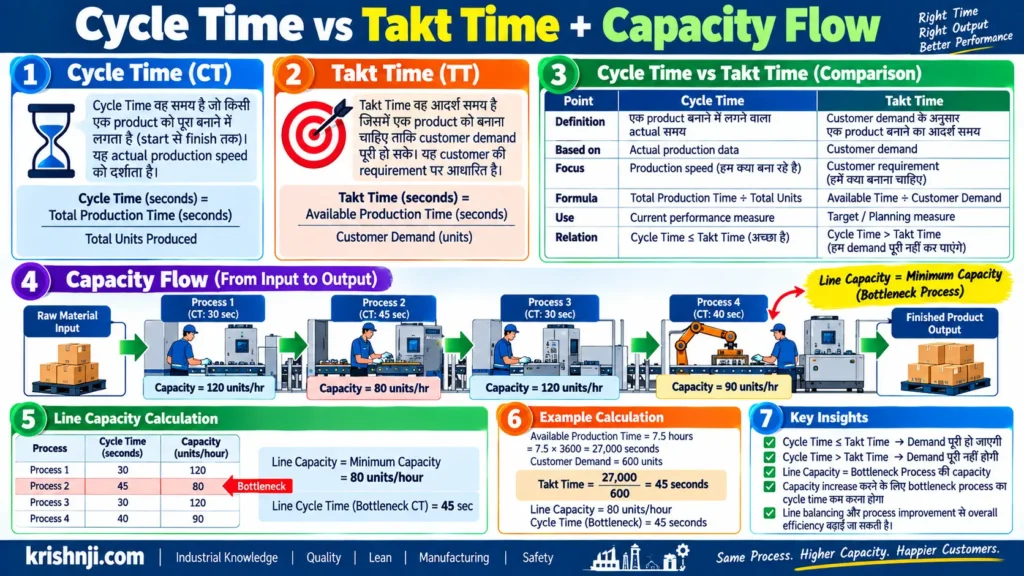
Q1. Cycle Time क्या है?
Direct Answer:
Cycle Time वह actual time है जो किसी machine, process या workstation को एक unit या एक cycle complete करने में लगता है।
Explanation:
Cycle Time production process की speed को समझने का एक important parameter है। यदि किसी process का cycle time 30 seconds है, तो ideal condition में एक unit complete करने में 30 seconds लगेंगे।
Cycle Time का उपयोग production capacity, UPH, line balancing और bottleneck analysis में किया जाता है।
Formula:
Cycle Time = Total Production Time ÷ Total Units Produced
Example:
Production Time = 60 minutes = 3,600 seconds
Output = 120 units
Cycle Time = 3,600 ÷ 120 = 30 seconds/unit
Interview Answer:
“Cycle Time किसी process या workstation को एक unit complete करने में लगने वाला time है। इसे Total Production Time divided by Total Output से calculate किया जा सकता है। इसका उपयोग capacity, UPH और bottleneck analysis के लिए किया जाता है।”
Q2. Takt Time क्या है?
Direct Answer:
Takt Time वह required production rate है जिस पर production करना जरूरी है ताकि customer demand को available production time के अंदर पूरा किया जा सके।
Explanation:
Cycle Time बताता है कि process वास्तव में कितने समय में एक unit बना रहा है, जबकि Takt Time बताता है कि customer demand पूरी करने के लिए एक unit कितने समय में बनना चाहिए।
Formula:
Takt Time = Available Production Time ÷ Customer Demand
Example:
Available Production Time = 420 minutes
Customer Demand = 840 units
Takt Time:
= 420 × 60 ÷ 840
= 30 seconds/unit
इसका मतलब demand पूरा करने के लिए average production rate 30 seconds/unit होना चाहिए।
Interview Answer:
“Takt Time customer demand के आधार पर required production pace बताता है। इसका formula Available Production Time divided by Customer Demand है। इसे Cycle Time से compare करके पता लगाया जा सकता है कि process demand के अनुसार चल रहा है या नहीं।”
Q3. Cycle Time और Takt Time में क्या Difference है?
Direct Answer:
Cycle Time actual process speed बताता है, जबकि Takt Time customer demand के अनुसार required production speed बताता है।
| Cycle Time | Takt Time |
|---|---|
| Actual process time | Required production pace |
| Process से related | Customer demand से related |
| Actual performance बताता है | Required rate बताता है |
| Process measurement में उपयोग | Production planning में उपयोग |
Example:
Cycle Time = 35 sec
Takt Time = 30 sec
इस situation में process required demand rate से slow है और capacity improvement की आवश्यकता हो सकती है।
Interview Answer:
“Cycle Time actual time है जो एक unit बनाने में लगता है, जबकि Takt Time customer demand पूरा करने के लिए required time per unit है। अगर Cycle Time Takt Time से ज्यादा है, तो process demand को meet करने में difficulty हो सकती है।”
Q4. UPH क्या है?
Direct Answer:
UPH का full form Units Per Hour है। यह बताता है कि किसी production process, machine या line से एक घंटे में कितने units produce होते हैं।
Formula:
UPH = Total Units Produced ÷ Production Hours
या ideal single-process condition में:
UPH = 3600 ÷ Cycle Time (seconds)
Example:
Cycle Time = 30 seconds
UPH = 3600 ÷ 30 = 120 units/hour
Interview Answer:
“UPH यानी Units Per Hour एक production productivity metric है जो hourly output बताता है। अगर cycle time 30 seconds है, तो ideal condition में UPH 120 units/hour होगी।”
Q5. UPPH क्या है?
Direct Answer:
UPPH का full form Units Per Person Hour है। यह बताता है कि एक person के available working hour में average कितने units produce किए गए।
Formula:
UPPH = Total Units Produced ÷ Total Man-Hours
जहाँ:
Man-Hours = Number of Persons × Working Hours
Example:
Output = 800 units
Manpower = 10 persons
Working Time = 8 hours
Total Man-Hours:
10 × 8 = 80 man-hours
UPPH:
800 ÷ 80 = 10 units/person-hour
Interview Answer:
“UPPH manpower productivity को measure करता है। इसे total output को total man-hours से divide करके calculate किया जाता है। इसका उपयोग manpower utilization और productivity improvement को evaluate करने के लिए किया जाता है।”
Q6. Capacity क्या है?
Direct Answer:
Capacity किसी machine, process या production line की एक निर्धारित समय में production करने की available capability है।
Explanation:
Capacity theoretical, rated, practical या available conditions के अनुसार define की जा सकती है। इसलिए interview में यह स्पष्ट करना जरूरी है कि calculation किस capacity definition के आधार पर हो रही है।
Basic Formula:
Capacity = Available Production Time ÷ Cycle Time
Example:
Available Time = 7 hours = 25,200 seconds
Cycle Time = 30 seconds
Capacity = 25,200 ÷ 30 = 840 units/day
यह ideal capacity है, यदि अन्य losses को calculation में शामिल नहीं किया गया है।
Interview Answer:
“Capacity किसी process या machine की defined operating conditions में production capability है। Basic calculation के लिए available production time को cycle time से divide किया जा सकता है, लेकिन practical capacity में downtime, changeover, quality loss और other constraints भी consider करने पड़ सकते हैं।”
Q7. Capacity Utilization क्या है?
Direct Answer:
Capacity Utilization यह बताता है कि available production capacity का कितना प्रतिशत वास्तव में utilize किया गया।
Formula:
Capacity Utilization (%) = Actual Output ÷ Available Capacity × 100
Example:
Available Capacity = 1,000 units/day
Actual Output = 850 units/day
Capacity Utilization = 850 ÷ 1,000 × 100 = 85%
Interview Answer:
“Capacity Utilization actual production को available capacity से compare करता है। अगर available capacity 1,000 units और actual output 850 units है, तो utilization 85% होगा। Low utilization के लिए downtime, demand, material, manpower, changeover या process constraints analyze किए जा सकते हैं।”
Q8. Production Efficiency क्या है?
Direct Answer:
Production Efficiency actual production performance को defined standard या expected performance के साथ compare करने का measure है।
Common Formula:
Efficiency (%) = Actual Output ÷ Standard Expected Output × 100
कुछ organizations में efficiency को standard hours और actual hours के आधार पर भी calculate किया जाता है, इसलिए interview में company-specific KPI definition confirm करना उचित है।
Example:
Standard Output = 1,000 units
Actual Output = 900 units
Efficiency = 900 ÷ 1,000 × 100 = 90%
Interview Answer:
“Production Efficiency actual performance को standard expected performance से compare करती है। इसका formula organization की KPI definition पर depend कर सकता है। इसलिए calculation से पहले standard definition समझना जरूरी है।”
Q9. Line Balancing क्या है?
Direct Answer:
Line Balancing production line के अलग-अलग workstations के बीच workload को इस तरह distribute करने की process है कि bottleneck और idle time कम हो तथा production flow smooth रहे।
Explanation:
अगर एक workstation बहुत ज्यादा time लेता है और बाकी stations जल्दी अपना काम पूरा कर लेते हैं, तो line में imbalance हो सकता है।
Basic Concept:
Work Content → Workstation Distribution → Cycle Time Alignment → Bottleneck Reduction
Example:
चार operations के times:
- A = 20 sec
- B = 45 sec
- C = 25 sec
- D = 40 sec
यदि required cycle time 30 seconds है, तो B और D को विशेष attention चाहिए क्योंकि उनका workload required pace से अधिक है।
Interview Answer:
“Line balancing में work elements को workstations के बीच इस तरह distribute किया जाता है कि workload balanced रहे, bottleneck और idle time कम हो और required production rate achieve हो सके।”
Q10. Bottleneck क्या है?
Direct Answer:
Bottleneck वह process, machine या workstation है जिसकी capacity production flow की overall output को limit करती है।
Explanation:
अगर एक process की capacity 60 UPH है और बाकी processes 100 UPH produce कर सकते हैं, तो 60 UPH वाला process overall flow को constrain कर सकता है।
Example:
| Process | Capacity |
|---|---|
| A | 100 UPH |
| B | 60 UPH |
| C | 100 UPH |
यहाँ Process B potential bottleneck है।
Interview Answer:
“Bottleneck वह constraint है जो production flow की maximum output को limit करता है। इसे identify करने के लिए cycle time, capacity, queue/WIP और downtime data को analyze किया जा सकता है।”
Q11. Man-Machine Ratio क्या है?
Direct Answer:
Man-Machine Ratio यह बताता है कि एक machine या machines के group को operate करने के लिए कितने manpower resources required या assigned हैं।
Basic Formula:
Man-Machine Ratio = Number of Operators ÷ Number of Machines
Example:
Operators = 6
Machines = 4
Ratio = 6 ÷ 4 = 1.5
अर्थात average 1 machine पर 1.5 operators assigned हैं।
Important:
Actual optimum ratio process complexity, machine automation, cycle time, material handling, inspection requirements और safety requirements पर depend करता है। केवल ratio कम करना हमेशा productivity improvement नहीं होता।
Interview Answer:
“Man-Machine Ratio manpower और machines के allocation को understand करने के लिए उपयोग किया जाता है। इसे operators divided by machines से calculate किया जा सकता है, लेकिन optimum ratio process requirement और automation level के अनुसार तय किया जाना चाहिए।”
Q12. Process Capability क्या है?
Direct Answer:
Process Capability यह बताती है कि कोई stable और controlled process defined specification limits के अंदर लगातार output produce करने में कितना capable है।
Explanation:
Process capability analysis में process variation को customer या specification requirements के साथ compare किया जाता है।
Common capability indices:
- Cp
- Cpk
Formula:
Cp = (USL − LSL) ÷ 6σ
जहाँ:
- USL = Upper Specification Limit
- LSL = Lower Specification Limit
- σ = Process Standard Deviation
और:
Cpk = Minimum [(USL − Mean) ÷ 3σ, (Mean − LSL) ÷ 3σ]
Example:
अगर process variation specification limits की तुलना में बहुत कम है और process mean target के करीब है, तो capability बेहतर हो सकती है।
Important Interview Point:
Process Capability calculation से पहले यह verify करना जरूरी है कि process sufficiently stable/in statistical control हो।
Interview Answer:
“Process Capability यह evaluate करती है कि stable process specification limits के अंदर consistently output दे सकता है या नहीं। इसके लिए Cp और Cpk जैसे indices commonly use होते हैं। Cp variation को और Cpk variation के साथ process centering को भी consider करता है।”
Q13. Standard Work क्या है?
Direct Answer:
Standard Work किसी process को perform करने का वर्तमान में defined और agreed best-known method है, जिसमें work sequence, required time और standard conditions को define किया जाता है।
मुख्य Elements:
- Takt Time
- Work Sequence
- Standard Work-in-Process (SWIP)
Example:
Assembly operation में:
Part Pick → Position → Assembly → Inspection → Transfer
अगर इस sequence के लिए standard time और required WIP defined है, तो यह Standard Work का हिस्सा हो सकता है।
Interview Answer:
“Standard Work process को standardized और repeatable बनाने का तरीका है। इसमें work sequence, takt time और standard WIP जैसे elements define किए जाते हैं। इससे process variation कम करने और continuous improvement के लिए baseline बनाने में मदद मिलती है।”
Q14. Cycle Time से Production Capacity कैसे Calculate करेंगे?
Direct Answer:
यदि available production time और cycle time पता हो, तो ideal production capacity calculate की जा सकती है।
Formula:
Capacity = Available Production Time ÷ Cycle Time
यदि time seconds में है:
Capacity per Hour = 3600 ÷ Cycle Time
Example:
Cycle Time = 45 seconds
Hourly Capacity = 3600 ÷ 45 = 80 units/hour
यदि 8-hour shift है:
80 × 8 = 640 units/shift
यह ideal calculation है। Actual output निकालते समय downtime, changeover, rejection, breaks और other losses को consider करना पड़ सकता है।
Interview Answer:
“Cycle Time से ideal hourly capacity निकालने के लिए 3600 को cycle time in seconds से divide करते हैं। 45-second cycle time पर ideal capacity 80 UPH होगी।”
Q15. अगर Cycle Time Takt Time से ज्यादा हो तो आप क्या करेंगे?
Direct Answer:
अगर Cycle Time > Takt Time है, तो process customer demand के required pace से slow है। Production Engineer को पहले data verify करके constraint identify करना चाहिए और फिर cycle time reduction, line balancing, manpower adjustment, method improvement या capacity enhancement जैसे actions evaluate करने चाहिए।
Example:
Takt Time = 30 sec
Cycle Time = 36 sec
Process को required demand rate meet करने के लिए improvement की जरूरत है।
Possible Actions:
- Work element analysis
- Motion reduction
- Method improvement
- Line balancing
- Bottleneck removal
- Machine parameter optimization
- Parallel operation
- Automation feasibility
- Setup/changeover improvement
Interview Answer:
“सबसे पहले मैं actual cycle time और takt time की calculation verify करूंगा। फिर process के work elements और losses analyze करके bottleneck identify करूंगा। उसके बाद line balancing, method improvement, motion reduction या capacity improvement जैसे actions लेकर cycle time को takt requirement के करीब लाने का प्रयास करूंगा।”
Q16. UPH कम हो रहा हो तो आप कैसे Analyze करेंगे?
Direct Answer:
UPH कम होने पर केवल output को देखने के बजाय production loss को categories में divide करके data-based loss analysis करना चाहिए।
Analysis Approach:
UPH Drop → Data Collection → Loss Categorization → Major Loss → RCA → Corrective Action → Verification
Possible Losses:
- Machine Breakdown
- Minor Stops
- High Cycle Time
- Changeover
- Material Shortage
- Manpower Shortage
- Quality Rejection
- Process Waiting
- Machine Setting/Adjustment
Example:
Standard UPH = 100
Actual UPH = 82
अगर analysis में पता चलता है कि 12% loss machine downtime से और 6% loss high cycle time से है, तो इन्हीं major losses को priority देकर improvement शुरू किया जा सकता है।
Interview Answer:
“UPH कम होने पर मैं पहले standard और actual UPH compare करूंगा। फिर downtime, cycle time, manpower, material और quality losses का data collect करके Pareto analysis करूंगा। Major loss identify करके RCA और corrective action करूंगा तथा improvement के बाद UPH verify करूंगा।
Production KPI & OEE Interview Questions & Answers
Production Engineer के लिए Production KPIs यह measure करने में मदद करते हैं कि production line या machine कितनी efficiently, consistently और effectively perform कर रही है। Interview में OEE, UPH, UPPH, FPY, RTY, Rejection Rate, PPM और DPMO जैसे KPIs से जुड़े questions पूछे जा सकते हैं।
एक अच्छे answer में केवल formula बताना पर्याप्त नहीं है। Production Engineer को यह भी explain करना आना चाहिए कि KPI खराब होने पर loss कहाँ है, root cause कैसे identify करेंगे और improvement को कैसे verify करेंगे।
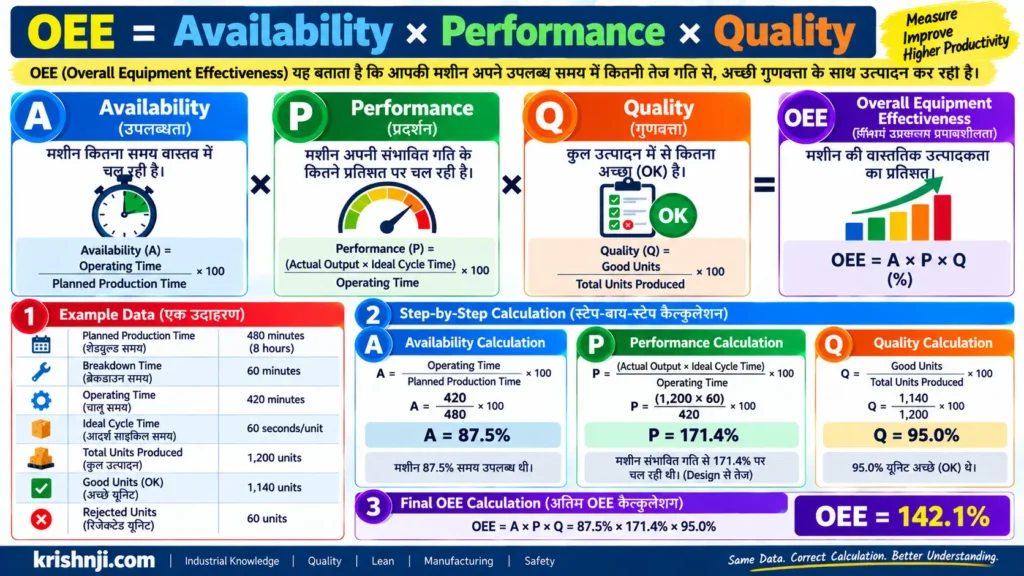
Q1. OEE क्या है?
Direct Answer:
OEE का full form Overall Equipment Effectiveness है। यह एक equipment या production process की effectiveness को तीन factors के आधार पर measure करता है:
Availability × Performance × Quality
OEE यह समझने में मदद करता है कि available production time में equipment का कितना effective utilization हुआ।
Formula:
OEE = Availability × Performance × Quality
अगर percentages को decimal में use किया जाए:
OEE = A × P × Q × 100
Example:
Availability = 90%
Performance = 95%
Quality = 98%
OEE = 0.90 × 0.95 × 0.98 × 100
OEE = 83.79%
Interview Answer:
“OEE यानी Overall Equipment Effectiveness equipment की effectiveness को measure करने वाला KPI है। यह Availability, Performance और Quality के product से calculate होता है। इससे हमें पता चलता है कि equipment में downtime, speed loss या quality loss कहाँ हो रहा है।”
Q2. OEE के तीन Components क्या हैं?
Direct Answer:
OEE के तीन components हैं:
- Availability
- Performance
- Quality
इन तीनों को मिलाकर OEE calculate किया जाता है।
OEE = Availability × Performance × Quality
1. Availability
Equipment planned production time में कितना available रहा।
मुख्य losses:
- Breakdown
- Setup
- Changeover
- Long stoppage
- Equipment failure
2. Performance
Equipment available रहने के दौरान कितनी speed पर चला compared with ideal या standard speed।
मुख्य losses:
- Minor Stops
- Reduced Speed
- Slow Cycle Time
3. Quality
Produced quantity में से कितने units good quality के थे।
मुख्य losses:
- Rejection
- Scrap
- Rework
- Startup defects
Interview Answer:
“OEE के तीन components Availability, Performance और Quality हैं। Availability time losses को, Performance speed losses को और Quality defect losses को represent करती है।”
Q3. Availability क्या है?
Direct Answer:
Availability यह measure करती है कि planned production time में equipment वास्तव में कितने समय available रहा।
Basic Formula:
Availability (%) = Operating Time ÷ Planned Production Time × 100
जहाँ:
Operating Time = Planned Production Time − Downtime
Example:
Planned Production Time = 480 min
Downtime = 60 min
Operating Time:
480 − 60 = 420 min
Availability:
420 ÷ 480 × 100 = 87.5%
Interview Answer:
“Availability planned production time में equipment के actual operating time को measure करती है। Breakdown, setup और changeover जैसे time losses Availability को reduce कर सकते हैं।”
Q4. Performance क्या है?
Direct Answer:
Performance यह measure करती है कि equipment operating time के दौरान ideal या standard production speed की तुलना में कितनी effectively run कर रहा है।
एक commonly used OEE formula:
Performance (%) = Ideal Cycle Time × Total Count ÷ Operating Time × 100
Example:
Ideal Cycle Time = 30 sec/unit
Total Count = 700 units
Operating Time = 22,000 sec
Performance:
= 30 × 700 ÷ 22,000 × 100
= 95.45%
Performance को प्रभावित करने वाले factors:
- Reduced Speed
- Minor Stops
- Machine running below standard speed
- Process interruptions
Interview Answer:
“Performance equipment की actual running speed को ideal speed के साथ compare करती है। इसका purpose यह identify करना है कि equipment available रहने के दौरान speed losses के कारण कितना output loss हो रहा है।”
Q5. Quality Rate क्या है?
Direct Answer:
Quality Rate यह बताता है कि total produced quantity में से कितने units good quality के हैं और बिना rejection या rework के acceptable हैं।
Common Formula:
Quality Rate (%) = Good Count ÷ Total Count × 100
या:
Quality = (Total Count − Defects) ÷ Total Count × 100
Example:
Total Production = 1,000 units
Rejected Units = 20
Good Units = 980
Quality Rate = 980 ÷ 1,000 × 100 = 98%
Interview Answer:
“Quality Rate total production में good units का percentage बताता है। Rejection, scrap और defined quality losses बढ़ने पर Quality Rate कम होती है।”
Q6. OEE कैसे Calculate करते हैं?
Direct Answer:
OEE calculate करने के लिए पहले Availability, Performance और Quality calculate किए जाते हैं और फिर तीनों को multiply किया जाता है।
Formula:
OEE = Availability × Performance × Quality
Example:
Planned Production Time = 480 min
Downtime = 48 min
Operating Time = 432 min
Availability:
432 ÷ 480 × 100 = 90%
मान लेते हैं:
Performance = 95%
Quality = 98%
तो:
OEE = 90% × 95% × 98%
OEE = 83.79%
Interview Answer:
“OEE calculate करने के लिए पहले Availability, Performance और Quality निकालते हैं। इसके बाद तीनों percentages को multiply करते हैं। इससे equipment effectiveness का combined indicator मिलता है।”
Q7. अगर OEE Low हो तो आप क्या करेंगे?
Direct Answer:
Low OEE होने पर सबसे पहले यह identify करना चाहिए कि loss Availability, Performance या Quality में से किस component में ज्यादा है। इसके बाद major loss को Pareto के माध्यम से prioritize करके RCA और corrective action करना चाहिए।
Problem-Solving Approach:
Low OEE → A/P/Q Analysis → Major Loss → Data Collection → RCA → Corrective Action → Verification → Standardization
Example:
मान लें:
Availability = 75%
Performance = 92%
Quality = 98%
यहाँ Availability सबसे बड़ा concern है।
तब Production Engineer को analyze करना चाहिए:
- Breakdown
- Setup
- Changeover
- Material waiting
- Machine adjustment
- Long stoppages
अगर Pareto से पता चलता है कि 60% downtime एक particular machine failure से आ रहा है, तो उस failure का RCA किया जाएगा।
Interview Answer:
“Low OEE होने पर मैं पहले Availability, Performance और Quality को separately analyze करूंगा। फिर Pareto से major loss identify करके data-based RCA करूंगा। Root cause के आधार पर corrective action implement करूंगा और improvement के बाद OEE तथा individual loss को verify करूंगा।”
Q8. Production Engineer कौन-कौन से KPIs Monitor करता है?
Direct Answer:
Production Engineer के KPIs company, process और role के अनुसार अलग हो सकते हैं, लेकिन सामान्यतः Safety, Quality, Delivery, Cost और Productivity से जुड़े KPIs monitor किए जाते हैं।
Important KPIs:
Productivity
- UPH
- UPPH
- Productivity %
- Output vs Target
Equipment
Quality
- FPY
- RTY
- Rejection %
- PPM
- DPMO
- Scrap
- Rework
Production
- Target Achievement
- Capacity Utilization
- Cycle Time
- Takt Time
- Changeover Time
- Line Efficiency
Interview Answer:
“मैं role और process के अनुसार Safety, Quality, Delivery, Cost और Productivity KPIs monitor करूंगा। इसमें OEE, UPH, UPPH, FPY, rejection, PPM, downtime, cycle time, target achievement और capacity utilization जैसे metrics important हैं।”
Q9. UPH क्या है?
Direct Answer:
UPH का full form Units Per Hour है। यह एक घंटे में produced units की quantity बताता है।
Formula:
UPH = Total Output ÷ Production Hours
Ideal single-process condition में:
UPH = 3600 ÷ Cycle Time (seconds)
Example:
Cycle Time = 30 seconds
UPH = 3600 ÷ 30 = 120 units/hour
Interview Answer:
“UPH hourly production output को measure करता है। इसे total output को production hours से divide करके calculate किया जाता है। Cycle time known हो तो ideal UPH 3600 divided by cycle time से calculate की जा सकती है।”
Q10. UPPH क्या है?
Direct Answer:
UPPH का full form Units Per Person Hour है। यह manpower productivity को measure करता है।
Formula:
UPPH = Total Output ÷ Total Man-Hours
Man-Hours = Number of Persons × Working Hours
Example:
Output = 800 units
Manpower = 10 persons
Working Time = 8 hours
Man-Hours:
10 × 8 = 80
UPPH:
800 ÷ 80 = 10 units/person-hour
Interview Answer:
“UPPH manpower productivity का indicator है। इसे total output को total man-hours से divide करके calculate किया जाता है।”
Q11. FPY क्या है?
Direct Answer:
FPY का full form First Pass Yield है। यह बताता है कि process से गुजरने वाले total units में से कितने units पहली बार में बिना rework के सही पाए गए।
Formula:
FPY (%) = First Pass Good Units ÷ Total Units Entered × 100
Example:
Total Units Entered = 1,000
First Pass Good = 960
FPY = 960 ÷ 1,000 × 100 = 96%
अगर 40 units को rework की आवश्यकता पड़ी, तो वे first-pass good count में शामिल नहीं होंगे।
Interview Answer:
“FPY process की first-time quality performance को measure करता है। यह बताता है कि कितने units पहली बार में बिना rework के acceptable बने। इसका उपयोग process quality और rework losses को monitor करने के लिए किया जाता है।”
Q12. RTY क्या है?
Direct Answer:
RTY का full form Rolled Throughput Yield है। यह multi-step production process में यह बताता है कि एक unit ने सभी process steps को बिना defect या rework के successfully pass करने की probability/yield क्या है।
यदि process steps independent yield के रूप में represent किए जाएँ, तो:
RTY = Yield₁ × Yield₂ × Yield₃ × … × Yieldₙ
Example:
Process A Yield = 98%
Process B Yield = 97%
Process C Yield = 99%
RTY = 0.98 × 0.97 × 0.99 × 100
RTY = 94.11%
इसका मतलब approximately 94.11% throughput सभी defined steps से first-pass basis पर successful रहा।
Interview Answer:
“RTY multi-process flow की combined first-pass yield को measure करता है। प्रत्येक process की yield को multiply करके rolled throughput yield निकाली जाती है। इससे hidden rework और process-to-process losses को understand करने में मदद मिलती है।”
Q13. Rejection Rate क्या है?
Direct Answer:
Rejection Rate यह बताती है कि total produced quantity में से कितने units quality requirements को meet नहीं करते और reject होते हैं।
Formula:
Rejection Rate (%) = Rejected Units ÷ Total Production × 100
Example:
Total Production = 2,000 units
Rejected = 30 units
Rejection Rate = 30 ÷ 2,000 × 100 = 1.5%
Interview Answer:
“Rejection Rate total production में rejected units का percentage है। अगर rejection बढ़ता है तो defect type, process, machine, material, parameter और operator method के आधार पर RCA करना चाहिए।”
Q14. PPM क्या है?
Direct Answer:
PPM का full form Parts Per Million है। Quality में यह बताता है कि एक million units या parts में कितने defective units पाए गए।
Formula:
PPM = Defective Units ÷ Total Units × 1,000,000
Example:
Defective Units = 25
Total Units = 100,000
PPM = 25 ÷ 100,000 × 1,000,000
= 250 PPM
Interview Answer:
“PPM quality performance को standardized scale पर express करने का तरीका है। इसका formula defective units divided by total units multiplied by one million है।”
Important:
Interview में यह भी clarify करें कि organization PPM को defective parts, defect occurrences या shipment/customer-return basis पर कैसे define करती है, क्योंकि denominator और definition context के अनुसार बदल सकते हैं।
Q15. DPMO क्या है?
Direct Answer:
DPMO का full form Defects Per Million Opportunities है। यह metric केवल defective units को नहीं बल्कि एक unit में available defect opportunities को भी consider करता है।
Formula:
DPMO = Total Defects ÷ (Total Units × Opportunities per Unit) × 1,000,000
Example:
Total Units = 1,000
Opportunities per Unit = 5
Total Defect Opportunities = 5,000
Actual Defects = 20
DPMO = 20 ÷ 5,000 × 1,000,000
= 4,000 DPMO
PPM और DPMO में Difference:
| PPM | DPMO |
|---|---|
| Defective units/parts पर focus | Defect opportunities पर focus |
| Part-level metric | Opportunity-level metric |
| एक part में multiple opportunities को अलग से capture नहीं करता | Multiple defect opportunities consider कर सकता है |
Interview Answer:
“DPMO यानी Defects Per Million Opportunities defect opportunities को consider करता है। यह total defects को total units multiplied by opportunities per unit से divide करके one million से multiply करता है। इसका उपयोग complex processes में defect performance compare करने के लिए किया जाता है।”
Production KPI Quick Reference Table
| KPI | Formula | Purpose |
|---|---|---|
| OEE | A × P × Q | Equipment effectiveness |
| Availability | Operating Time ÷ Planned Time × 100 | Time loss monitoring |
| Performance | Ideal CT × Total Count ÷ Operating Time × 100 | Speed loss monitoring |
| Quality Rate | Good Count ÷ Total Count × 100 | Quality performance |
| UPH | Output ÷ Production Hours | Hourly productivity |
| UPPH | Output ÷ Man-Hours | Manpower productivity |
| FPY | First Pass Good ÷ Total Entered × 100 | First-pass quality |
| RTY | Yield₁ × Yield₂ × … × Yieldₙ | Multi-process yield |
| Rejection % | Reject ÷ Total × 100 | Defect monitoring |
| PPM | Defective Units ÷ Total Units × 1M | Defect rate |
| DPMO | Defects ÷ (Units × Opportunities) × 1M | Opportunity-based defect rate |
Interview में KPI Question का सही Approach क्या होनी चाहिए?
Production Engineer interview में अगर interviewer पूछता है:
“आपकी line का OEE कम हो गया है, आप क्या करेंगे?”
तो केवल यह कहना:
“मैं OEE improve करूंगा।”
एक weak answer होगा।
इसके बजाय answer को इस sequence में रखें:
OEE ↓ → Availability / Performance / Quality Analysis → Major Loss → Pareto → RCA → Corrective Action → Verification → Standardization
उदाहरण:
“सबसे पहले मैं OEE के तीन components—Availability, Performance और Quality को अलग-अलग analyze करूंगा। इसके बाद major loss को Pareto से identify करूंगा। अगर Availability loss ज्यादा है तो breakdown, changeover और stoppage data analyze करूंगा। Root cause मिलने के बाद corrective action implement करके OEE और संबंधित loss को before-after data से verify करूंगा। Successful improvement को standardize करूंगा।”
KPI Interview का Golden Rule
हर KPI को इस 5-Step Method से तैयार करें:
1. Definition → 2. Formula → 3. Calculation → 4. Interpretation → 5. Improvement Action
यानी interviewer अगर formula के बाद पूछे “इस KPI को improve कैसे करेंगे?”, तो आपके पास practical answer भी तैयार होना चाहिए।
Lean Manufacturing Interview Questions for Production Engineer
Production Engineer के interview में Lean Manufacturing से जुड़े questions का उद्देश्य केवल Lean tools की definitions check करना नहीं होता। Interviewer यह समझना चाहता है कि candidate waste identify कर सकता है, process flow improve कर सकता है और Lean concepts को actual production line पर practically implement कर सकता है या नहीं।
इसलिए Lean interview answers में केवल “What is Lean?” बताने के बजाय Problem → Waste → Analysis → Improvement → Result → Standardization approach दिखाना महत्वपूर्ण है।
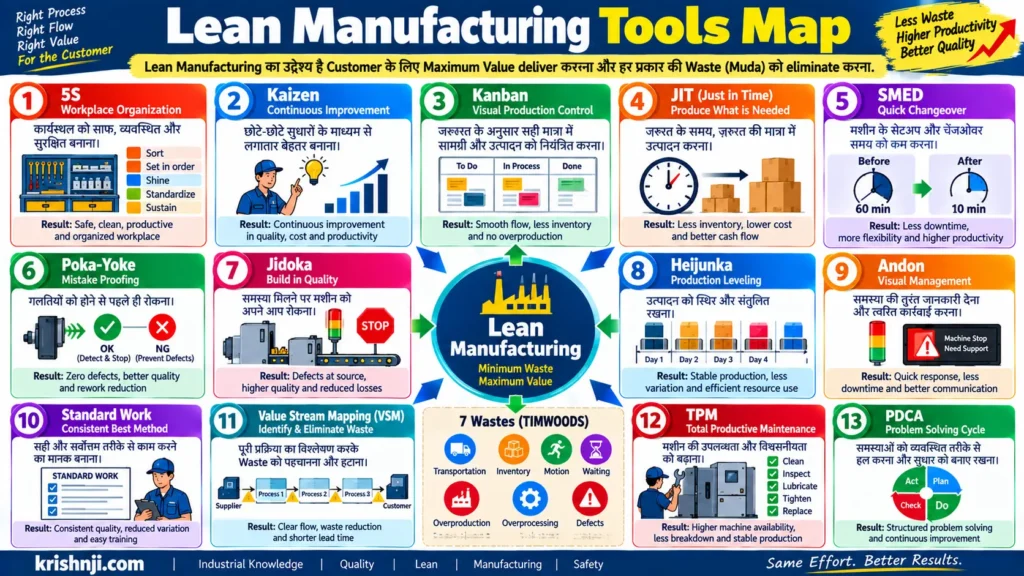
Q1. Lean Manufacturing क्या है?
Direct Answer:
Lean Manufacturing एक systematic approach है जिसका उद्देश्य customer के लिए value create करते हुए waste को कम करना, process flow improve करना, lead time घटाना और continuous improvement करना है।
Explanation:
Lean का मुख्य focus केवल cost reduction नहीं है। इसका उद्देश्य ऐसे activities को identify करना है जो customer के लिए value नहीं बनातीं और उन्हें eliminate या reduce करना है।
Lean Manufacturing में commonly used concepts हैं:
- 5S
- Kaizen
- Kanban
- JIT
- SMED
- Poka-Yoke
- Jidoka
- Heijunka
- Visual Management
- Andon
Example:
अगर production line में operator को material लेने के लिए बार-बार 20–30 steps चलना पड़ता है, तो यह unnecessary motion है। Material point-of-use पर रखने से motion और cycle time loss कम किया जा सकता है।
Interview Answer:
“Lean Manufacturing का उद्देश्य customer value को maximize करते हुए non-value-added activities और waste को systematically reduce करना है। इसके लिए 5S, Kaizen, Kanban, JIT, SMED और Poka-Yoke जैसे tools का उपयोग किया जाता है।”
Q2. 5S क्या है?
Direct Answer:
5S workplace organization और visual management की Lean methodology है। इसका उद्देश्य workplace को organized, clean, standardized और disciplined बनाना है।
5S के पाँच steps:
- Sort — Seiri
- Set in Order — Seiton
- Shine — Seiso
- Standardize — Seiketsu
- Sustain — Shitsuke
Example:
Production line पर unnecessary tools हटाकर required tools को identified locations पर रखना, tool shadow board लगाना और daily cleaning checklist maintain करना 5S implementation का example है।
Interview Answer:
“5S workplace को organized और standardized बनाने की methodology है। इसके पांच steps Sort, Set in Order, Shine, Standardize और Sustain हैं। इसका उद्देश्य workplace efficiency, visual control, safety और discipline improve करना है।”
Q3. Kaizen क्या है?
Direct Answer:
Kaizen का अर्थ Continuous Improvement है। इसमें छोटे या बड़े systematic improvements के माध्यम से process को लगातार बेहतर बनाने का प्रयास किया जाता है।
Example:
अगर operator को component उठाने के लिए हर cycle में ज्यादा movement करनी पड़ती है, तो material holder को operator के ergonomic reach zone में shift करना एक simple Kaizen हो सकता है।
Kaizen Process:
Problem → Current Condition → Root Cause → Improvement → Result → Standardization
Interview Answer:
“Kaizen continuous improvement की approach है। मैं पहले current condition और problem को data से identify करूंगा, root cause analyze करूंगा, improvement implement करूंगा और before-after result verify करके successful method को standardize करूंगा।”
Q4. Poka-Yoke क्या है?
Direct Answer:
Poka-Yoke एक mistake-proofing technique है जिसका उद्देश्य human error को prevent करना या error होने पर तुरंत detect करना है।
Example:
अगर component केवल एक specific orientation में fit होना चाहिए, तो ऐसा fixture design करना कि गलत orientation में component fit ही न हो सके, Poka-Yoke है।
Types:
- Prevention
- Detection
Interview Answer:
“Poka-Yoke mistake-proofing technique है। इसका उद्देश्य defect होने से पहले error को prevent करना या process में error को immediately detect करना है।”
Q5. Kanban क्या है?
Direct Answer:
Kanban एक visual pull-based system है जिसका उपयोग material या production replenishment को actual consumption या demand के आधार पर control करने के लिए किया जाता है।
Example:
Assembly line पर दो-bin system है। पहला bin consume होने के बाद empty-bin signal के आधार पर material replenishment trigger होता है।
Benefits:
- Excess inventory reduction
- Better material flow
- Visual control
- WIP control
- Overproduction reduction
Interview Answer:
“Kanban एक visual pull system है जो actual consumption के आधार पर material या production replenishment को control करता है। इसका उद्देश्य overproduction और unnecessary inventory को reduce करना है।”
Q6. Just-in-Time (JIT) क्या है?
Direct Answer:
JIT का उद्देश्य required material या component को required quantity में, required time पर और required location पर उपलब्ध कराना है ताकि unnecessary inventory और waiting को कम किया जा सके।
Example:
अगर assembly line को हर घंटे 500 components चाहिए, तो material supply system को actual consumption और defined replenishment cycle के अनुसार design किया जा सकता है।
Important:
JIT का मतलब “zero inventory at any cost” नहीं है। Practical implementation में supply reliability, lead time, demand variation और risk को consider करना आवश्यक है।
Interview Answer:
“JIT का उद्देश्य material को required quantity और required time पर उपलब्ध कराना है ताकि excess inventory, waiting और material-related waste कम हो।”
Q7. SMED क्या है?
Direct Answer:
SMED का full form Single-Minute Exchange of Die है। यह setup और changeover time को significantly reduce करने की Lean methodology है।
मुख्य concept:
Internal Setup → External Setup → Simplify → Standardize
Example:
अगर machine changeover में 60 minutes लगते हैं, तो activities को analyze करके जो काम machine running के दौरान किया जा सकता है उसे पहले करना, quick clamps लगाना और tools को pre-stage करना changeover time reduce कर सकता है।
Interview Answer:
“SMED changeover time reduction की methodology है। इसमें internal और external setup activities को अलग करके external activities को machine stop होने से पहले perform किया जाता है और setup को simplify एवं standardize किया जाता है।”
Q8. Jidoka क्या है?
Direct Answer:
Jidoka का concept है quality को process के अंदर build करना और abnormal condition detect होने पर process को stop या control करना, ताकि defect आगे न जाए।
Example:
अगर automated assembly machine sensor से गलत component detect करती है, तो machine automatically stop हो सकती है और Andon signal generate कर सकती है।
Interview Answer:
“Jidoka का उद्देश्य abnormality को early stage पर detect करके process को control या stop करना है ताकि defect अगले process तक pass न हो। इसमें built-in quality और abnormality response important हैं।”
Q9. Heijunka क्या है?
Direct Answer:
Heijunka का मतलब Production Leveling है। इसका उद्देश्य production volume और product mix को available demand के अनुसार level करना है ताकि uneven production, overproduction और excessive workload को reduce किया जा सके।
Example:
यदि demand बहुत fluctuate करती है, तो production schedule को level करके daily production में unnecessary peaks और valleys कम करने का प्रयास किया जा सकता है।
Interview Answer:
“Heijunka production leveling की approach है। इसका उद्देश्य production volume और product mix को level करके uneven workload, inventory और production fluctuation को reduce करना है।”
Q10. Visual Management क्या है?
Direct Answer:
Visual Management ऐसी techniques का उपयोग है जिनसे process की current condition, abnormality, target या standard को देखकर आसानी से समझा जा सके।
Examples:
- Floor marking
- Safety signs
- Production boards
- Status indicators
- Color coding
- Tool shadow boards
- KPI boards
- Material location labels
Example:
Production board पर Target = 1,000 units और Actual = 850 units clearly display करने से production gap तुरंत visible हो जाता है।
Interview Answer:
“Visual Management information को visual और easily understandable बनाता है ताकि normal और abnormal condition को जल्दी identify किया जा सके और appropriate action लिया जा सके।”
Q11. Andon System क्या है?
Direct Answer:
Andon एक visual और अक्सर audible signaling system है जिसका उपयोग production line पर abnormality, machine issue, quality problem या operator assistance की आवश्यकता को immediately communicate करने के लिए किया जाता है।
Example:
Operator को quality defect दिखाई देता है। वह Andon signal activate करता है। Supervisor या support team को तुरंत indication मिलता है और issue response शुरू होता है।
Benefits:
- Faster response
- Abnormality visibility
- Quality containment
- Downtime reduction
- Problem escalation
Interview Answer:
“Andon abnormality communication और escalation का visual system है। इसका purpose issue को जल्दी visible बनाना और responsible support team को timely response के लिए alert करना है।”
Q12. Lean Manufacturing के Seven Wastes क्या हैं?
Direct Answer:
Lean में Seven Wastes को commonly TIMWOOD से remember किया जाता है:
- Transportation — unnecessary material movement
- Inventory — excess raw material, WIP या finished goods
- Motion — unnecessary operator movement
- Waiting — operator, machine या material waiting
- Overproduction — requirement से ज्यादा production
- Overprocessing — unnecessary processing
- Defects — rejection, rework और scrap
Example:
अगर operator को component लेने के लिए बार-बार दूर जाना पड़ता है, तो यह Motion waste हो सकता है।
अगर machine material के लिए 10 minutes wait करती है, तो यह Waiting waste है।
Interview Answer:
“Lean के traditional Seven Wastes Transportation, Inventory, Motion, Waiting, Overproduction, Overprocessing और Defects हैं। Production Engineer का काम इन wastes को identify करके process flow और productivity improve करना है।”
Q13. आप Production Line में Lean Waste कैसे Identify करेंगे?
Direct Answer:
Lean waste identify करने के लिए मैं Gemba observation, process mapping, time study, motion study, production data और operator feedback का उपयोग करूंगा।
Approach:
Observe → Map Process → Collect Data → Identify Waste → Quantify Loss → RCA → Improvement → Verify
Example:
अगर operator हर cycle में 15 steps extra चल रहा है:
Cycle = 1,000/day
तो unnecessary movement बहुत significant हो सकता है। Material point-of-use पर रखने से motion waste reduce किया जा सकता है।
Interview Answer:
“मैं पहले Gemba पर जाकर actual process observe करूंगा। फिर process flow और work elements को map करके waiting, motion, transportation, overprocessing और other wastes identify करूंगा। Major waste को data से quantify करके Kaizen या process improvement implement करूंगा और before-after result verify करूंगा।”
Q14. आपने Lean Concept को Actual Production Line में कैसे Implement किया?
Direct Answer:
इस question का answer candidate के actual experience पर आधारित होना चाहिए। केवल Lean tool की definition नहीं, बल्कि Problem → Analysis → Action → Result explain करना चाहिए।
Recommended Answer Structure:
Problem → Data → Waste → Root Cause → Lean Tool → Implementation → Result → Standardization
Example Answer:
“मेरी production line में एक workstation पर operator को material लेने के लिए बार-बार workstation से बाहर जाना पड़ता था, जिससे unnecessary motion और cycle time loss हो रहा था। मैंने Gemba observation और time study से movement को analyze किया। इसके बाद material को point-of-use पर shift किया और dedicated material holder लगाया। इसके बाद cycle time और operator movement को before-after data से compare किया। Improvement effective रहने पर इस arrangement को standard work में include किया गया।”
Interview Tip:
अपने वास्तविक experience में जहाँ possible हो वहाँ before/after data जरूर बताएं।
Q15. आपने 5S को Production Line पर कैसे Implement किया?
Direct Answer:
5S implementation केवल cleaning activity नहीं है। इसे Sort → Organize → Clean → Standardize → Sustain के systematic approach से implement करना चाहिए।
Practical Approach:
- Unnecessary items identify करें
- Red Tag activity करें
- Required items की fixed location define करें
- Labels और floor marking लगाएं
- Cleaning standards बनाएं
- Visual standards display करें
- Daily/weekly audit करें
- Abnormality पर corrective action लें
Example Answer:
“मैंने workstation पर unnecessary tools और materials को identify करके अलग किया। Required tools के लिए fixed locations और visual identification बनाया। Cleaning और inspection points define किए और regular 5S audit शुरू किया। इससे workplace organization improve हुआ और tool searching तथा unnecessary movement कम हुआ।”
Q16. आपने Kaizen के माध्यम से Production कैसे Improve किया?
Direct Answer:
Kaizen improvement को measurable बनाने के लिए baseline और post-improvement performance compare करना चाहिए।
Approach:
Current State → Problem → Data → Root Cause → Kaizen → Before/After → Standardization
Example Answer:
“एक process में cycle time standard से ज्यादा था। मैंने work elements को observe करके unnecessary movement और handling time identify किया। Material placement और work sequence में improvement किया। इसके बाद cycle time को before और after data से compare किया। Improvement sustain करने के लिए revised work instruction और standard work को update किया।”
Important:
अगर actual result आपके पास है तो answer में real figure दें, जैसे:
Cycle Time: 32 sec → 28 sec
लेकिन interview में unverified या fabricated numbers नहीं बताने चाहिए।
Q17. Poka-Yoke का Production Line में Practical Example बताइए।
Direct Answer:
Poka-Yoke का practical implementation ऐसा mechanism बनाना है जो गलत operation को prevent या immediately detect करे।
Example:
मान लें assembly process में दो similar components हैं और गलत component लगाने से defect बनता है। Fixture में component-specific locator या sensor लगाया जा सकता है ताकि:
Correct Part → Assembly Allowed
Wrong Part → Assembly Blocked / Alarm
Interview Answer:
“एक assembly process में wrong orientation के कारण defect की possibility थी। इसे prevent करने के लिए fixture में orientation-specific locating arrangement लगाया गया ताकि wrong orientation में component properly fit न हो सके। इस तरह error को operator inspection पर depend करने के बजाय process level पर prevent किया गया।”
Q18. Kanban और JIT में क्या Difference है?
Direct Answer:
JIT एक broader production philosophy/system है जिसका उद्देश्य required material को सही समय और quantity में उपलब्ध कराना है, जबकि Kanban एक visual pull mechanism है जिसका उपयोग replenishment और flow को control करने के लिए किया जा सकता है।
| JIT | Kanban |
|---|---|
| Broader production approach | Specific control mechanism |
| Right quantity, right time | Visual pull/replenishment signal |
| Inventory और flow optimization | Material/production signal |
| Kanban को use कर सकता है | JIT implementation में support कर सकता है |
Interview Answer:
“JIT एक broader approach है जिसका focus required material को required time पर उपलब्ध कराना है। Kanban एक visual pull signal/system है जो replenishment को actual consumption के आधार पर control करने में मदद करता है।”
Q19. Lean Implementation के बाद Improvement को कैसे Measure करेंगे?
Direct Answer:
Lean improvement को केवल “process better हो गया” कहकर measure नहीं करना चाहिए। Improvement के लिए baseline और measurable KPI define करना चाहिए।
Possible KPIs:
- Cycle Time
- UPH
- UPPH
- OEE
- Downtime
- Changeover Time
- WIP
- Lead Time
- Rejection
- FPY
- PPM
- Operator Motion
- Material Distance
Example:
अगर SMED project किया गया:
Before Changeover = 60 min
After Changeover = 40 min
Improvement:
20 minutes reduction
Percentage reduction:
20 ÷ 60 × 100 = 33.33%
Interview Answer:
“Lean improvement measure करने के लिए पहले baseline KPI define करूंगा। Improvement के बाद उसी KPI को comparable conditions में measure करूंगा। उदाहरण के लिए SMED project में changeover time, Kaizen में cycle time या UPH और quality improvement में FPY या rejection rate compare किया जा सकता है।”
Q20. Lean Implementation को Sustain कैसे करेंगे?
Direct Answer:
Lean improvement को sustain करने के लिए successful improvement को standardize, document, train, audit और continuously monitor करना जरूरी है।
Sustainment Approach:
Improvement → Standard Work → Work Instruction → Training → Visual Standard → Audit → KPI Monitoring → Further Kaizen
Example:
अगर Kaizen के बाद material location बदल दी गई लेकिन standard documentation update नहीं किया गया, तो future में material फिर पुराने location पर जा सकता है।
इसलिए:
- Standard Work update
- Work Instruction update
- Visual marking
- Operator training
- Audit
- KPI monitoring
जरूरी हैं।
Interview Answer:
“Improvement को sustain करने के लिए मैं revised standard work और work instruction update करूंगा, operators को train करूंगा, visual controls implement करूंगा और regular audit तथा KPI monitoring रखूंगा। इससे improvement temporary action न रहकर standard process बन जाता है।”
Lean Manufacturing Interview — Quick Revision
| Topic | Interview में याद रखें |
|---|---|
| Lean Manufacturing | Value + Waste Reduction + Flow + Continuous Improvement |
| 5S | Sort → Set in Order → Shine → Standardize → Sustain |
| Kaizen | Continuous Improvement |
| Poka-Yoke | Mistake Proofing |
| Kanban | Visual Pull System |
| JIT | Right Material, Right Quantity, Right Time |
| SMED | Changeover Reduction |
| Jidoka | Built-in Quality + Abnormality Response |
| Heijunka | Production Leveling |
| Visual Management | Information visible at workplace |
| Andon | Abnormality Signal/Escalation |
| Seven Wastes | TIMWOOD |
| Lean Implementation | Problem → Data → Action → Result |
| Lean Sustainment | Standardize → Train → Audit → Monitor |
Lean Interview का सबसे Important Answer Framework
जब interviewer पूछे:
“आपने Lean concept को actual production line में कैसे implement किया?”
तो answer को इस sequence में रखें:
1. Problem
क्या problem थी?
2. Current State
उस समय process की condition क्या थी?
3. Data
Problem को किस data से prove किया?
4. Waste / Root Cause
कौन-सा Lean waste या root cause मिला?
5. Lean Tool
कौन-सा Lean concept use किया?
6. Implementation
Actual shop floor पर क्या change किया?
7. Result
KPI में क्या improvement आया?
8. Standardization
Improvement को sustain कैसे किया?
Short Formula:
Problem → Data → Waste → Root Cause → Lean Tool → Action → Result → Standardization
यही framework 5S, Kaizen, Poka-Yoke, SMED, Kanban और अन्य Lean projects के experience-based interview questions में इस्तेमाल किया जा सकता है।
एक महत्वपूर्ण Interview Rule
अगर आपने वास्तव में किसी Lean project पर काम नहीं किया है, तो fabricated experience न बताएं। Fresher के लिए answer इस तरह दिया जा सकता है:
“मेरे practical experience में अभी इस tool का complete implementation नहीं हुआ है, लेकिन अगर मुझे production line पर implement करना हो तो मैं पहले current condition और baseline data collect करूंगा, waste identify करूंगा, root cause analyze करूंगा और appropriate Lean tool के माध्यम से improvement implement करके KPI से result verify करूंगा।”
इस तरह answer honest भी रहता है और आपकी problem-solving approach भी दिखाता है।
Quality-Related Production Engineer Interview Questions & Answers
Production Engineer के interview में Quality-related questions यह check करते हैं कि candidate production और quality के बीच relationship को कितना समझता है। Production Engineer को केवल output achieve करना ही नहीं होता, बल्कि defect prevention, process control, rejection reduction और problem solving में भी active role निभाना पड़ता है।
इस section में Defect, Rejection, FPY, RTY, SPC, Control Chart, RCA, 5 Why, Fishbone, Pareto, CAPA, Control Plan और FMEA जैसे important topics cover किए गए हैं।
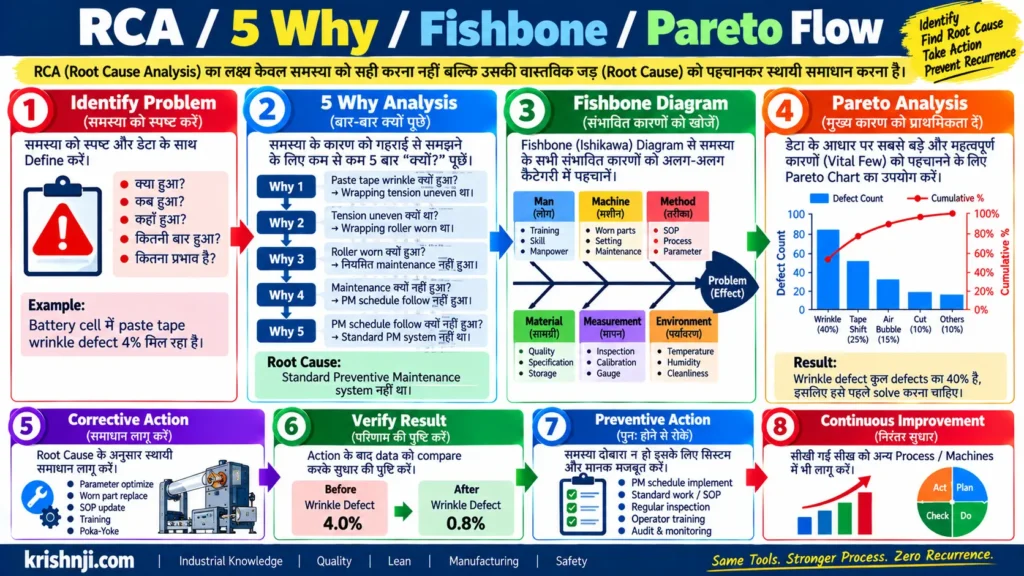
Q1. Defect क्या है?
Direct Answer:
Defect वह condition है जिसमें product, component या process output defined specification, drawing, standard या customer requirement को meet नहीं करता।
Explanation:
Defect किसी dimensional, functional, visual, material या process-related requirement से deviation हो सकता है।
Examples:
- Wrong dimension
- Scratch
- Dent
- Wrong component
- Improper welding
- Leakage
- Electrical failure
- Incorrect assembly
Example:
अगर किसी component की specification 10 ± 0.1 mm है और measured dimension 10.25 mm है, तो वह defined specification के अनुसार defect हो सकता है।
Interview Answer:
“Defect वह non-conformance है जिसमें product या process defined specification या customer requirement को meet नहीं करता। Production Engineer का focus defect को detect करने के साथ-साथ उसके root cause को eliminate करके recurrence prevent करने पर होना चाहिए।”
Q2. Rejection क्या है?
Direct Answer:
Rejection वह स्थिति है जब कोई product या component defined acceptance criteria को meet नहीं करता और उसे accepted output से अलग करके reject किया जाता है।
Explanation:
हर defect necessarily final rejection नहीं होता। कुछ defects rework या repair के बाद acceptable हो सकते हैं, जबकि कुछ products scrap/rejection के रूप में classify किए जा सकते हैं—यह company quality system और defined criteria पर depend करता है।
Formula:
Rejection Rate (%) = Rejected Quantity ÷ Total Production × 100
Example:
Total Production = 5,000
Rejected = 50
Rejection Rate = 50 ÷ 5,000 × 100 = 1%
Interview Answer:
“Rejection उस output को कहते हैं जो defined acceptance criteria को meet नहीं करता और accepted production में शामिल नहीं किया जाता। Rejection rate को monitor करके major defect categories और root causes identify किए जा सकते हैं।”
Q3. Defect और Rejection में क्या Difference है?
Direct Answer:
Defect product या process में मौजूद non-conformance है, जबकि Rejection उस non-conforming output का disposition है जिसे defined criteria के अनुसार accept नहीं किया गया।
| Defect | Rejection |
|---|---|
| Non-conformance | Non-accepted output |
| Problem/condition को describe करता है | Product disposition को describe करता है |
| Defect repairable हो सकता है | Rejected product scrap/rework/other disposition में जा सकता है |
| Process quality analysis में उपयोग | Output loss measurement में उपयोग |
Interview Answer:
“Defect non-conformance को describe करता है, जबकि rejection accepted output से बाहर किए गए product को represent करता है। कुछ defects rework के बाद acceptable हो सकते हैं, इसलिए दोनों terms को context के अनुसार समझना जरूरी है।”
Q4. FPY क्या है?
Direct Answer:
FPY का full form First Pass Yield है। यह बताता है कि process में आने वाले total units में से कितने units पहली बार में बिना rework के सही निकलते हैं।
Formula:
FPY (%) = First Pass Good Units ÷ Total Units Entered × 100
Example:
Total Units Entered = 1,000
First Pass Good = 960
FPY = 960 ÷ 1,000 × 100 = 96%
Interview Answer:
“FPY first-pass quality performance को measure करता है। यह बताता है कि कितने units पहली बार में बिना rework के acceptable बने। Low FPY होने पर defect type, process step और root cause analyze करना चाहिए।”
Q5. RTY क्या है?
Direct Answer:
RTY का full form Rolled Throughput Yield है। यह multiple process steps की combined first-pass yield को measure करता है।
Formula:
RTY = Yield₁ × Yield₂ × Yield₃ × … × Yieldₙ
Example:
Process 1 Yield = 98%
Process 2 Yield = 97%
Process 3 Yield = 99%
RTY = 0.98 × 0.97 × 0.99 × 100
= 94.11%
इससे पता चलता है कि सभी process steps को first-pass basis पर successfully pass करने का combined yield कितना है।
Interview Answer:
“RTY multiple process steps की combined first-pass yield है। प्रत्येक process की yield को multiply करके RTY calculate की जाती है। यह hidden rework और process-to-process quality losses identify करने में useful है।”
Q6. SPC क्या है?
Direct Answer:
SPC का full form Statistical Process Control है। यह statistical techniques का उपयोग करके process variation को monitor, analyze और control करने की methodology है।
Explanation:
SPC का उद्देश्य केवल final inspection पर defect पकड़ना नहीं है, बल्कि process में variation को early stage पर identify करना है।
SPC में commonly used tools:
- Control Charts
- Process Capability Analysis
- Trend Analysis
- Variation Analysis
Example:
यदि किसी machine process में dimension लगातार target के आसपास fluctuate कर रहा है, तो control chart के माध्यम से process behavior monitor किया जा सकता है।
Interview Answer:
“SPC statistical methods के द्वारा process variation को monitor और control करने की approach है। इसका focus process को stable और predictable बनाने तथा abnormal variation को early detect करने पर होता है।”
Q7. Control Chart क्या है?
Direct Answer:
Control Chart एक statistical tool है जिसका उपयोग समय के साथ process data को plot करके यह monitor करने के लिए किया जाता है कि process statistical control में है या नहीं।
इसके मुख्य elements:
- Center Line (CL)
- Upper Control Limit (UCL)
- Lower Control Limit (LCL)
Important:
Control Limits और Specification Limits एक ही चीज नहीं हैं।
- Control Limits process variation से related हैं।
- Specification Limits customer/design requirements से related हैं।
Example:
अगर process measurement control limits के बाहर जाता है या defined non-random pattern दिखाई देता है, तो process investigation की आवश्यकता हो सकती है।
Interview Answer:
“Control Chart process data को time sequence में monitor करने का statistical tool है। इसमें center line और control limits होते हैं और इसका उद्देश्य unusual process variation या instability को identify करना है।”
Q8. Control Chart में UCL और LCL क्या होते हैं?
Direct Answer:
UCL का full form Upper Control Limit और LCL का full form Lower Control Limit है। ये process variation के expected statistical range को define करने में मदद करते हैं।
Common 3-Sigma Concept:
UCL = Mean + 3σ
LCL = Mean − 3σ
यह formulation chart type और statistical assumptions के अनुसार specific calculation factors के साथ vary कर सकती है।
Example:
अगर process mean 50 है और standard deviation 2 है, तो simple 3-sigma illustration में:
UCL = 50 + 6 = 56
LCL = 50 − 6 = 44
Interview Answer:
“UCL और LCL control chart की statistical control limits हैं। ये process variation की expected range को represent करती हैं। Control limits से बाहर points या unusual patterns मिलने पर process को investigate करना चाहिए।”
Q9. RCA क्या है?
Direct Answer:
RCA का full form Root Cause Analysis है। यह किसी problem या defect के underlying root cause को identify करने की systematic approach है ताकि केवल symptom नहीं बल्कि actual cause को address किया जा सके।
RCA Approach:
Problem Definition → Data Collection → Analysis → Root Cause → Corrective Action → Verification
Common RCA Tools:
- 5 Why
- Fishbone Diagram
- Pareto Analysis
- Process Mapping
- Data Analysis
Example:
Problem: Production rejection बढ़ गया।
सिर्फ “operator ने गलत काम किया” कहना RCA नहीं है। आगे पूछना होगा:
- Error क्यों हुआ?
- Work instruction clear थी?
- Poka-Yoke था?
- Training adequate थी?
- Process parameter सही था?
- Machine condition कैसी थी?
Interview Answer:
“RCA का उद्देश्य problem के actual root cause को identify करना है। मैं problem को clearly define करके data collect करूंगा, appropriate RCA tool use करूंगा, root cause verify करूंगा और फिर corrective action की effectiveness check करूंगा।”
Q10. 5 Why Analysis क्या है?
Direct Answer:
5 Why एक problem-solving technique है जिसमें “Why?” repeatedly पूछकर problem के underlying cause तक पहुंचने का प्रयास किया जाता है।
Example:
Problem: Machine ने production stop किया।
Why 1: Machine stopped → Sensor signal नहीं आया।
Why 2: Signal नहीं आया → Sensor misaligned था।
Why 3: Sensor misaligned क्यों था → Mounting loose थी।
Why 4: Mounting loose क्यों हुई → Fastening method inadequate थी।
Why 5: Method inadequate क्यों थी → Standard fastening requirement defined नहीं थी।
यहाँ केवल sensor alignment ठीक करना temporary action हो सकता है। Standard fastening requirement को establish करना deeper corrective action हो सकता है—बशर्ते data से यह root cause verify हो।
Interview Answer:
“5 Why में problem के पीछे repeatedly Why पूछकर underlying cause identify किया जाता है। लेकिन केवल पांच बार Why पूछना mandatory नहीं है; analysis तब तक करना चाहिए जब तक evidence-supported root cause तक न पहुंच जाएं।”
Q11. Fishbone Diagram क्या है?
Direct Answer:
Fishbone Diagram को Ishikawa या Cause-and-Effect Diagram भी कहा जाता है। इसका उपयोग किसी problem के संभावित causes को systematically categorize करने के लिए किया जाता है।
Manufacturing में common categories:
Man → Machine → Method → Material → Measurement → Environment
Example:
Problem: High Rejection
Possible causes:
- Man: Training issue
- Machine: Parameter variation
- Method: Incorrect work sequence
- Material: Material variation
- Measurement: Calibration issue
- Environment: Temperature/humidity variation
इसके बाद possible causes को data और verification से validate किया जाता है।
Interview Answer:
“Fishbone Diagram potential causes को categories में organize करने का RCA tool है। इसका उपयोग brainstorming और cause identification के लिए किया जाता है, लेकिन identified causes को actual data से verify करना जरूरी है।”
Q12. Pareto Analysis क्या है?
Direct Answer:
Pareto Analysis एक prioritization technique है जिसका उपयोग यह identify करने के लिए किया जाता है कि कौन-से defect या losses total problem में सबसे बड़ा contribution दे रहे हैं।
यह commonly 80/20 principle से associated है, लेकिन actual data में distribution हमेशा exactly 80/20 नहीं होता।
Example:
एक line में defects:
| Defect | Quantity |
|---|---|
| Scratch | 100 |
| Welding Issue | 60 |
| Dimension | 25 |
| Leakage | 10 |
| Other | 5 |
यहाँ Scratch और Welding Issue major contributors हैं। इसलिए initial improvement priority इन्हें दी जा सकती है।
Interview Answer:
“Pareto Analysis defect या loss categories को contribution के अनुसार prioritize करने के लिए use होता है। इससे Production Engineer को यह decide करने में मदद मिलती है कि improvement के लिए पहले किस major loss पर focus करना चाहिए।”
Q13. CAPA क्या है?
Direct Answer:
CAPA का full form Corrective Action and Preventive Action है। इसका उद्देश्य existing problem को correct करने के साथ-साथ उसके recurrence और similar potential problems को prevent करना है।
Corrective Action:
Existing problem के root cause को eliminate करना।
Preventive Action:
Potential या similar problem को occur होने से रोकने के लिए systemic action लेना।
Example:
Problem: Wrong component assembly
Containment: Suspect stock segregate करना।
Corrective Action: Root cause के अनुसार fixture/process/work instruction सुधारना।
Preventive/Systemic Action: Similar stations पर same risk review करके applicable controls implement करना।
Interview Answer:
“CAPA में existing problem के root cause को eliminate करने के लिए corrective action और recurrence या similar risk को prevent करने के लिए preventive/systemic action शामिल होता है। Action की effectiveness verify करना भी जरूरी है।”
Q14. Control Plan क्या है?
Direct Answer:
Control Plan एक documented plan है जो बताता है कि manufacturing process में कौन-से process और product characteristics control करने हैं, कैसे measure करना है, कितनी frequency पर check करना है और abnormality मिलने पर क्या reaction करना है।
Common elements:
- Process Step
- Product/Process Characteristic
- Specification
- Measurement Method
- Sample Size
- Frequency
- Control Method
- Reaction Plan
- Responsibility
Example:
अगर welding process में weld strength critical characteristic है, तो Control Plan में measurement method, frequency, specification और reaction plan define किया जा सकता है।
Interview Answer:
“Control Plan production process के important characteristics और controls को define करता है। इसमें क्या check करना है, कैसे check करना है, कितनी frequency पर करना है और out-of-control condition में reaction क्या होगा, यह define किया जाता है।”
Q15. FMEA क्या है?
Direct Answer:
FMEA का full form Failure Mode and Effects Analysis है। यह एक structured risk analysis technique है जिसका उपयोग potential failure modes को identify करके उनके effects, causes और existing controls को evaluate करने के लिए किया जाता है।
FMEA में generally consider किए जाने वाले factors:
- Failure Mode
- Effect
- Cause
- Prevention/Detection Controls
- Risk Evaluation
- Recommended Actions
Example:
Process: Assembly
Potential Failure Mode: Wrong Component
Effect: Product malfunction
Possible Cause: Similar-looking components
Potential Control: Poka-Yoke / Barcode verification / Visual identification
Interview Answer:
“FMEA potential failure modes और उनके risks को proactively identify करने की methodology है। इसका उद्देश्य failure होने के बाद केवल reaction करना नहीं, बल्कि risk को पहले identify करके appropriate controls establish करना है।”
Q16. FMEA और Control Plan में क्या Relationship है?
Direct Answer:
FMEA risk analysis में identified important failure modes और controls को production process में implement करने के लिए Control Plan एक practical control mechanism बन सकता है।
Simple Flow:
Process → FMEA → Risk Identification → Controls → Control Plan → Shop-Floor Execution
Example:
FMEA में wrong orientation को significant risk माना गया।
Possible control:
Poka-Yoke Fixture
Control Plan में:
- Check characteristic
- Control method
- Frequency
- Reaction plan
define किया जा सकता है।
Interview Answer:
“FMEA potential process risks को identify और analyze करता है, जबकि Control Plan उन important characteristics और controls को shop floor पर monitor करने के लिए define करता है। दोनों documents के बीच consistency होना जरूरी है।”
Q17. अगर Control Chart में Out-of-Control Signal मिले तो आप क्या करेंगे?
Direct Answer:
सबसे पहले signal को verify करके यह determine करना चाहिए कि process में special cause variation है या data/measurement issue। इसके बाद affected product को assess और necessary containment करके root cause investigate करना चाहिए।
Approach:
Signal → Verify Data/Measurement → Containment if Required → Process Check → RCA → Corrective Action → Verify → Resume Control
Example:
अगर dimension measurement अचानक control limit के बाहर चला गया:
- Measurement system verify करें
- Recent process change check करें
- Machine parameter check करें
- Tool condition check करें
- Material variation check करें
- Affected output identify करें
- Root cause verify करें
- Corrective action लें
Interview Answer:
“Control chart में abnormal signal मिलने पर मैं पहले data और measurement system verify करूंगा। आवश्यकता होने पर suspect product contain करूंगा। फिर machine, material, method और process parameters की जांच करके special cause identify करूंगा और corrective action के बाद process stability को verify करूंगा।”
Q18. Production Line पर Rejection अचानक बढ़ जाए तो आप क्या करेंगे?
Direct Answer:
Sudden rejection increase होने पर मेरा पहला focus suspect output को contain करना और आगे defect propagation रोकना होगा। इसके बाद rejection data को analyze करके defect pattern और root cause identify किया जाएगा।
Answer Framework:
Containment → Data → Analysis → RCA → Corrective Action → Verification → Preventive/Systemic Action
1. Containment
- Suspect material/output identify करें
- Good और suspect stock segregate करें
- Further production/dispatch risk control करें
- Relevant team को inform करें
2. Data Collection
Collect करें:
- Defect type
- Defect quantity
- Time/shift
- Machine
- Line/station
- Material lot
- Operator/skill information where relevant
- Process parameters
- Previous vs current rejection
3. Analysis
Pareto, trend और stratification से देखें:
- कौन-सा defect बढ़ा?
- किस machine/station पर?
- किस time period में?
- किस material lot में?
- कौन-सा parameter change हुआ?
4. RCA
Use करें:
- 5 Why
- Fishbone
- Process observation
- Parameter verification
- Measurement verification
5. Corrective Action
Verified root cause के आधार पर:
- Machine setting correction
- Process parameter correction
- Method improvement
- Material issue resolution
- Fixture/tool correction
- Poka-Yoke
- Work instruction improvement
6. Verification
Action के बाद compare करें:
Before Rejection → After Rejection
और यह verify करें कि defect वास्तव में reduce हुआ है।
7. Preventive/Systemic Action
Similar processes या stations में same risk applicable है या नहीं, यह review करें और आवश्यक होने पर:
- Control Plan update
- FMEA review
- Work Instruction update
- Standard Work update
- Training
- Poka-Yoke
- Process monitoring
implement करें।
Interview Answer:
“अगर production line पर rejection अचानक बढ़ जाए तो मैं सबसे पहले suspect output को contain और segregate करूंगा ताकि defect आगे न जाए। फिर defect type, machine, shift, material lot और process parameter के हिसाब से data analyze करूंगा। Pareto और RCA tools जैसे 5 Why या Fishbone से verified root cause identify करूंगा। उसके बाद corrective action implement करके rejection को before-after data से verify करूंगा और recurrence रोकने के लिए Control Plan, FMEA, Standard Work या Poka-Yoke जैसे systemic controls review करूंगा।”
Quality Interview — Quick Revision Table
| Topic | Interview में Key Point |
|---|---|
| Defect | Specification/requirement से non-conformance |
| Rejection | Non-accepted output |
| FPY | First-pass good output |
| RTY | Multiple processes की combined first-pass yield |
| SPC | Statistical process control |
| Control Chart | Process variation monitoring |
| UCL/LCL | Statistical control limits |
| RCA | Root cause identification |
| 5 Why | Repeated Why-based analysis |
| Fishbone | Cause categorization |
| Pareto | Major contributors prioritization |
| CAPA | Corrective + Preventive/Systemic Action |
| Control Plan | Process/product controls + reaction plan |
| FMEA | Proactive risk analysis |
| Containment | Suspect output/risk को control करना |
Quality Problem-Solving का Answer Framework
Production Engineer के लिए यह sequence याद रखना बहुत useful है:
Containment → Data → Analysis → RCA → Corrective Action → Verification → Preventive/Systemic Action
इसे किसी भी practical quality problem पर apply किया जा सकता है:
High Rejection → Defect Increase → FPY Drop → Process Variation → Customer Complaint → Repeated Defect
लेकिन हर situation में exact action problem और evidence के अनुसार तय होगा।
Interview में एक महत्वपूर्ण बात
“Operator की गलती थी” को सीधे root cause नहीं मानना चाहिए।
अगर operator error मिला भी है, तो आगे investigate करें:
- Work Instruction clear थी?
- Training adequate थी?
- Method practical था?
- Poka-Yoke available था?
- Process में error detect करने का control था?
- Standard Work follow हो रहा था?
- Machine/material condition सही थी?
इससे answer blame-oriented होने के बजाय systematic problem-solving oriented दिखाई देता है।
Quality Interview Answer Formula
Problem → Containment → Data → Root Cause → Corrective Action → Verification → Prevention → Standardization
यही framework Production Engineer को Quality और Production दोनों perspectives से problem handle करने की ability दिखाने में मदद करता है।
Machine, Automation & Process Questions for Production Engineer
Production Engineer को machine operate करने के साथ-साथ उसके basic automation system को समझना भी जरूरी होता है। Production line में PLC, sensors, pneumatic systems, solenoid valves, actuators, HMI और interlocks process control, safety और automatic operation में महत्वपूर्ण भूमिका निभाते हैं।
Interview में interviewer केवल यह नहीं पूछता कि “PLC क्या है?”, बल्कि यह भी पूछ सकता है कि “Sensor fail हो जाए तो production पर क्या impact होगा?” या “Machine start नहीं हो रही तो आप troubleshooting कैसे करेंगे?”
इसलिए answers में Concept → Function → Practical Application → Troubleshooting approach रखना उपयोगी है।
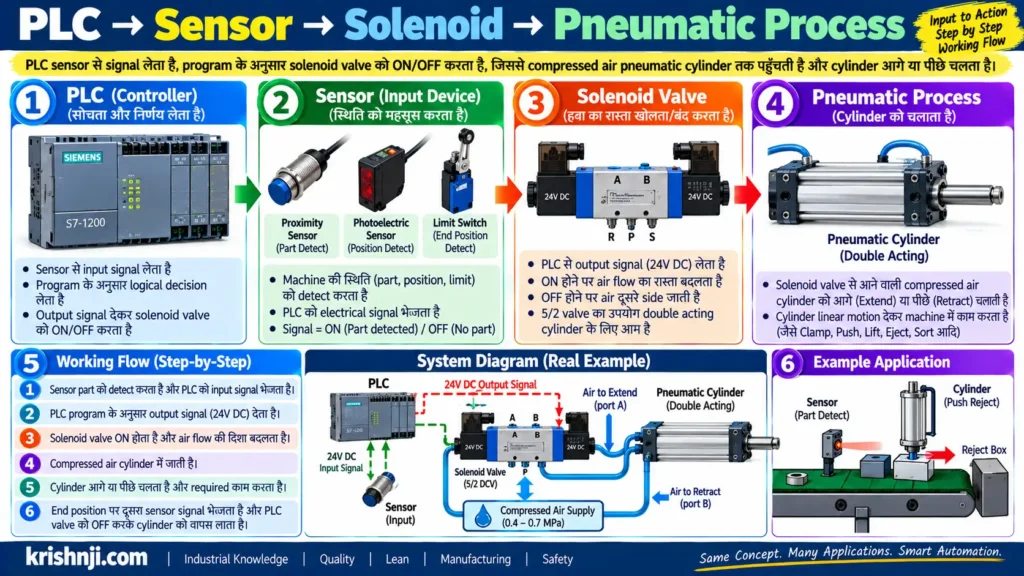
Q1. PLC क्या है?
Direct Answer:
PLC का full form Programmable Logic Controller है। यह एक industrial controller है जिसका उपयोग machines और manufacturing processes को monitor और control करने के लिए किया जाता है।
Explanation:
PLC inputs से signals receive करता है, programmed logic के अनुसार उन्हें process करता है और outputs को control करता है।
Basic Flow:
Input → PLC Logic → Output
Inputs:
- Proximity Sensor
- Photoelectric Sensor
- Push Button
- Limit Switch
- Pressure Sensor
Outputs:
- Solenoid Valve
- Motor Contactor
- Relay
- Indicator
- Actuator
Example:
Sensor detects component → PLC receives signal → PLC logic checks condition → Solenoid Valve activates → Pneumatic Cylinder moves.
Interview Answer:
“PLC एक industrial controller है जो sensors और other input devices से signals लेकर programmed logic के अनुसार outputs control करता है। Production machines में इसे sequence control, interlocking, automation और process monitoring के लिए use किया जाता है।”
Q2. Production Machine में Sensor का क्या Role है?
Direct Answer:
Sensor machine को physical condition या process status detect करके electrical signal देता है, जिसे PLC या control system process करके appropriate action ले सकता है।
Sensors क्या detect कर सकते हैं?
- Object presence
- Position
- Distance
- Speed
- Pressure
- Temperature
- Level
- Movement
Example:
अगर component fixture में सही position पर आता है:
Component Present → Sensor ON → PLC Signal → Process Start
Interview Answer:
“Sensor machine के लिए feedback device की तरह काम करता है। यह object presence, position या process condition detect करके control system को signal देता है, जिससे machine automatic decision या action ले सकती है।”
Q3. Proximity Sensor क्या है?
Direct Answer:
Proximity Sensor एक non-contact sensor है जो किसी object की presence या position को बिना physical contact के detect कर सकता है।
Common types:
- Inductive
- Capacitive
- Magnetic
- Other proximity technologies
Inductive Proximity Sensor:
मुख्यतः metallic objects detect करने के लिए commonly use किया जाता है।
Example:
Machine fixture में metal component present है या नहीं:
Metal Part → Proximity Sensor Detects → PLC Signal → Next Operation
Interview Answer:
“Proximity sensor non-contact detection के लिए use होता है। Inductive proximity sensor विशेष रूप से metallic objects की presence या position detect करने के लिए commonly used है।”
Q4. Photoelectric Sensor क्या है?
Direct Answer:
Photoelectric Sensor light beam का उपयोग करके object की presence, absence या position detect करता है।
Common arrangements:
- Through Beam
- Retro-reflective
- Diffuse
Example:
Conveyor पर product sensor के सामने आता है:
Product Blocks Light → Sensor Output Changes → PLC Receives Signal
इस signal के आधार पर counting, stopping, positioning या sequence control किया जा सकता है।
Interview Answer:
“Photoelectric sensor light-based detection principle पर काम करता है और non-contact तरीके से object presence, absence या position detect कर सकता है। Conveyor और automated assembly systems में इसका common use है।”
Q5. Proximity Sensor और Photoelectric Sensor में क्या Difference है?
Direct Answer:
दोनों non-contact detection के लिए use हो सकते हैं, लेकिन उनकी sensing technology और application अलग होती है।
| Proximity Sensor | Photoelectric Sensor |
|---|---|
| Proximity sensing technology | Light-based sensing |
| Inductive type metals के लिए common | कई object types detect कर सकता है |
| Short-range detection में common | Longer-range applications possible |
| Position detection में useful | Presence/counting/conveyor applications में common |
Interview Answer:
“Proximity sensor और photoelectric sensor दोनों non-contact detection के लिए use हो सकते हैं। Inductive proximity sensor metallic object detection में commonly use होता है, जबकि photoelectric sensor light beam के आधार पर object presence या position detect करता है।”
Q6. Solenoid Valve क्या है और कैसे काम करता है?
Direct Answer:
Solenoid Valve एक electrically operated valve है जो electrical signal मिलने पर pneumatic या fluid flow को control करता है।
Basic Working:
Electrical Signal → Solenoid Coil Energize → Valve Position Changes → Air Flow Changes
Pneumatic system में यह compressed air को cylinder के अलग-अलग ports तक भेज सकता है।
Example:
PLC output ON → Solenoid coil energize → Valve shifts → Compressed air cylinder में जाती है → Cylinder extends.
Interview Answer:
“Solenoid valve electrically operated valve है। PLC से electrical signal मिलने पर solenoid coil energize होती है और valve compressed air के flow को control करता है, जिससे pneumatic cylinder जैसे actuator operate हो सकते हैं।”
Q7. Pneumatic Cylinder कहाँ इस्तेमाल होता है?
Direct Answer:
Pneumatic Cylinder compressed air की energy को linear mechanical motion में convert करता है।
Common applications:
- Clamping
- Pushing
- Pick and Place
- Material positioning
- Ejection
- Fixture locking
- Assembly operations
Example:
PLC → Solenoid Valve → Compressed Air → Pneumatic Cylinder → Clamping
Assembly fixture में component को hold करने के लिए pneumatic cylinder use किया जा सकता है।
Interview Answer:
“Pneumatic cylinder compressed air को linear mechanical motion में convert करता है। Production machines में इसे clamping, pushing, positioning, ejection और automated assembly operations के लिए use किया जाता है।”
Q8. Actuator क्या होता है?
Direct Answer:
Actuator वह device है जो control signal या available energy को physical movement या mechanical action में convert करता है।
Examples:
- Pneumatic Cylinder
- Hydraulic Cylinder
- Electric Motor
- Servo Motor
- Solenoid Actuator
Example:
PLC signal → Solenoid Valve → Pneumatic Cylinder → Mechanical movement.
Interview Answer:
“Actuator control system के command को physical action में convert करता है। Pneumatic cylinder, motor और servo motor common industrial actuators हैं।”
Q9. Machine Interlock क्या होता है?
Direct Answer:
Machine Interlock एक safety या process-control mechanism है जो defined condition पूरी होने तक machine को किसी operation को perform करने से रोकता है।
Example:
अगर machine safety door open है:
Door Open → Interlock Active → Machine Cycle Start Blocked
Door close और required safety conditions satisfied होने पर machine operation allow हो सकता है।
Other Examples:
- Fixture not clamped
- Component not detected
- Safety door open
- Air pressure low
- Emergency condition
- Required process confirmation missing
Interview Answer:
“Interlock ऐसी condition-based logic है जो required safety या process condition satisfy होने तक machine operation को allow नहीं करती। इसका उपयोग safety और error prevention दोनों के लिए किया जा सकता है।”
Q10. Sensor Failure होने पर Production पर क्या Impact होगा?
Direct Answer:
Sensor failure से machine को incorrect input या no input मिल सकता है, जिससे sequence interruption, false detection, machine stoppage, wrong operation या quality issue हो सकता है।
Possible Impacts:
- Machine not starting
- Machine not stopping at required condition
- Wrong component detection
- Missing component not detected
- Counting error
- Position error
- Cycle interruption
- Quality defect
- Unplanned downtime
Troubleshooting Approach:
Alarm → Sensor Status → Wiring → Power Supply → Mounting/Alignment → Sensor Output → PLC Input → Program Logic
Example:
Component present है लेकिन sensor signal नहीं दे रहा:
- Sensor power check
- LED/status check
- Sensor alignment check
- Cable/connector check
- Sensor output check
- PLC input status check
- Replacement/test sensor if required
Interview Answer:
“Sensor failure machine sequence और quality दोनों को affect कर सकता है। मैं पहले sensor power, LED/status, mounting, alignment, cable और output signal check करूंगा। फिर PLC input status verify करूंगा और जरूरत पड़ने पर sensor replace करके machine sequence और quality condition verify करूंगा।”
Q11. HMI क्या है?
Direct Answer:
HMI का full form Human-Machine Interface है। यह operator और machine control system के बीच visual interface provide करता है।
HMI पर commonly देखा जा सकता है:
- Machine Status
- Production Count
- Alarm
- Process Parameters
- Recipe
- Cycle Time
- Fault Information
- Manual/Auto Mode
- Maintenance Information
Example:
Operator HMI पर देख सकता है:
Machine Status → Running
या:
Alarm → Sensor Not Detected
Interview Answer:
“HMI operator और machine control system के बीच interface है। इसके माध्यम से machine status, alarms, parameters, production count और other process information monitor या authorized controls के माध्यम से manage की जा सकती है।”
Q12. Machine Parameter क्या होता है?
Direct Answer:
Machine Parameter वह defined setting या operating condition है जो machine/process performance और product quality को affect करती है।
Examples:
- Temperature
- Pressure
- Speed
- Force
- Time
- Voltage
- Current
- Welding Energy
- Feed Rate
- Stroke
- Position
Example:
अगर welding process में energy, pressure या time process quality को affect करते हैं, तो इनके defined ranges process parameters हो सकते हैं।
Interview Answer:
“Machine parameters वे defined operating settings हैं जो process performance और product quality को influence करते हैं। Production Engineer को critical parameters की standard range monitor और control करनी चाहिए।”
Q13. Automation क्या है?
Direct Answer:
Automation ऐसी technology/process है जिसमें machines, control systems और software का उपयोग करके human intervention को reduce करते हुए repetitive या defined operations automatically perform किए जाते हैं।
Basic Components:
Sensor → PLC/Controller → Logic → Actuator → Feedback
Example:
Component detection → PLC decision → Pneumatic cylinder operation → Position confirmation → Next process.
Benefits:
- Consistent process
- Productivity improvement
- Reduced manual handling
- Better repeatability
- Improved process control
- Data availability
Important:
Automation का मतलब केवल manpower reduction नहीं है। सही automation का उद्देश्य safety, quality, productivity, consistency और process capability improve करना भी हो सकता है।
Interview Answer:
“Industrial automation में sensors, controllers, actuators और software की मदद से defined operations automatically perform और control किए जाते हैं। इसका उद्देश्य process consistency, productivity, safety और quality improve करना हो सकता है।”
Q14. Poka-Yoke को Machine Automation में कैसे Implement कर सकते हैं?
Direct Answer:
Machine automation में Poka-Yoke को sensors, interlocks, fixtures, vision systems या PLC logic के माध्यम से implement किया जा सकता है ताकि wrong condition में process आगे न बढ़े या abnormality तुरंत detect हो।
Example:
Required component absent:
Sensor = OFF → PLC Interlock → Cycle Start Blocked
या wrong orientation:
Vision/Sensor → Wrong Condition → Alarm → Machine Stop
Interview Answer:
“Automation में Poka-Yoke sensors और PLC logic के माध्यम से implement किया जा सकता है। उदाहरण के लिए अगर component present नहीं है तो sensor signal के आधार पर PLC cycle start को block कर सकता है। इससे defect process के अगले step तक जाने से पहले prevent हो सकता है।”
Q15. PLC और HMI में क्या Difference है?
Direct Answer:
PLC मुख्यतः machine/process की control logic execute करता है, जबकि HMI operator को machine की status और information देखने तथा authorized commands/parameter interaction के लिए interface देता है।
| PLC | HMI |
|---|---|
| Control system | Operator interface |
| Logic execute करता है | Information display करता है |
| Inputs process करता है | Status/alarms दिखाता है |
| Outputs control करता है | Operator interaction provide करता है |
Example:
Sensor signal → PLC → logic decision → Solenoid output
Operator → HMI → status/alarm/authorized command
Interview Answer:
“PLC machine का control logic handle करता है, जबकि HMI operator और machine के बीच interface provide करता है। PLC process control करता है और HMI machine status, alarms और process information को visualize करता है।”
Q16. Machine Start नहीं हो रही हो तो आप कैसे Troubleshoot करेंगे?
Direct Answer:
Machine troubleshooting में बिना जांच के component replace करने के बजाय systematic fault-finding approach अपनानी चाहिए।
Basic Troubleshooting Sequence:
Safety → Alarm → Power → Air/Utility → Interlock → Sensor → PLC Input/Output → Actuator → Mechanical Condition → Trial Verification
Example:
अगर machine cycle start नहीं कर रही:
- Safety condition check
- Emergency stop status
- HMI alarm check
- Air pressure check
- Door/fixture interlock check
- Required sensor signals check
- PLC input status check
- PLC output status check
- Solenoid/actuator check
- Mechanical obstruction check
Interview Answer:
“मैं पहले safety और alarm condition verify करूंगा। उसके बाद power और utilities जैसे pneumatic supply check करूंगा। फिर interlocks, sensors, PLC input-output और actuator sequence को step-by-step verify करूंगा। Root cause मिलने के बाद correction करके machine को controlled trial पर verify करूंगा।”
Q17. PLC Input और Output क्या होते हैं?
Direct Answer:
PLC Inputs field devices से signals receive करते हैं, जबकि Outputs field devices को control signals provide करते हैं।
Inputs:
- Proximity Sensor
- Photoelectric Sensor
- Push Button
- Limit Switch
- Pressure Switch
Outputs:
- Solenoid Valve
- Relay
- Contactor
- Indicator
- Actuator control
Example:
Proximity Sensor → PLC Input
PLC logic:
Input ON → Output ON
PLC Output → Solenoid Valve
Interview Answer:
“PLC input field devices से signals receive करता है और PLC output controlled devices को command देता है। उदाहरण के लिए proximity sensor PLC input हो सकता है और solenoid valve PLC output के माध्यम से control किया जा सकता है।”
Q18. अगर Pneumatic Cylinder Move नहीं कर रहा हो तो आप क्या Check करेंगे?
Direct Answer:
Pneumatic cylinder troubleshoot करते समय air supply, solenoid valve, control signal, tubing, fittings, cylinder condition और mechanical obstruction को systematically check करना चाहिए।
Troubleshooting:
- Air pressure check
- Air supply isolation/availability check
- Solenoid valve signal check
- Solenoid coil condition
- Tubing/fittings check
- Flow control setting
- Cylinder rod condition
- Mechanical obstruction
- Sensor feedback
- PLC sequence
Example:
PLC output ON है लेकिन cylinder move नहीं कर रहा:
PLC Output → Solenoid Coil → Valve Shift → Air Flow → Cylinder
इस chain में fault locate किया जा सकता है।
Interview Answer:
“सबसे पहले pneumatic supply और pressure check करूंगा। फिर PLC output और solenoid coil/valve operation verify करूंगा। उसके बाद tubing, fittings, flow control और cylinder की mechanical condition check करूंगा। अंत में sensor feedback और sequence logic verify करूंगा।”
Q19. Sensor बार-बार False Signal दे रहा हो तो क्या करेंगे?
Direct Answer:
False signal होने पर केवल sensor replace करना पर्याप्त नहीं है। पहले यह identify करना चाहिए कि problem sensor, mounting, wiring, environment, target या PLC logic में कहाँ है।
Check Points:
- Sensor alignment
- Sensing distance
- Target position
- Sensor mounting
- Cable/connector
- Power supply
- Electrical noise
- Environmental condition
- Sensor sensitivity/settings
- PLC input
- Program logic
Example:
Photoelectric sensor dust के कारण unstable signal दे रहा है तो cleaning और mounting/environment correction required हो सकती है।
Interview Answer:
“मैं sensor alignment, sensing distance, target condition, power supply, wiring और connector check करूंगा। फिर environmental factors और PLC input status verify करूंगा। Root cause के आधार पर sensor setting, mounting, protection या replacement action करूंगा और machine sequence verify करूंगा।”
Q20. Machine Automation में Production Engineer की क्या Role होती है?
Direct Answer:
Production Engineer automation का केवल operator नहीं होता; उसकी role में machine performance monitoring, process stability, downtime analysis, parameter control, basic troubleshooting और improvement opportunities identify करना शामिल हो सकता है।
Key Responsibilities:
- Machine performance monitoring
- Cycle Time monitoring
- Automation-related downtime analysis
- Sensor/interlock issues की basic troubleshooting
- Process parameter monitoring
- Automation improvement ideas
- Poka-Yoke implementation
- Production data monitoring
- Maintenance/Automation team coordination
- Standard Work और Work Instruction adherence
Example:
अगर automated machine का sensor failure बार-बार production रोक रहा है, तो Production Engineer:
Downtime Data → Failure Pattern → Root Cause → Corrective Action → Verification → Prevention
approach अपना सकता है।
Interview Answer:
“Production Engineer को automation की basic working और troubleshooting समझनी चाहिए। मैं machine performance, cycle time, downtime और critical parameters monitor करूंगा, basic sensor/interlock issues identify करूंगा और जरूरत पड़ने पर Maintenance या Automation team के साथ root cause और improvement पर काम करूंगा।”
Machine & Automation — Quick Revision Table
| Topic | Interview में Key Point |
|---|---|
| PLC | Machine control logic |
| Sensor | Physical condition → Electrical signal |
| Proximity Sensor | Non-contact detection |
| Inductive Sensor | Metallic object detection |
| Photoelectric Sensor | Light-based detection |
| Solenoid Valve | Electrical signal → Fluid/Air control |
| Pneumatic Cylinder | Compressed air → Linear motion |
| Actuator | Energy/control → Physical action |
| Interlock | Condition satisfied होने तक operation block |
| HMI | Operator-machine interface |
| Machine Parameter | Process operating setting |
| Automation | Automatic process control |
| Poka-Yoke | Error prevention/detection |
| PLC Input | Field signal to PLC |
| PLC Output | PLC command to device |
Machine Troubleshooting का Answer Framework
जब interviewer पूछे:
“Machine काम नहीं कर रही है, आप क्या करेंगे?”
तो बिना किसी random component को बदलने के यह sequence बताना बेहतर है:
Safety → Alarm → Power → Utility → Interlock → Sensor → PLC → Actuator → Mechanical → Verification
उदाहरण:
Machine Not Running
↓
HMI Alarm Check
↓
Power & Pneumatic Supply
↓
Safety / Interlock
↓
Sensor Status
↓
PLC Input/Output
↓
Solenoid / Actuator
↓
Mechanical Condition
↓
Root Cause
↓
Correction + Trial
↓
Verification
Interview में एक महत्वपूर्ण बात याद रखें!
Production Engineer को यह claim नहीं करना चाहिए कि वह हर PLC program या electrical fault को independently repair कर सकता है, अगर उसका actual experience ऐसा नहीं है।
बेहतर practical answer:
“मैं basic PLC input-output status, sensor signal, interlock और machine sequence को troubleshoot कर सकता हूँ। अगर issue detailed PLC programming, electrical circuit या control-system modification से related हो तो मैं Maintenance/Automation Engineer के साथ coordinate करके root cause और corrective action implement करूंगा।”
इससे answer practical, safe और experience-based रहता है।
Production Engineer Problem-Solving Interview Questions & Answers
Production Engineer के interview में Problem-Solving questions candidate की practical capability को assess करने के लिए बहुत important होते हैं। Interviewer यह जानना चाहता है कि production problem आने पर candidate data कैसे collect करता है, loss कैसे identify करता है, root cause कैसे verify करता है और improvement को कैसे sustain करता है।
Production environment में केवल problem को temporarily fix करना पर्याप्त नहीं होता। एक strong Production Engineer को root cause identify करके corrective action, result verification और recurrence prevention तक जाना चाहिए।
इस section में common production problems को Problem → Analysis → Action → Result framework से समझाया गया है।
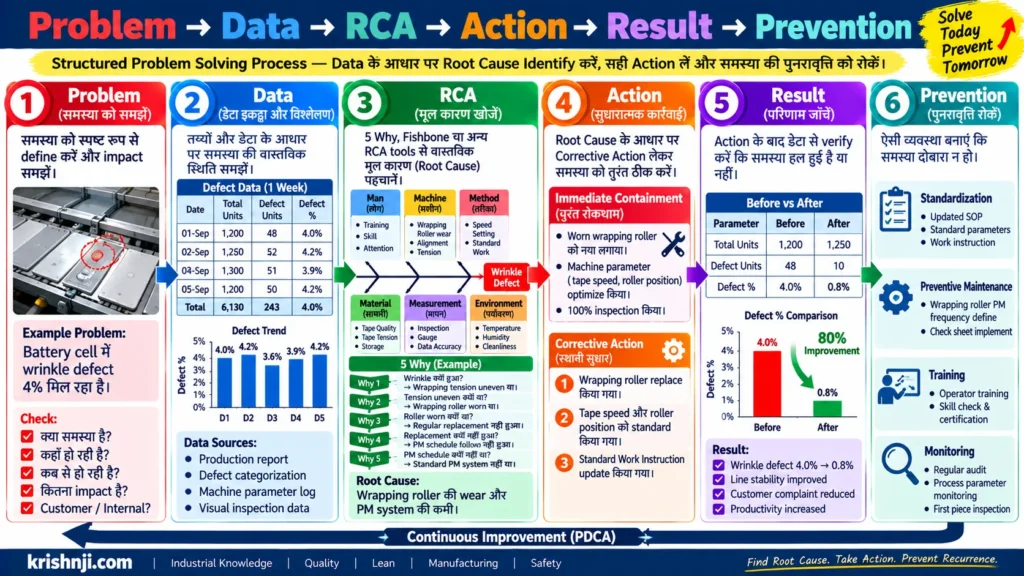
Q1. Production Line पर Rejection अचानक बढ़ जाए तो आप क्या करेंगे?
Problem
Production line का rejection rate अचानक बढ़ गया है और normal level से significantly ज्यादा defects generate हो रहे हैं।
Analysis
सबसे पहले suspect output को contain करके defect को आगे जाने से रोकूंगा।
फिर data collect करूंगा:
- Defect type
- Defect quantity
- Machine/station
- Shift/time
- Material lot
- Process parameters
- Operator/skill information where relevant
- Previous vs current rejection
इसके बाद Pareto और trend analysis से major defect identify करूंगा।
फिर 5 Why, Fishbone और process observation के माध्यम से root cause investigate करूंगा।
Action
Verified root cause के आधार पर:
- Machine parameter correction
- Material issue correction
- Process method improvement
- Tool/fixture correction
- Poka-Yoke
- Work Instruction update
- Operator training
जैसा appropriate corrective action लिया जाएगा।
Result
Corrective action के बाद rejection को before vs after data से verify करूंगा।
अगर improvement sustained है, तो relevant Control Plan, FMEA, Standard Work या Work Instruction को review/update करके recurrence prevention सुनिश्चित करूंगा।
Interview Answer:
“सबसे पहले मैं suspect output को contain करूंगा। फिर defect type, machine, shift, material और process parameters का data collect करके Pareto analysis करूंगा। Major defect पर RCA करके verified root cause identify करूंगा। उसके आधार पर corrective action implement करूंगा और rejection को before-after data से verify करके successful action को standardize करूंगा।”
Q2. Production Target लगातार Miss हो रहा हो तो आप क्या करेंगे?
Problem
Line का daily या shift production target लगातार achieve नहीं हो रहा है।
Analysis
पहले target और actual production का gap calculate करूंगा।
फिर loss categories analyze करूंगा:
- Machine Breakdown
- Downtime
- High Cycle Time
- Material Shortage
- Manpower Shortage
- Quality Rejection
- Changeover
- Minor Stops
- Process Waiting
इसके बाद loss का Pareto बनाकर major contributor identify करूंगा।
Action
अगर downtime major loss है तो Maintenance के साथ RCA।
अगर cycle time high है तो:
- Time study
- Work element analysis
- Motion study
- Line balancing
अगर material shortage है तो PPC/Stores के साथ material availability issue resolve करूंगा।
Result
Improvement के बाद:
Target → Actual → Gap → Major Loss → Action → New Actual
को compare करूंगा।
Interview Answer:
“Target miss होने पर मैं केवल manpower को increase नहीं करूंगा। पहले target-versus-actual gap और loss categories analyze करूंगा। Pareto से major loss identify करके RCA और cross-functional corrective action करूंगा और उसके बाद production recovery को data से verify करूंगा।”
Q3. Machine बार-बार Breakdown हो रही हो तो क्या करेंगे?
Problem
एक machine बार-बार breakdown होकर production downtime बढ़ा रही है।
Analysis
Breakdown history collect करूंगा:
- Failure type
- Frequency
- Duration
- Time between failures
- Machine component
- Shift
- Operating condition
- Previous maintenance action
इसके बाद Pareto और failure trend analyze करूंगा।
अगर same component repeatedly fail हो रहा है तो detailed RCA करूंगा।
Action
Root cause के अनुसार:
- Component replacement
- Alignment correction
- Lubrication improvement
- Parameter correction
- Preventive maintenance frequency review
- Design improvement
- Sensor/interlock improvement
जैसे actions लिए जा सकते हैं।
Result
Monitor करूंगा:
अगर breakdown frequency और downtime sustainably reduce होते हैं तो action effective माना जा सकता है।
Interview Answer:
“मैं breakdown history और downtime data analyze करूंगा और repeated failure को Pareto से prioritize करूंगा। Root cause verify करके Maintenance team के साथ corrective action करूंगा। फिर MTBF, MTTR और downtime के before-after trend से effectiveness verify करूंगा।”
Q4. UPH अचानक कम हो जाए तो आप कैसे Analyze करेंगे?
Problem
Production line का UPH standard से नीचे चला गया है।
Analysis
पहले standard और actual UPH compare करूंगा।
फिर check करूंगा:
- Cycle Time
- Downtime
- Minor Stops
- Material Waiting
- Manpower
- Quality Loss
- Changeover
- Bottleneck
Cycle time study और loss analysis के द्वारा major contributor identify करूंगा।
Action
अगर cycle time issue है तो work element analysis।
अगर downtime issue है तो breakdown/RCA।
अगर bottleneck है तो line balancing या capacity improvement।
Result
Before-after:
UPH Before → Improvement → UPH After
के साथ associated loss reduction verify करूंगा।
Interview Answer:
“UPH कम होने पर मैं पहले cycle time और downtime दोनों check करूंगा। इसके बाद loss data का Pareto बनाकर major contributor identify करूंगा। Root cause के आधार पर corrective action लेकर UPH और संबंधित loss को before-after data से verify करूंगा।”
Q5. Production में Bottleneck कैसे Identify और Remove करेंगे?
Problem
Production line की overall output required target से कम है और एक workstation पर WIP लगातार accumulate हो रहा है।
Analysis
हर workstation का:
- Cycle Time
- Capacity
- UPH
- Work Content
- Downtime
- WIP
compare करूंगा।
जिस station की effective capacity lowest है और जो overall flow को constrain कर रहा है, उसे bottleneck candidate के रूप में investigate करूंगा।
Action
Possible actions:
- Work redistribution
- Line balancing
- Cycle Time reduction
- Motion reduction
- Parallel operation
- Additional capacity
- Automation
- SMED
Result
Monitor करूंगा:
- Bottleneck Cycle Time
- Line UPH
- WIP
- Idle Time
- Target Achievement
Interview Answer:
“मैं workstation-wise cycle time और capacity compare करके bottleneck identify करूंगा। फिर bottleneck के work elements और losses analyze करूंगा। Root cause के अनुसार line balancing, cycle-time reduction या capacity improvement करूंगा और line output तथा WIP में improvement verify करूंगा।”
Q6. Cycle Time Standard से ज्यादा हो जाए तो क्या करेंगे?
Problem
Process का actual cycle time standard cycle time से लगातार ज्यादा है।
Analysis
Time study करके process को individual work elements में divide करूंगा।
देखूंगा:
- Operator Motion
- Material Handling
- Waiting
- Machine Processing
- Inspection
- Adjustment
- Rework
- Unnecessary movement
Action
Non-value-added activities remove/reduce करूंगा।
Possible actions:
- Workstation rearrangement
- Material point-of-use
- Work sequence improvement
- Tool improvement
- Automation
- Parameter optimization
- Line balancing
Result
Standard CT → Actual CT → Improvement → New CT
compare करूंगा और quality/safety पर कोई negative impact तो नहीं आया, यह भी verify करूंगा।
Interview Answer:
“मैं cycle time को work elements में break करके time study करूंगा। Non-value-added motion, waiting और unnecessary handling identify करूंगा। फिर method improvement या line balancing के द्वारा cycle time reduce करूंगा और quality तथा safety maintain करते हुए before-after result verify करूंगा।”
Q7. 5 Why Analysis कब और कैसे Use करेंगे?
Problem
किसी recurring production problem का immediate cause तो पता है लेकिन actual root cause clear नहीं है।
Analysis
Problem को specific और measurable तरीके से define करूंगा।
फिर repeatedly “Why?” पूछकर cause chain बनाऊंगा।
लेकिन केवल पांच बार Why पूछना mandatory नहीं है। Analysis को evidence और verified root cause तक ले जाना चाहिए।
Action
Potential root cause को actual data, process observation या test से verify करूंगा।
फिर verified cause को eliminate करने वाला corrective action implement करूंगा।
Result
Problem recurrence monitor करूंगा।
Interview Answer:
“5 Why का उपयोग cause chain को deeper level तक analyze करने के लिए करूंगा। मैं केवल पांच बार Why पूछने के बजाय evidence के आधार पर verified root cause तक जाऊंगा और फिर corrective action की effectiveness monitor करूंगा।”
Q8. Fishbone Analysis कब Use करेंगे?
Problem
Problem के कई potential causes हो सकते हैं और root cause immediately clear नहीं है।
Analysis
Potential causes को categories में organize करूंगा:
Man → Machine → Method → Material → Measurement → Environment
फिर प्रत्येक potential cause को data से verify करूंगा।
Action
Verified root cause पर corrective action implement करूंगा।
Result
Defect/problem trend को before-after compare करूंगा।
Interview Answer:
“Fishbone का उपयोग potential causes को systematically organize करने के लिए करूंगा। लेकिन Fishbone में listed हर cause root cause नहीं होता। Actual root cause को data और process verification से confirm करूंगा।”
Q9. Pareto Analysis का Production में क्या Use है?
Problem
Production line में multiple defects या losses हैं लेकिन resources limited हैं।
Analysis
सभी defect/loss categories की quantity या impact collect करके descending order में analyze करूंगा।
Action
Top contributors को improvement priority दूंगा।
उदाहरण:
Downtime Losses:
- Sensor failure
- Breakdown
- Material waiting
- Changeover
- Adjustment
अगर sensor failure सबसे बड़ा contributor है, तो initial RCA उसी पर focus किया जा सकता है।
Result
Improvement के बाद नया Pareto बनाकर check करूंगा कि major loss वास्तव में reduce हुआ या loss किसी दूसरे category में shift हुआ।
Interview Answer:
“Pareto का उपयोग problems को contribution के आधार पर prioritize करने के लिए करता हूँ। इससे limited resources को highest-impact loss पर focus किया जा सकता है।”
Q10. PDCA क्या है और Production Problem में कैसे Use करेंगे?
Problem
Production process में improvement की आवश्यकता है लेकिन action को structured तरीके से execute करना है।
Analysis
Plan: Problem और target define करें।
Do: Improvement implement करें।
Check: Result को data से verify करें।
Act: Successful improvement को standardize करें या further improvement plan करें।
Action
Example:
Problem: Cycle Time high
Plan: CT को 35 sec से 30 sec तक reduce करने का target।
Do: Workstation arrangement और work sequence improve करना।
Check: New CT measure करना।
Act: Effective method को Standard Work में include करना।
Result
PDCA cycle repeat करके continuous improvement किया जा सकता है।
Interview Answer:
“PDCA structured continuous improvement cycle है। मैं पहले problem और target plan करूंगा, improvement implement करूंगा, result को data से check करूंगा और successful action को standardize करके sustain करूंगा।”
Q11. CAPA और Corrective Action में क्या Difference है?
Problem
Production में recurring defect मिला है।
Analysis
Root cause identify करने के बाद केवल immediate correction और long-term corrective action के difference को understand करना जरूरी है।
Action
Correction:
Current defective condition को ठीक करना।
Corrective Action:
Root cause को eliminate करना ताकि problem repeat न हो।
Preventive/Systemic Action:
Similar/potential risks को prevent करने के लिए broader control improve करना।
Result
Effectiveness verification के बाद recurrence monitor किया जाएगा।
Interview Answer:
“Correction current problem को ठीक करता है, जबकि corrective action root cause को address करता है। CAPA framework में corrective और preventive/systemic actions के साथ effectiveness verification भी important है।”
Q12. Data Analysis Production Problem में क्यों Important है?
Problem
Production problem के कई possible causes हैं और assumptions के आधार पर decision लेना risky है।
Analysis
Relevant data collect करूंगा:
- Date/Time
- Machine
- Shift
- Product
- Defect
- Quantity
- Cycle Time
- Downtime
- Material Lot
- Process Parameters
फिर:
- Trend
- Pareto
- Stratification
- Comparison
- Correlation where appropriate
का उपयोग करूंगा।
Action
Data के आधार पर highest-impact problem को prioritize करके RCA करूंगा।
Result
Action के बाद same KPI को फिर measure करके improvement verify करूंगा।
Interview Answer:
“Data analysis assumptions को reduce करके actual loss और pattern identify करने में मदद करता है। मैं relevant production data collect करके trend, Pareto और stratification जैसे methods से major contributor identify करूंगा और action की effectiveness भी data से verify करूंगा।”
Q13. Production Loss Analysis कैसे करेंगे?
Problem
Actual production planned production से कम है।
Analysis
Production loss को categories में divide करूंगा:
- Breakdown
- Setup/Changeover
- Minor Stops
- Reduced Speed
- Material Shortage
- Manpower
- Quality Rejection
- Waiting
- Process Issue
फिर प्रत्येक loss का:
Frequency × Duration × Quantity Impact
analyze करूंगा।
Action
Pareto के आधार पर top losses पर RCA और improvement projects शुरू करूंगा।
Result
Monitor करूंगा:
Total Loss Before → Loss Reduction → Total Loss After
और production output में corresponding improvement verify करूंगा।
Interview Answer:
“Loss analysis में मैं production gap को अलग-अलग loss categories में break करूंगा। प्रत्येक loss का frequency और duration analyze करके Pareto से major contributors identify करूंगा और उन्हीं पर targeted improvement करूंगा।”
Q14. अगर Production और Quality के बीच Conflict हो जाए तो क्या करेंगे?
Problem
Production target achieve करने का pressure है लेकिन quality issue के कारण product को आगे process करने में risk है।
Analysis
पहले safety और quality requirement को verify करूंगा और affected output की status clear करूंगा।
Data और defined acceptance criteria के आधार पर decision support करूंगा।
Action
- Suspect material segregate
- Quality team को involve
- Root cause investigation
- Temporary containment
- Production recovery plan
- Verified corrective action
Result
Production recovery के साथ quality requirement maintain हुई या नहीं, इसे data से verify करूंगा।
Interview Answer:
“मैं production target के लिए quality requirement compromise नहीं करूंगा। पहले suspect output को contain करके Quality team के साथ defined acceptance criteria के अनुसार situation assess करूंगा। Root cause और corrective action के बाद safe और conforming production को resume करने का plan बनाऊंगा।”
Q15. अगर Operator बार-बार Same Mistake कर रहा हो तो क्या करेंगे?
Problem
एक ही operator या workstation पर recurring human-error related defect दिखाई दे रहा है।
Analysis
सीधे operator को blame करने के बजाय check करूंगा:
- Work Instruction
- Training
- Standard Work
- Process sequence
- Tool/fixture
- Poka-Yoke
- Visual indication
- Workstation ergonomics
- Machine condition
Action
Root cause के आधार पर:
- Training
- Work Instruction improvement
- Visual aid
- Poka-Yoke
- Fixture modification
- Process simplification
कर सकता हूँ।
Result
Defect rate और recurrence को monitor करूंगा।
Interview Answer:
“मैं इसे केवल operator error मानकर close नहीं करूंगा। पहले Work Instruction, training, process method और Poka-Yoke availability check करूंगा। अगर system-level cause है तो process control improve करूंगा और defect trend से effectiveness verify करूंगा।”
Q16. अगर Material Shortage के कारण Production रुक रहा हो तो क्या करेंगे?
Problem
Required material समय पर available नहीं है और production stoppage हो रहा है।
Analysis
Check करूंगा:
- Material stock
- Line-side stock
- Consumption rate
- Replenishment frequency
- Kanban
- Material planning
- Supplier/PPC issue
- Stores process
- Material movement
Action
Immediate containment के लिए available alternate production sequence या material redistribution, जहाँ approved हो, consider करूंगा।
Long-term:
- Kanban/replenishment improvement
- Min-Max level review
- Material planning improvement
- Line-side supermarket
- Escalation mechanism
Result
Material-related downtime और production loss को compare करूंगा।
Interview Answer:
“पहले current material availability और production requirement assess करूंगा। Immediate production risk को control करने के बाद Stores/PPC के साथ root cause identify करूंगा। अगर issue recurring है तो replenishment system, Kanban या material planning में systemic improvement करूंगा।”
Q17. अगर OEE अचानक गिर जाए तो Problem-Solving कैसे करेंगे?
Problem
Machine या production line का OEE अचानक previous level से नीचे चला गया है।
Analysis
OEE को तीन components में break करूंगा:
Availability → Performance → Quality
फिर major loss identify करूंगा।
Example:
Availability ↓
→ Breakdown / Changeover / Waiting
Performance ↓
→ Speed Loss / Minor Stops / High Cycle Time
Quality ↓
→ Rejection / Scrap / Rework
Action
जिस component का contribution सबसे ज्यादा है, उस पर targeted RCA करूंगा।
Result
OEE के साथ individual component और loss KPI भी compare करूंगा।
Interview Answer:
“OEE गिरने पर मैं पहले Availability, Performance और Quality को separately analyze करूंगा। फिर major loss को Pareto से identify करके RCA और corrective action करूंगा। केवल OEE बढ़ना पर्याप्त नहीं है; underlying loss में sustainable reduction भी verify करूंगा।”
Q18. अगर एक Defect बार-बार Repeat हो रहा हो तो क्या करेंगे?
Problem
Corrective action के बावजूद same defect बार-बार वापस आ रहा है।
Analysis
Check करूंगा:
- Previous RCA सही था?
- Root cause वास्तव में verified था?
- Action symptom पर था या root cause पर?
- Corrective action effective था?
- Standardization हुई?
- Similar process में same risk है?
- Control Plan/FMEA updated हैं?
Action
RCA को re-open करके evidence-based analysis करूंगा।
आवश्यक होने पर:
- Poka-Yoke
- Process control
- Parameter monitoring
- Standard Work
- Control Plan
- FMEA review
करूंगा।
Result
Defect recurrence को defined monitoring period में track करूंगा।
Interview Answer:
“Recurring defect में मैं previous corrective action की effectiveness verify करूंगा। अगर defect repeat हो रहा है तो root cause analysis को re-open करके देखूंगा कि action actual root cause को address कर रहा था या केवल symptom को। जरूरत पड़ने पर process control, Poka-Yoke, Control Plan और FMEA को review करूंगा।”
Q19. अगर Improvement के बाद Result नहीं मिले तो क्या करेंगे?
Problem
Improvement action implement किया गया लेकिन expected KPI improvement नहीं आया।
Analysis
Check करूंगा:
- Baseline सही था?
- Measurement method सही है?
- Root cause सही identify हुआ था?
- Action वास्तव में implement हुआ?
- Implementation consistent है?
- Other losses ने benefit offset किया?
- Target realistic था?
Action
Data को re-check करके PDCA cycle दोबारा चलाऊंगा।
जरूरत होने पर:
- Root cause re-analysis
- Additional data
- New hypothesis
- Trial
- Cross-functional review
करूंगा।
Result
New action के बाद फिर से measurable KPI verification करूंगा।
Interview Answer:
“Expected result नहीं आने पर मैं action को successful मानकर close नहीं करूंगा। पहले baseline, measurement, root cause और implementation verify करूंगा। फिर PDCA cycle repeat करके evidence के आधार पर next action define करूंगा।”
Q20. किसी Problem को Permanently Solve कैसे करेंगे?
Problem
Production problem बार-बार वापस आ रही है और temporary corrections किए जा रहे हैं।
Analysis
Problem को केवल symptom level पर नहीं बल्कि system level पर analyze करूंगा।
Check करूंगा:
- Root Cause
- Process Control
- Standard Work
- Training
- Poka-Yoke
- Control Plan
- FMEA
- Monitoring System
Action
Verified root cause eliminate करके:
Corrective Action → Standardization → Training → Control → Monitoring
implement करूंगा।
Result
Problem recurrence को defined period में monitor करूंगा।
अगर recurrence नहीं होती और KPI stable रहता है, तो improvement sustain होने का evidence मिलता है।
Interview Answer:
“Permanent solution के लिए मैं केवल immediate correction नहीं करूंगा। Root cause को verify करके eliminate करूंगा और फिर Standard Work, Control Plan, FMEA, Poka-Yoke या training जैसे appropriate controls के माध्यम से recurrence prevent करूंगा। अंत में defined period तक KPI और defect trend monitor करूंगा।”
Production Problem-Solving — Quick Revision
| Tool / Method | Main Purpose |
|---|---|
| RCA | Root cause identify करना |
| 5 Why | Cause chain को deeper analyze करना |
| Fishbone | Potential causes को categories में organize करना |
| Pareto | Major contributors prioritize करना |
| PDCA | Structured continuous improvement |
| CAPA | Corrective + Preventive/Systemic Action |
| Data Analysis | Evidence-based decision making |
| Loss Analysis | Production losses identify और quantify करना |
| Containment | Problem को आगे फैलने से रोकना |
| Verification | Action effective है या नहीं check करना |
| Standardization | Improvement को sustain करना |
Production Engineer Problem-Solving का Answer Framework
Interview में लगभग किसी भी production problem के लिए यह framework याद रखा जा सकता है:
1. Problem
क्या हुआ?
↓
2. Containment
Problem को आगे फैलने से कैसे रोकेंगे?
↓
3. Data
Problem को quantify करने के लिए कौन-सा data चाहिए?
↓
4. Analysis
Pattern और major loss कैसे identify करेंगे?
↓
5. RCA
Actual root cause कैसे verify करेंगे?
↓
6. Action
Root cause eliminate करने के लिए क्या करेंगे?
↓
7. Result
Before vs After KPI क्या रहा?
↓
8. Prevention
Problem दोबारा न आए इसके लिए क्या करेंगे?
↓
9. Standardization
Improvement को Standard Work, WI, Control Plan, FMEA या Poka-Yoke में कैसे integrate करेंगे?
Interview Answer Formula
Production Engineer के लिए सबसे useful formula:
Problem → Data → Analysis → Root Cause → Action → Result → Prevention
और अगर interviewer पूछे:
“आपने यह problem personally कैसे solve की?”
तो इसे experience-based answer में बदलें:
Situation → Problem → Baseline → Analysis → Root Cause → Action → Result → Standardization
Important Rule
Interview में केवल यह न कहें:
“मैं RCA करूंगा।”
बल्कि बताएं:
“मैं कौन-सा data collect करूंगा, कौन-सा tool use करूंगा, root cause कैसे verify करूंगा, कौन-सा corrective action लूंगा और result को किस KPI से measure करूंगा।”
यही difference एक theoretical answer और एक shop-floor Production Engineer answer के बीच होता है।
Production Engineer Scenario-Based Interview Questions & Answers
Production Engineer interview में scenario-based questions से interviewer यह देखता है कि candidate केवल theoretical concepts जानता है या वास्तविक shop-floor problem को systematically solve भी कर सकता है। ऐसे questions में सही answer केवल “मैं RCA करूंगा” नहीं है, बल्कि Problem Identification → Containment → Data → RCA → Corrective Action → Verification → Prevention → Standardization का practical approach दिखाना चाहिए।
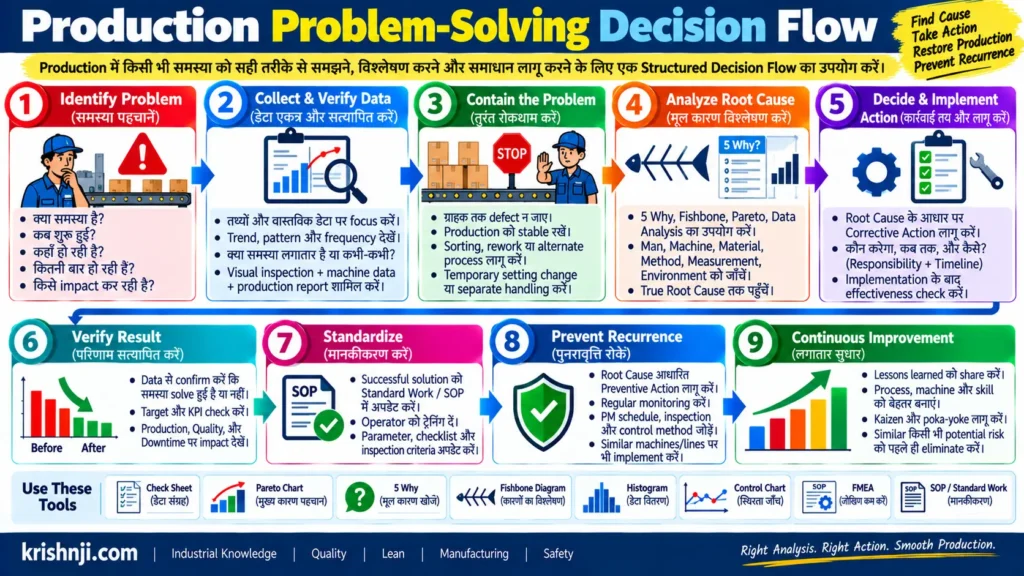
Scenario 1: Production Target Achieve नहीं हो रहा। क्या करेंगे?
Problem:
Shift का production target निर्धारित quantity से कम है।
Analysis:
सबसे पहले Target vs Actual production gap calculate करूंगा। इसके बाद downtime, cycle time, UPH, manpower availability, material shortage, rejection, changeover और bottleneck जैसे losses को check करूंगा।
Action:
- Current production status check करूंगा।
- Major loss identify करूंगा।
- Machine downtime है तो Maintenance के साथ RCA करूंगा।
- Cycle Time ज्यादा है तो Process/Production team के साथ analysis करूंगा।
- Material shortage है तो Stores/PPC से coordinate करूंगा।
- Rejection बढ़ा है तो Quality team के साथ containment और RCA करूंगा।
- Manpower shortage है तो available manpower को critical processes पर redistribute करूंगा।
Result:
Action के बाद UPH, downtime, rejection और production output को monitor करूंगा और देखूंगा कि target gap कम हुआ या नहीं। Improvement को standard work में शामिल करूंगा।
Interview Answer:
“सबसे पहले मैं Target vs Actual gap identify करूंगा। फिर production loss को downtime, cycle time, manpower, material और quality के आधार पर analyze करूंगा। सबसे बड़ा loss identify करके concerned department के साथ corrective action लूंगा और UPH तथा output से improvement verify करूंगा।”
Possible Follow-up:
अगर सभी machines running हैं फिर भी target achieve नहीं हो रहा तो?
Cycle Time, manpower allocation, micro-stoppages, material feeding, line balancing और actual UPH को analyze करूंगा।
Scenario 2: Machine बार-बार Breakdown हो रही है। क्या करेंगे?
Problem:
एक machine बार-बार breakdown होने के कारण production loss हो रहा है।
Analysis:
Breakdown history, frequency, duration, alarm history और failure pattern check करूंगा। यह भी देखूंगा कि breakdown mechanical, electrical, pneumatic, sensor, parameter या operating condition से related है या नहीं।
Action:
- Immediate breakdown को Maintenance team के साथ restore करूंगा।
- Breakdown frequency और downtime data collect करूंगा।
- Repeated failure का RCA करूंगा।
- 5 Why या Fishbone का उपयोग करूंगा।
- Root cause के आधार पर corrective action करूंगा।
- अगर component बार-बार fail हो रहा है तो component life और preventive maintenance requirement review करूंगा।
Result:
Breakdown frequency, MTBF और downtime को action से पहले और बाद में compare करूंगा।
Interview Answer:
“मैं केवल machine को restart करके problem close नहीं करूंगा। Breakdown history और failure pattern analyze करके recurring root cause identify करूंगा। Maintenance team के साथ corrective action implement करके MTBF और downtime से effectiveness verify करूंगा।”
Scenario 3: Rejection अचानक बढ़ गया। क्या करेंगे?
Problem:
Production line पर rejection rate अचानक बढ़ गया है।
Analysis:
सबसे पहले defective products को contain और segregate करूंगा। फिर defect type, station, shift, machine, operator, material lot और process parameters के अनुसार data analyze करूंगा।
Action:
- Suspected material/product को segregate करूंगा।
- Defect का exact type identify करूंगा।
- Pareto से major defect identify करूंगा।
- 5 Why/Fishbone से RCA करूंगा।
- Process parameter और machine condition verify करूंगा।
- Material lot और change history check करूंगा।
- Root cause मिलने पर corrective action implement करूंगा।
Result:
FPY, rejection rate या PPM को compare करके effectiveness verify करूंगा। फिर control plan, SOP या Poka-Yoke में required improvement standardize करूंगा।
Interview Answer:
“पहले containment करूंगा ताकि defective product आगे न जाए। फिर defect data को machine, shift, material और process parameters के अनुसार analyze करूंगा। Pareto और RCA के बाद corrective action implement करके FPY या rejection rate से result verify करूंगा।”
Scenario 4: Cycle Time Standard से ज्यादा है।
Problem:
Process का actual Cycle Time standard Cycle Time से ज्यादा हो गया है।
Analysis:
Actual Cycle Time को standard से compare करूंगा और process को individual elements में break करके देखूंगा कि additional time कहाँ लग रहा है।
Action:
- Time study करूंगा।
- Motion और waiting losses identify करूंगा।
- Operator method verify करूंगा।
- Machine parameters check करूंगा।
- Material feeding और handling time देखूंगा।
- Bottleneck operation identify करूंगा।
- आवश्यकता होने पर line balancing या Kaizen करूंगा।
Result:
Actual Cycle Time को standard के करीब लाकर UPH और line capacity में improvement verify करूंगा।
Interview Answer:
“मैं सीधे operator को fast काम करने के लिए नहीं कहूंगा। पहले time study और element-wise analysis करके extra time का कारण identify करूंगा। फिर method, machine, material या manpower से related root cause पर action लेकर Cycle Time और UPH verify करूंगा।”
Scenario 5: Production Line में Bottleneck है।
Problem:
एक process बाकी processes की तुलना में धीमा है और पूरी line की output को limit कर रहा है।
Analysis:
हर process का Cycle Time, UPH, WIP और utilization compare करूंगा।
Action:
- Bottleneck station identify करूंगा।
- Bottleneck का Cycle Time analyze करूंगा।
- Unnecessary motion और waiting eliminate करूंगा।
- Work content redistribute करूंगा।
- Manpower balancing करूंगा।
- Machine/process improvement check करूंगा।
- जरूरत होने पर parallel operation या additional capacity evaluate करूंगा।
Result:
Bottleneck Cycle Time, line UPH और overall production output को compare करूंगा।
Interview Answer:
“पहले data से bottleneck confirm करूंगा। फिर bottleneck station का work content और Cycle Time analyze करके waste हटाऊंगा। जरूरत के अनुसार line balancing, manpower redistribution या process improvement करूंगा और final output से improvement verify करूंगा।”
Scenario 6: Operator Shortage है। क्या करेंगे?
Problem:
Required manpower उपलब्ध नहीं है और production target प्रभावित हो सकता है।
Analysis:
सबसे पहले critical processes identify करूंगा और skill matrix check करूंगा।
Action:
- Available manpower की skill mapping करूंगा।
- Critical operations पर skilled operators assign करूंगा।
- Multi-skilled operators को utilize करूंगा।
- Non-critical activities को temporarily redistribute करूंगा।
- Supervisor/HR से additional manpower requirement communicate करूंगा।
- Safety और quality requirements को compromise नहीं करूंगा।
Result:
Manpower utilization, UPH, output और quality को monitor करूंगा।
Interview Answer:
“मैं केवल available operators को randomly distribute नहीं करूंगा। पहले critical processes और skill matrix देखूंगा। फिर skilled manpower को bottleneck और critical operations पर allocate करके production loss minimize करूंगा, साथ ही safety और quality requirements maintain करूंगा।”
Scenario 7: Material Shortage के कारण Line Stop हो रही है।
Problem:
Required material/component समय पर उपलब्ध नहीं होने से production line रुक रही है।
Analysis:
Material requirement, stock level, consumption rate, shortage frequency और supply lead time check करूंगा।
Action:
- Immediate shortage quantity identify करूंगा।
- Stores/PPC/Purchase team को escalation करूंगा।
- Available stock को critical process में prioritize करूंगा।
- Alternative approved material उपलब्ध है तो relevant team से verification करूंगा।
- Material shortage का recurring reason identify करूंगा।
- Kanban, min-max level या replenishment system review करूंगा।
Result:
Line stoppage time और material shortage frequency को monitor करूंगा।
Interview Answer:
“पहले line को recover करने के लिए immediate material availability coordinate करूंगा। उसके बाद shortage history और consumption data analyze करके recurring root cause identify करूंगा। Long-term में inventory control, Kanban या replenishment system को improve करने पर focus करूंगा।”
Scenario 8: OEE लगातार कम है। क्या करेंगे?
Problem:
OEE लगातार target से नीचे है।
Analysis:
सबसे पहले OEE को तीन components में break करूंगा:
OEE = Availability × Performance × Quality
फिर identify करूंगा कि मुख्य loss Availability, Performance या Quality में है।
Action:
- Availability low है → breakdown और downtime analyze करूंगा।
- Performance low है → speed loss, micro-stop और Cycle Time analyze करूंगा।
- Quality low है → rejection और defect analysis करूंगा।
- Pareto से major loss identify करूंगा।
- RCA करके corrective action implement करूंगा।
Result:
OEE के साथ-साथ individual components और major loss category को before/after compare करूंगा।
Interview Answer:
“मैं केवल OEE percentage देखकर action नहीं लूंगा। पहले Availability, Performance और Quality को separately analyze करूंगा। फिर Pareto से major loss identify करके RCA और corrective action करूंगा और OEE improvement को verify करूंगा।”
Scenario 9: Operator SOP Follow नहीं कर रहा।
Problem:
Operator standard operating procedure के अनुसार process नहीं कर रहा है।
Analysis:
पहले यह verify करूंगा कि SOP current, clear और operator के लिए understandable है या नहीं। इसके बाद training, skill level और actual working method को compare करूंगा।
Action:
- Immediate deviation को correct करूंगा।
- Product/process risk होने पर containment करूंगा।
- Operator को सही method explain करूंगा।
- Training requirement identify करूंगा।
- SOP/WI की clarity verify करूंगा।
- अगर mistake repeat हो रही है तो Poka-Yoke या visual control की possibility देखूंगा।
Result:
Process audit और defect/rejection data से verify करूंगा कि deviation दोबारा हो रहा है या नहीं।
Interview Answer:
“मैं तुरंत operator को blame नहीं करूंगा। पहले यह check करूंगा कि SOP सही और clearly understood है या नहीं। फिर training, process condition और human error की possibility analyze करके corrective action और जरूरत होने पर Poka-Yoke implement करूंगा।”
Scenario 10: Production और Quality Department में Conflict है।
Problem:
Production target पूरा करना चाहता है जबकि Quality team quality requirement के कारण production रोकना चाहती है।
Analysis:
सबसे पहले actual defect, specification, process condition और quality requirement का objective data check करूंगा।
Action:
- Defective product को contain करूंगा।
- Quality concern को understand करूंगा।
- Specification और approved standard verify करूंगा।
- Data के आधार पर joint RCA करूंगा।
- Immediate containment और production recovery plan बनाऊंगा।
- Root cause पर corrective action करूंगा।
Result:
Quality requirement maintain करते हुए production recovery verify करूंगा।
Interview Answer:
“मैं Production या Quality में से किसी एक side को automatically support नहीं करूंगा। पहले specification और actual data verify करूंगा। Customer और product quality को compromise किए बिना containment, RCA और corrective action के माध्यम से दोनों departments के लिए practical solution निकालने की कोशिश करूंगा।”
Important Interview Point:
Production target achieve करना महत्वपूर्ण है, लेकिन quality और safety को compromise करके target achieve करना सही production नहीं है।
Scenario 11: Customer Demand अचानक बढ़ गई। क्या करेंगे?
Problem:
Customer demand अचानक बढ़ने से existing production capacity पर्याप्त नहीं है।
Analysis:
सबसे पहले revised demand को available capacity से compare करूंगा।
Check करूंगा:
- Current Capacity
- Required Capacity
- Cycle Time
- Available Hours
- Machine Capacity
- Manpower
- Material Availability
- Bottleneck
- Overtime/Additional Shift possibility
Action:
- Capacity gap calculate करूंगा।
- Bottleneck identify करूंगा।
- Existing process में capacity improvement opportunities देखूंगा।
- Additional shift/overtime feasibility check करूंगा।
- Manpower और material availability coordinate करूंगा।
- Quality और safety requirements maintain करूंगा।
Result:
Required demand और achievable production capacity के बीच gap को monitor करूंगा।
Interview Answer:
“पहले demand और available capacity का gap calculate करूंगा। फिर bottleneck, manpower, machine availability और material constraints analyze करूंगा। Existing capacity improvement, additional shift या approved capacity options evaluate करके achievable production plan तैयार करूंगा।”
Scenario 12: Machine Parameter बार-बार Change हो रहा है।
Problem:
Machine/process parameter बार-बार बदल रहा है, जिससे process stability और quality प्रभावित हो सकती है।
Analysis:
सबसे पहले parameter का standard value, allowed range और actual trend check करूंगा। Parameter किसके द्वारा, कब और क्यों change हुआ इसकी history भी verify करूंगा।
Action:
- Current parameter को approved standard से compare करूंगा।
- Machine/HMI parameter access और change history check करूंगा।
- Unauthorized change को control करूंगा।
- Process parameter locking/password या access control की आवश्यकता evaluate करूंगा।
- Parameter change के बाद quality impact verify करूंगा।
- SOP/WI में standard parameter और reaction plan clearly define करूंगा।
Result:
Parameter variation, defect rate और process stability को before/after monitor करूंगा।
Interview Answer:
“मैं केवल parameter को वापस standard value पर set नहीं करूंगा। पहले यह identify करूंगा कि parameter बार-बार क्यों बदल रहा है। फिर authorized setting, access control, SOP और parameter monitoring को improve करके process stability verify करूंगा।”
Scenario-Based Interview Answer Framework
ऊपर के scenarios को याद करने के बजाय इस 8-Step Framework को समझना ज्यादा useful है। Interview में अलग-अलग problems आने पर इसी framework को apply किया जा सकता है।
| Step | क्या करना है? | Interview में क्या दिखाना है? |
|---|---|---|
| 1. Problem Identification | Actual problem और gap identify करें | Target vs Actual, Standard vs Actual |
| 2. Containment | Problem को आगे बढ़ने से रोकें | Defect segregation, machine isolation, temporary control |
| 3. Data Collection | Relevant data collect करें | Downtime, CT, UPH, rejection, shift, machine, lot |
| 4. Root Cause Analysis | Actual root cause identify करें | 5 Why, Fishbone, Pareto, data analysis |
| 5. Corrective Action | Root cause को address करें | Process/machine/method/ material/manpower action |
| 6. Result Verification | Action effective है या नहीं देखें | KPI before vs after |
| 7. Preventive Action | Problem repeat होने की संभावना कम करें | Poka-Yoke, PM, training, control improvement |
| 8. Standardization | Improvement को standard बनाएं | SOP, WI, Control Plan, checklist, monitoring |
Master Interview Formula
Problem → Containment → Data → RCA → Corrective Action → Result → Prevention → Standardization
इसे एक practical example से समझें:
Rejection बढ़ा
↓
Containment → Defective material segregate
↓
Data → Defect type + machine + shift + lot
↓
RCA → Pareto + 5 Why + process analysis
↓
Corrective Action → Root cause remove
↓
Result → Rejection/FPY verify
↓
Preventive Action → Poka-Yoke / control improvement
↓
Standardization → SOP + Control Plan + Monitoring
Interview में Scenario Answer देते समय 5 गलतियाँ न करें
1. केवल “RCA करूंगा” नहीं कहें
Weak Answer:
“मैं RCA करूंगा और problem solve करूंगा।”
Better Answer:
“मैं पहले data collect करके major loss identify करूंगा, फिर 5 Why/Fishbone के माध्यम से root cause verify करके corrective action implement करूंगा।”
2. बिना Data के Root Cause declare न करें
यदि rejection बढ़ा है तो तुरंत “operator mistake” को root cause बताना सही approach नहीं है।
Material, Machine, Method, Manpower, Measurement और Environment जैसे factors भी verify करने चाहिए।
3. हर Problem का Solution Operator Training न बताएं
अगर problem बार-बार repeat हो रही है तो केवल training पर्याप्त नहीं हो सकती। Process improvement, Poka-Yoke, machine interlock, visual control या standardization की आवश्यकता भी हो सकती है।
4. Result को Measure करना न भूलें
Interview answer में केवल action बताने से answer अधूरा रहता है।
उदाहरण:
“Corrective action के बाद rejection rate, FPY, UPH, downtime या OEE को before-after compare करूंगा।”
5. Safety और Quality को Target के लिए Compromise न करें
Production Engineer का उद्देश्य केवल maximum production निकालना नहीं है।
एक balanced production decision में:
Safety + Quality + Delivery + Cost + Productivity
सभी factors को ध्यान में रखना चाहिए।
Scenario-Based Answer का Rule
अगर interviewer कोई भी नया scenario पूछता है और आपको तुरंत answer याद नहीं आता, तो इस sequence को follow करें:
Problem समझो → Safety देखो → Containment करो → Data लो → Root Cause खोजो → Corrective Action लो → Result Measure करो → Prevention करो → Standardize करो।
यही approach एक candidate के answer को “theoretical answer” से “shop-floor problem-solving answer” में बदल देती है।
Production Engineer Interview Questions for Freshers
Production Engineer Fresher Interview में क्या पूछा जाता है?
Production Engineer Fresher interview में interviewer आमतौर पर candidate की engineering fundamentals, manufacturing knowledge, production concepts, Lean Manufacturing, Quality, Safety, academic project/internship और communication skills को assess करता है। Fresher से बहुत ज्यादा industry experience की अपेक्षा नहीं होती, लेकिन उसे basic concepts को practical manufacturing situation से जोड़कर explain करना आना चाहिए।
Q1. Production Engineering क्या है?
Direct Answer:
Production Engineering engineering की वह field है जिसमें products को निर्धारित Quality, Quantity, Cost, Delivery और Safety requirements के अनुसार efficiently manufacture करने के लिए processes, machines, manpower और resources को optimize किया जाता है।
Example:
अगर assembly line पर daily 1,000 units produce करने हैं, तो Production Engineer process flow, Cycle Time, manpower, machine capacity और quality requirements को manage करके target achieve करने में support करता है।
Fresher Interview Answer:
“Production Engineering में मेरा understanding यह है कि available resources का effective utilization करके required product को सही quality, quantity, cost और time में safely produce करना होता है।”
Possible Follow-up:
Production Engineer और Mechanical Engineer में क्या difference है?
Q2. Production और Productivity में क्या difference है?
Answer:
Production का मतलब है कितनी quantity produce हुई।
Productivity का मतलब है available input/resources के comparison में कितनी output प्राप्त हुई।
Formula:
Productivity = Output ÷ Input
Input में manpower, machine hours, material या अन्य resources हो सकते हैं।
Example:
अगर दो operators 8 घंटे में 800 units produce करते हैं, तो productivity को output per man-hour के रूप में analyze किया जा सकता है।
Fresher Interview Tip:
सिर्फ definition न बताएं। एक छोटा manufacturing example जोड़ें।
Q3. Cycle Time क्या होता है?
Answer:
Cycle Time किसी process में एक unit complete करने में लगने वाला actual time है।
Formula:
Cycle Time = Total Production Time ÷ Total Units Produced
Example:
यदि 60 minutes में 120 units produce हुए:
Cycle Time = 60 × 60 ÷ 120
= 30 seconds/unit
Fresher Interview Answer:
“Cycle Time मुझे यह बताता है कि एक unit complete करने में process को कितना actual time लग रहा है। Production capacity और bottleneck analysis में यह important KPI है।”
Q4. Takt Time क्या है और Cycle Time से कैसे अलग है?
Answer:
Takt Time customer demand को पूरा करने के लिए required production pace बताता है, जबकि Cycle Time actual process time बताता है।
Formula:
Takt Time = Available Production Time ÷ Customer Demand
अगर:
Available Time = 7.5 hours
Demand = 900 units
तो:
Takt Time = 27,000 ÷ 900
= 30 seconds/unit
अगर actual Cycle Time 40 seconds है और Takt Time 30 seconds है, तो current process required demand को meet नहीं कर पाएगा।
Fresher Tip:
यह question interview में बहुत common है, इसलिए Cycle Time vs Takt Time जरूर अच्छी तरह समझें।
Q5. OEE क्या है?
Answer:
OEE यानी Overall Equipment Effectiveness machine या equipment की effectiveness को Availability, Performance और Quality के आधार पर measure करने वाला KPI है।
Formula:
OEE = Availability × Performance × Quality
जहाँ:
- Availability → Machine planned time में कितनी available रही
- Performance → Machine ideal speed के comparison में कैसी perform कर रही है
- Quality → Total production में कितने good units हैं
Fresher Interview Answer:
“OEE equipment effectiveness को तीन factors—Availability, Performance और Quality—के combination से measure करता है।”
Q6. 5S क्या है?
Answer:
5S workplace organization और discipline की Lean Manufacturing methodology है।
इसके पाँच steps हैं:
- Sort
- Set in Order
- Shine
- Standardize
- Sustain
Practical Example:
Production workstation पर unnecessary tools हटाना, required tools के लिए fixed location बनाना, cleaning standard बनाना और daily audit करना 5S implementation का example है।
Fresher Interview Tip:
5S को केवल definitions के रूप में न बताएं। Workplace example जरूर दें।
Q7. Kaizen क्या है?
Answer:
Kaizen का अर्थ continuous improvement है। इसका उद्देश्य छोटे-छोटे systematic improvements के माध्यम से productivity, quality, safety और efficiency improve करना है।
Example:
अगर operator को हर cycle में material लेने के लिए दूर जाना पड़ता है, तो material location को point-of-use के पास shift करके unnecessary motion reduce किया जा सकता है।
Fresher Answer:
“मेरे understanding के अनुसार Kaizen continuous small improvements पर focus करता है। इसका उद्देश्य process में waste और losses को systematically reduce करना है।”
Q8. Poka-Yoke क्या है?
Answer:
Poka-Yoke mistake-proofing technique है जिसका उद्देश्य human error को prevent या immediately detect करना है।
Example:
अगर component केवल एक orientation में correctly fit हो सकता है और fixture गलत orientation में component को accept नहीं करता, तो यह Poka-Yoke का example है।
Interview Tip:
एक practical example देने से answer ज्यादा strong बनता है।
Q9. Bottleneck क्या होता है?
Answer:
Production line का वह process या operation जो पूरी line की output को limit करता है, bottleneck कहलाता है।
Example:
अगर तीन processes के Cycle Times 20, 25 और 45 seconds हैं, तो 45-second process line capacity को limit कर सकता है।
Fresher Interview Answer:
“मैं bottleneck identify करने के लिए process-wise Cycle Time, output और WIP को compare करूंगा और फिर उस process की capacity improve करने के opportunities देखूंगा।”
Q10. Production line में Quality और Productivity दोनों को कैसे maintain करेंगे?
Answer:
Production बढ़ाने के लिए quality requirements को compromise नहीं करना चाहिए। Process को standard work, process controls, inspection, Poka-Yoke और continuous monitoring के माध्यम से control करना चाहिए।
Fresher Answer:
“मेरे लिए production target important है, लेकिन quality और safety को compromise करके target achieve करना sustainable solution नहीं है। मैं process control और data-based improvement पर focus करूंगा।”
Q11. RCA क्या है?
Answer:
RCA यानी Root Cause Analysis किसी problem के वास्तविक कारण को identify करने की systematic method है, ताकि केवल symptom को ठीक करने के बजाय problem को permanently reduce किया जा सके।
Common RCA tools:
- 5 Why
- Fishbone Diagram
- Pareto Analysis
- Process Analysis
- Data Analysis
Example:
अगर rejection बढ़ गया है, तो केवल defective units को अलग करना solution नहीं है। Defect क्यों आया, किस machine/process/parameter/material से related है, यह identify करना RCA का हिस्सा है।
Q12. 5 Why Analysis क्या है?
Answer:
5 Why एक problem-solving technique है जिसमें “Why?” repeatedly पूछकर problem के underlying cause तक पहुंचने की कोशिश की जाती है।
Example:
Problem: Machine stop हो गई।
Why? → Sensor signal नहीं आया।
Why? → Sensor detect नहीं कर रहा था।
Why? → Sensor alignment खराब थी।
Why? → Mounting loose थी।
Why? → Mounting inspection standard पर्याप्त नहीं था।
यह केवल example है; वास्तविक RCA में हर Why को evidence से verify करना चाहिए।
Fresher Tip:
यह न कहें कि हर problem में exactly पाँच Why पूछना compulsory है। जरूरत के अनुसार analysis आगे बढ़ता है।
Q13. Production में Safety क्यों important है?
Answer:
Safety production process का fundamental requirement है। Unsafe condition से injury, equipment damage, production loss और quality problems हो सकते हैं।
Fresher को basic safety concepts पता होने चाहिए:
- PPE
- Machine Guarding
- Emergency Stop
- Interlock
- LOTO
- Safe Work Procedure
- Near Miss Reporting
Fresher Interview Answer:
“Production target important है, लेकिन unsafe condition में production continue करना सही approach नहीं है। पहले hazard को control करके safe condition establish करनी चाहिए।”
Q14. Manufacturing Process क्या होता है?
Answer:
Manufacturing Process वह sequence of operations है जिसके द्वारा raw material या component को required specifications वाले finished product में transform किया जाता है।
Typical flow:
Raw Material → Process → Inspection → Assembly → Testing → Final Inspection → Packing
Actual process industry और product के अनुसार अलग हो सकता है।
Fresher Tip:
अपने academic project, internship या किसी known manufacturing process का example दें।
Q15. अगर production line पर rejection अचानक बढ़ जाए तो आप क्या करेंगे?
Answer:
Problem → Containment → Data → RCA → Corrective Action → Verification
सबसे पहले defective products को identify और segregate करूंगा। फिर defect type, machine, shift, material lot और process parameters का data collect करूंगा। इसके बाद Pareto/5 Why/Fishbone से root cause analyze करूंगा।
Fresher Interview Answer:
“Fresher के रूप में मैं बिना evidence के root cause assume नहीं करूंगा। पहले senior/Quality team के guidance में containment और data collection करूंगा, फिर RCA process में contribute करके corrective action की effectiveness verify करूंगा।”
यह answer fresher के लिए ज्यादा realistic है।
Q16. अपने Engineering Project के बारे में बताइए।
यह question Fresher interview में बहुत important है।
Answer को इस structure में रखें:
Project → Problem → Your Role → Method → Result → Learning
Example Structure:
“मेरे final-year project का topic ___ था। इसका objective ___ problem को solve करना था। इसमें मेरी responsibility ___ थी। हमने ___ method/technology का उपयोग किया। Project के दौरान मुझे ___ challenge मिला और हमने ___ approach से उसे solve किया। इस project से मैंने technical knowledge के साथ teamwork और problem-solving सीखी।”
Important:
Project में ऐसी technology या responsibility claim न करें जिसे आपने वास्तव में perform नहीं किया।
Q17. आपने Internship में क्या सीखा?
Answer Framework:
Company/Department → Process → Your Exposure → Learning → Practical Understanding
Example:
“Internship के दौरान मुझे manufacturing process का practical exposure मिला। मैंने process flow, SOP, quality inspection और shop-floor safety को closely observe किया। इससे मुझे classroom concepts को actual manufacturing environment से connect करने में मदद मिली।”
अगर internship में कोई specific machine/process देखा है, तो उसका नाम और purpose बताना answer को stronger बनाता है।
Q18. आप Production Engineer क्यों बनना चाहते हैं?
Answer:
इस question का answer केवल “मुझे production field पसंद है” तक सीमित नहीं होना चाहिए।
Better Structure:
Engineering Background → Manufacturing Interest → Problem Solving → Continuous Improvement → Career Goal
Sample Answer:
“मेरी engineering background ने मुझे manufacturing और technical processes में interest develop किया है। मुझे shop-floor problems को understand करके उनके practical solutions find करना interesting लगता है। Production Engineering में मुझे process improvement, productivity, quality और problem-solving पर काम करने का opportunity मिलता है। इसलिए मैं इस field में अपना career develop करना चाहता हूँ।”
Q19. अगर आपको किसी technical question का answer नहीं पता हो तो क्या करेंगे?
Answer:
Fresher के लिए यह बहुत important question है।
गलत approach:
“मुझे नहीं पता।”
बेहतर approach:
“इस particular concept पर मेरी knowledge अभी limited है। लेकिन मेरी understanding के अनुसार ___ है। मैं इसे properly learn करना चाहूंगा।”
अगर बिल्कुल knowledge नहीं है:
“I am not fully familiar with this topic yet, so I don’t want to give you an incorrect answer. I would like to learn it.”
Fresher Golden Rule:
Guess करने से बेहतर है honestly acknowledge करना और learning attitude दिखाना।
Q20. आप हमें Production Engineer के रूप में क्यों hire करना चाहिए?
Answer:
Fresher के पास experience नहीं है, इसलिए answer में fake achievements बताने की जरूरत नहीं है।
Sample Answer:
“As a fresher, मेरे पास extensive industry experience नहीं है, लेकिन मेरे engineering fundamentals clear हैं और manufacturing processes, production concepts, Lean, Quality और Safety में मेरी strong interest है। मैं जल्दी सीखने, data के आधार पर problems को understand करने और shop-floor team के साथ काम करने के लिए तैयार हूँ। मैं अपने technical knowledge को practical experience में convert करके organization में contribute करना चाहता हूँ।”
Fresher को Interview Answers कैसे देने चाहिए?
Fresher की सबसे common mistake होती है कि वह या तो bookish definition बोलता है या फिर experienced engineer जैसा answer देने की कोशिश करता है।
एक अच्छा fresher answer इस structure में होना चाहिए:
Formula 1: Technical Question
Definition → Purpose → Example
उदाहरण:
Question: Poka-Yoke क्या है?
Definition: Mistake-proofing technique।
Purpose: Human error को prevent/detect करना।
Example: Wrong orientation component को fixture accept न करे।
Formula 2: Formula-Based Question
Formula → Variables → Example → Interpretation
उदाहरण:
Question: UPH क्या है?
Formula:
UPH = Output ÷ Production Hours
फिर छोटा numerical example दें और बताएं कि UPH बढ़ने का production पर क्या effect होगा।
Formula 3: Problem-Solving Question
Problem → Data → RCA → Action → Result
उदाहरण:
“अगर rejection बढ़ता है तो पहले containment करूंगा, फिर defect data collect करूंगा, RCA करूंगा, corrective action implement करूंगा और FPY/rejection rate से result verify करूंगा।”
Formula 4: Project Question
Project → Problem → Role → Method → Result → Learning
यह Fresher के लिए सबसे useful frameworks में से एक है।
Formula 5: HR Question
Direct Answer → Reason → Example → Career Connection
Answer को unnecessarily बहुत लंबा न करें।
Fresher के लिए Answer देने के 8 Important Rules
| Rule | क्या करें? |
|---|---|
| 1. Clear रहें | पहले direct answer दें |
| 2. Short रखें | पहले 30–60 seconds में core answer दें |
| 3. Example दें | Manufacturing example जोड़ें |
| 4. Fundamentals strong रखें | Definition + Formula समझें |
| 5. Fake Experience न बताएं | जो किया है वही बताएं |
| 6. Data समझें | KPI और basic calculations जानते हों |
| 7. Learning attitude दिखाएं | Unknown topic पर honest रहें |
| 8. Safety & Quality याद रखें | Target के लिए इन्हें compromise न करें |
Fresher Answer में “I Know” और “I Have Experience” का Difference
यह distinction interview में बहुत important है।
अगर आपने Concept पढ़ा है:
“I have studied the concept of OEE and understand its three components—Availability, Performance and Quality.”
अगर आपने Project में Apply किया है:
“During my academic project, I applied ___ to analyze ___.”
अगर आपने Internship में Observe किया है:
“During my internship, I observed how ___ was implemented on the shop floor.”
अगर आपने Actual Job में Implement किया है:
“In my previous role, I implemented ___ and measured the improvement using ___.”
इन चारों statements को एक-दूसरे की जगह use नहीं करना चाहिए।
Fresher के लिए सबसे Important Preparation Order
अगर interview के लिए समय कम है, तो preparation इस order में करें:
1. Production Fundamentals
↓
2. Cycle Time + Takt Time + UPH + Capacity
↓
3. OEE + Production KPIs
↓
4. Lean Manufacturing
↓
5. Quality + RCA
↓
6. Machine & Automation Basics
↓
7. Safety
↓
8. Project + Internship
↓
9. Practical Scenarios
↓
10. HR + Self Introduction
↓
11. Mock Interview
Fresher Interview का Formula
अधिकतर technical questions के लिए यह formula याद रखें:
Concept समझो → Simple Definition दो → Formula/Key Point बताओ → Manufacturing Example दो → अगर possible हो तो Practical Application बताओ।
और scenario-based questions में:
Problem → Containment → Data → RCA → Corrective Action → Result Verification → Prevention → Standardization
यही approach एक Fresher के answer को केवल “book knowledge” से आगे ले जाकर “engineering thinking” दिखाने में मदद करती है।
Production Engineer Interview Questions for Experienced Engineers
Experienced Production Engineer Interview में क्या पूछा जाता है?
Experienced Production Engineer से interviewer केवल technical definitions नहीं पूछता। वह यह समझना चाहता है कि candidate ने actual plant में production target, OEE, UPH, rejection, downtime, manpower, quality problems, improvement projects, cost reduction और team handling जैसी responsibilities को कैसे manage किया है।
इसलिए experienced candidate के answers में केवल “मैंने क्या किया” नहीं, बल्कि “Problem क्या थी → Baseline क्या था → Root Cause क्या मिला → Action क्या लिया → Result कितना आया” clearly दिखाई देना चाहिए।
Q1. आपके current plant में daily production target कितना है और आप उसे कैसे achieve करते हैं?
यह experienced candidate के लिए बहुत important question है क्योंकि इससे interviewer आपकी actual production responsibility समझ सकता है।
Answer Structure:
Target → Actual → Gap → Major Loss → Action → Result
Sample Answer:
“मेरी current line में daily production target ___ units है। मैं shift-wise target और actual output monitor करता हूँ। अगर gap आता है तो downtime, Cycle Time, manpower, material shortage, rejection और bottleneck को analyze करता हूँ। Major loss identify करने के बाद concerned team के साथ corrective action लेकर UPH और final output monitor करता हूँ।”
Follow-up Questions:
- आपका highest production कितना रहा?
- Target miss होने का सबसे common reason क्या है?
- आप shift-wise production कैसे monitor करते हैं?
- Production loss कैसे calculate करते हैं?
Important: यहाँ अपनी वास्तविक plant figures ही बताएं।
Q2. आपके plant में OEE कितना है और आपने OEE कैसे improve किया?
Experienced candidate को केवल OEE की definition नहीं बतानी चाहिए।
Answer Framework:
Current OEE → Availability → Performance → Quality → Major Loss → Action → Result
Sample Answer:
“हमारी line का OEE लगभग ___% था। Analysis में पाया कि major loss Availability/Performance/Quality में था। मैंने downtime और loss data का Pareto बनाया। Major loss पर RCA किया और ___ corrective action implement किया। इसके बाद OEE ___% से बढ़कर ___% हुआ।”
Follow-up:
Interviewer: OEE improvement में आपका personal contribution क्या था?
इसका answer clearly बताएं:
“मेरी responsibility data analysis, root cause identification, action coordination और result verification में थी।”
Q3. आपने UPH कैसे improve किया?
Answer Structure:
Baseline UPH → Loss Identification → Action → New UPH
Example:
“Line का UPH ___ था जबकि target ___ था। मैंने Cycle Time, micro-stoppage, operator movement और material feeding को analyze किया। Major loss ___ था। इसके लिए हमने ___ improvement किया। Improvement के बाद UPH ___ तक पहुंचा।”
Interviewer के Follow-up:
- UPH improve होने का data कैसे verify किया?
- क्या manpower increase की थी?
- Cycle Time कितना reduce हुआ?
- Quality पर क्या impact पड़ा?
Golden Rule: केवल “UPH improve किया” न कहें। Before → After data रखें।
Q4. आपके plant में rejection बढ़ने पर आप क्या approach अपनाते हैं?
Answer:
“सबसे पहले मैं containment करता हूँ ताकि suspected defective material आगे न जाए। फिर defect type, machine, shift, operator, material lot और process parameter के अनुसार data analyze करता हूँ। Pareto से major defect identify करके 5 Why/Fishbone से RCA करता हूँ। Root cause verify होने के बाद corrective action implement करता हूँ और FPY, rejection rate या PPM से effectiveness verify करता हूँ।”
Follow-up:
“अगर operator error मिले तो?”
बेहतर answer:
“मैं केवल operator error को final root cause नहीं मानूंगा। Training, SOP clarity, process design, Poka-Yoke और working condition भी verify करूंगा।”
Q5. आपने machine downtime कैसे reduce किया?
Answer Framework:
Downtime Baseline → Breakdown Data → Pareto → Recurring Failure → RCA → Action → Result
Sample:
“हमारी machine का monthly downtime ___ minutes था। Breakdown history analyze करने पर पता चला कि major downtime ___ failure के कारण था। Maintenance team के साथ 5 Why analysis किया और root cause ___ मिला। हमने ___ corrective action implement किया। इसके बाद downtime ___% reduce हुआ और machine availability improve हुई।”
Follow-up:
- MTBF क्या है?
- MTTR क्या है?
- Breakdown और minor stoppage में difference?
- Preventive Maintenance कैसे improve करेंगे?
Q6. आपने manpower shortage को कैसे manage किया?
Experienced Production Engineer से केवल “operator arrange किया” वाला answer पर्याप्त नहीं है।
Answer Framework:
Required Manpower → Available Manpower → Skill Matrix → Critical Process → Redistribution → Result
Sample Answer:
“Manpower shortage के समय मैंने पहले critical और bottleneck operations identify किए। फिर skill matrix के आधार पर available manpower को redistribute किया। Multi-skilled operators को critical processes में लगाया और non-critical activities को temporarily adjust किया। इससे production loss minimize हुआ, जबकि safety और quality requirements maintain रहीं।”
Follow-up:
“अगर skilled operator उपलब्ध न हो तो?”
Answer:
“मैं available trained manpower की skill mapping करके temporary allocation करूंगा और आवश्यकता होने पर supervisor/HR के साथ training या additional manpower plan करूंगा।”
Q7. आपने कोई Productivity Improvement Project किया है?
यह experienced candidate के लिए बहुत important question है।
Answer Framework:
Problem → Baseline → Root Cause → Improvement → Result
Sample:
“हमारी line में productivity target से कम थी। Baseline analysis में UPH ___ था। Data analysis से पता चला कि major loss ___ के कारण था। मैंने ___ improvement implement करने में participate/lead किया। इसके बाद UPH ___ से बढ़कर ___ हुआ और productivity में ___% improvement आया।”
Interviewer पूछ सकता है:
“आपने personally क्या किया?”
यहाँ team का पूरा काम अपने नाम न करें।
बताएं:
- मैंने data analysis किया।
- मैंने time study किया।
- मैंने RCA lead/support किया।
- मैंने trial coordinate किया।
- मैंने action implementation monitor किया।
- मैंने before-after result verify किया।
Q8. आपने Cost Reduction के लिए क्या improvement किया?
Cost reduction का मतलब केवल manpower कम करना नहीं है।
Possible areas:
- Material consumption
- Rejection
- Scrap
- Downtime
- Energy
- Manpower utilization
- Consumables
- Changeover time
- Tool life
- Machine efficiency
Answer Framework:
Cost Problem → Baseline Cost → Root Cause → Action → Saving
Sample:
“एक process में material consumption standard से अधिक था। मैंने actual consumption और standard consumption का comparison किया। Analysis से ___ loss identify हुआ। Process parameter/method में improvement करके material loss reduce किया। Improvement के बाद monthly consumption ___ से ___ हुआ, जिससे estimated saving ₹___ per month हुई।”
Important: Cost saving figures तभी बताएं जब आपके पास actual/approved data हो।
Q9. आपने कोई Kaizen किया है? Example बताइए।
Strong Answer Structure:
Before → Problem → Kaizen → After → Benefit
Sample:
“एक workstation पर operator को component लेने के लिए बार-बार अपनी working position छोड़नी पड़ती थी। इससे unnecessary motion और cycle time loss हो रहा था। हमने material को point-of-use के पास reposition किया और workstation arrangement improve किया। इससे operator motion reduce हुआ और Cycle Time/UPH में measurable improvement आया।”
Follow-up:
- Kaizen का benefit कैसे measure किया?
- क्या SOP update की?
- Improvement sustain कैसे किया?
Q10. आपने RCA कब और कैसे किया?
Sample Answer:
“एक recurring defect लगातार repeat हो रहा था। पहले हमने containment किया। इसके बाद defect data को machine, shift और material lot के अनुसार analyze किया। Pareto से major defect identify किया और Fishbone तथा 5 Why से root cause investigate किया। Root cause verify होने के बाद corrective action implement किया और effectiveness को rejection/FPY data से verify किया।”
Strong Point:
RCA का मतलब केवल 5 Why करना नहीं है।
एक experienced engineer को यह दिखाना चाहिए कि:
Data → Analysis → Root Cause Verification → Action → Result
पूरी chain समझता है।
Q11. आपने CAPA में क्या role निभाया है?
Answer Framework:
Problem → Containment → RCA → Corrective Action → Preventive/Systemic Action → Effectiveness
Sample:
“CAPA के दौरान मैंने initial containment, data collection और RCA में participate किया। Root cause identify होने के बाद corrective action implement कराया और effectiveness verify की। Recurrence रोकने के लिए SOP, process control, training या Poka-Yoke जैसे preventive/systemic controls को review किया।”
Follow-up:
Corrective Action और Preventive Action में क्या difference है?
उत्तर देते समय action को actual problem और future recurrence prevention से connect करें।
Q12. आपने downtime का analysis कैसे किया?
Answer:
मैं downtime को केवल total minutes के रूप में नहीं देखूंगा। पहले category-wise loss बनाऊंगा:
- Machine Breakdown
- Material Shortage
- Changeover
- Quality Hold
- Utility Failure
- Manpower
- Process Issue
- Minor Stoppage
फिर:
Downtime Data → Pareto → Major Loss → RCA → Action → Verification
Sample Answer:
“मैंने पिछले ___ days का downtime data analyze किया। Pareto में पाया कि total downtime का major portion ___ category से आ रहा था। उसी loss पर RCA और corrective action किया और बाद में downtime trend compare किया।”
Q13. अगर OEE low है लेकिन production target achieve हो रहा है, तो क्या करेंगे?
यह experienced candidate की thinking check करने वाला अच्छा question है।
Answer:
“मैं केवल production target achieve होने के कारण OEE loss को ignore नहीं करूंगा। OEE के Availability, Performance और Quality components को analyze करूंगा और hidden losses identify करूंगा। अगर target overtime, excessive manpower या additional running hours के कारण achieve हो रहा है, तो sustainable improvement की आवश्यकता हो सकती है।”
इस answer में short-term output और sustainable productivity के बीच difference दिखना चाहिए।
Q14. आपने production productivity कैसे improve की?
Answer Framework:
Current Productivity → Loss Analysis → Improvement → Result
Possible improvement areas:
- Cycle Time reduction
- Line balancing
- Manpower optimization
- Material movement reduction
- Machine availability
- Changeover reduction
- Rejection reduction
- Standard Work improvement
Sample:
“Productivity improvement के लिए मैंने पहले output और input दोनों को baseline किया। फिर major loss identify किया। Improvement के बाद केवल production output नहीं, बल्कि manpower hours और other inputs को भी compare किया ताकि actual productivity improvement verify हो सके।”
Q15. आपने किसी difficult production problem को कैसे solve किया?
यह open-ended question है और आपके पास अपना strongest project बताने का opportunity है।
Best Structure:
Situation → Problem → Baseline → Analysis → Root Cause → Action → Result → Standardization
Sample:
“एक process में recurring production loss आ रहा था। Baseline में ___ loss था। Data analysis से major issue ___ identify हुआ। RCA के दौरान root cause ___ मिला। हमने ___ corrective action implement किया। इसके बाद loss ___ तक reduce हुआ। Improvement को sustain करने के लिए SOP/WI और monitoring system update किया।”
Q16. आपने team को कैसे handle किया?
Experienced Production Engineer के लिए leadership केवल “मैं operators को motivate करता हूँ” नहीं है।
Strong Answer:
“मैं team handling में clear target, role allocation, communication और regular follow-up पर focus करता हूँ। अगर production issue आता है तो पहले facts और data समझता हूँ, फिर concerned team members के साथ action plan बनाता हूँ। Improvement के बाद result review करके required standardization करता हूँ।”
Follow-up:
अगर operator आपके instruction को follow नहीं करता तो?
पहले reason समझें:
Skill → Training → Communication → SOP → Workload → Discipline
फिर appropriate action लें।
Q17. अगर Production और Quality में conflict हो जाए तो आप क्या करेंगे?
Experienced Engineer Answer:
“मैं किसी department को automatically सही या गलत नहीं मानूंगा। पहले specification, actual defect data और process condition verify करूंगा। Customer requirement और approved quality standards को ध्यान में रखते हुए containment करूंगा। इसके बाद Production और Quality दोनों के साथ joint RCA और corrective action पर काम करूंगा।”
Important:
Target achieve करने के लिए quality compromise करना solution नहीं है।
Q18. आपने previous/current plant में सबसे बड़ा improvement क्या किया?
यह experienced engineer के interview का सबसे important question हो सकता है।
यहाँ interviewer आपके पूरे practical experience को एक project में evaluate कर सकता है।
Answer Framework:
Problem → Baseline → Root Cause → Action → Result
1. Problem
पहले problem clearly बताएं।
“हमारी ___ process में ___ problem लगातार आ रही थी।”
2. Baseline
Problem का measurable starting point बताएं।
“Improvement से पहले rejection ___%, UPH ___, downtime ___ minutes/month था।”
3. Root Cause
“Data analysis और RCA से पता चला कि major reason ___ था।”
4. Action
“Root cause के आधार पर हमने ___ corrective action implement किया।”
5. Result
सबसे important हिस्सा:
“Improvement के बाद rejection ___% से ___% हुआ और UPH ___ से ___ हुआ।”
6. Standardization
अगर possible हो तो अंत में:
“Improvement को sustain करने के लिए SOP/WI, checklist, parameter standard और monitoring system update किया।”
सबसे Strong Experience Answer Format
इसे याद रखें:
Problem
↓
Baseline
↓
Data Analysis
↓
Root Cause
↓
Corrective Action
↓
Result
↓
Standardization
Example
Problem: Line में recurring rejection issue था।
Baseline: Rejection लगभग 4.2% था।
Analysis: Defect data और machine/process conditions analyze किए।
Root Cause: Process parameter variation और control gap identify हुआ।
Action: Parameter standardization और process control improvement किया।
Result: Rejection 4.2% से घटकर 1.8% हुआ।
Standardization: Updated parameter sheet, SOP और monitoring checklist लागू की गई।
ध्यान दें: यह केवल answer structure का example है। Interview में वही numbers बताएं जिन्हें आप वास्तविक data से support कर सकते हैं।
Experienced Engineer को अपने Improvement Project के लिए कौन-कौन से Data तैयार रखने चाहिए?
Interview से पहले कम से कम 2–3 वास्तविक improvement projects तैयार रखें।
हर project के लिए यह data लिखकर revise करें:
| Parameter | क्या तैयार रखें? |
|---|---|
| Problem | Actual problem क्या थी? |
| Baseline | Starting condition क्या थी? |
| Target | Improvement target क्या था? |
| Data | कौन-सा data collect किया? |
| RCA | Root cause कैसे identify किया? |
| Action | आपने personally क्या किया? |
| KPI | कौन-सा KPI improve हुआ? |
| Result | Before vs After |
| Cost | Saving हुई तो कितनी? |
| Quality | Rejection/FPY/PPM impact |
| Productivity | UPH/UPPH impact |
| Sustainability | Improvement कैसे sustain किया? |
Interviewer आपके Improvement Project पर कौन-कौन से Follow-up Questions पूछ सकता है?
अगर आपने कहा:
“मैंने UPH improve किया।”
तो interviewer तुरंत पूछ सकता है:
- पहले UPH कितना था?
- Target कितना था?
- Problem क्या थी?
- आपने data कैसे collect किया?
- Root cause क्या मिला?
- आपने कौन-सा RCA tool use किया?
- आपने personally क्या action लिया?
- Team में कौन-कौन involved था?
- Improvement के बाद UPH कितना हुआ?
- Quality पर क्या impact पड़ा?
- Manpower increase की थी?
- Cost saving हुई?
- Improvement कितने समय तक sustain हुआ?
- SOP/WI update किया?
- अगर problem फिर वापस आए तो क्या करेंगे?
इसलिए experienced candidate को अपने project की पूरी story पता होनी चाहिए, केवल final result नहीं।
Experience Answer में “मैंने” और “हमने” का सही उपयोग कैसे करें?
यह छोटी चीज interview में credibility बढ़ाती है।
गलत:
“हमारी team ने project किया और production improve हो गया।”
इससे interviewer को आपका personal contribution पता नहीं चलता।
बेहतर:
“Team ने overall project पर काम किया। मेरी responsibility data analysis, time study और root cause verification की थी। मैंने ___ improvement implement करने को coordinate किया और result monitoring की।”
इससे teamwork + individual contribution दोनों दिखते हैं।
Experienced Engineer के लिए 7 Important Rules
1. Definition से ज्यादा Experience बताएं
अगर interviewer पूछता है:
“Kaizen क्या है?”
तो definition के बाद अपने actual Kaizen का example दें।
2. हमेशा Baseline बताएं
“Production improve किया।”
से बेहतर:
“UPH ___ से ___ किया।”
3. अपने Personal Contribution को स्पष्ट करें
Interviewer जानना चाहता है:
“आपने personally क्या किया?”
4. Data बिना Improvement अधूरा है
जहाँ संभव हो:
- Before
- Target
- After
- Percentage Improvement
- Monthly Saving
बताएं।
5. Fake Numbers बिल्कुल न बनाएं
अगर exact figure याद नहीं है:
“Approximately ___”
कह सकते हैं, लेकिन ऐसा number न बताएं जिसे बाद में explain न कर सकें।
6. Result के साथ Sustainability बताएं
Improvement के बाद:
SOP + WI + Training + Poka-Yoke + Monitoring + Control Plan
में से applicable control बताएं।
7. हर Project में Learning बताएं
अंत में interviewer पूछ सकता है:
“What did you learn from this project?”
आप बता सकते हैं:
“इस project से मुझे data-based problem solving, cross-functional coordination और improvement को sustain करने की importance समझ में आई।”
Experienced Production Engineer — Quick Revision
| Interview Area | Candidate को क्या तैयार रखना चाहिए? |
|---|---|
| Production Target | Current target, actual output, gap analysis |
| OEE | Current OEE + major loss |
| UPH | Baseline + improvement |
| Rejection | Defect + RCA + FPY/PPM |
| Downtime | Major breakdown/loss + action |
| Manpower | Skill matrix + allocation |
| Kaizen | 2–3 actual examples |
| Productivity | Before vs After |
| Cost Reduction | Actual saving/project |
| RCA | Real problem + root cause |
| CAPA | Corrective + preventive/systemic action |
| Leadership | Team handling examples |
| Improvement Project | Problem → Baseline → RCA → Action → Result |
| Sustainability | SOP/WI/Control/Monitoring |
Experienced Engineer का Important Interview Formula
जब interviewer पूछे:
“आपने अपने previous/current plant में क्या improvement किया?”
तो answer को इस sequence में रखें:
Problem → Baseline → Data Analysis → Root Cause → Your Action → Result → Standardization
और अगर possible हो तो इसे KPI से connect करें:
Problem → Baseline KPI → RCA → Improvement → New KPI → Business/Quality Benefit
यही structure interviewer को यह समझने में मदद करता है कि candidate ने केवल production process देखा नहीं है, बल्कि उसे data के आधार पर analyze करके measurable improvement में contribute किया है।
Production Engineer HR Interview Questions & Answers
Production Engineer के HR Interview में केवल technical knowledge नहीं देखी जाती। HR यह समझने की कोशिश करता है कि candidate team के साथ कैसे काम करता है, pressure और conflict को कैसे handle करता है, अपनी strengths और weaknesses को कितना realistically समझता है, job change क्यों करना चाहता है और company में long-term कैसे contribute कर सकता है।
HR answers में सबसे important rule है:
Honest + Professional + Specific + Positive
Answer को बहुत लंबा करने के बजाय 30–90 seconds में clear और structured रखें।
Q1. Tell me about yourself.
यह लगभग हर Production Engineer interview का सबसे important opening question है।
Best Answer Structure
Current Role → Experience → Technical Skills → Major Contribution → Career Goal
Experienced Engineer Sample Answer
“Good morning. My name is ___. I have ___ years of experience in manufacturing/production. Currently, I am working as a Production Engineer, where I am responsible for production target achievement, process monitoring, productivity, quality, downtime and continuous improvement activities.
I have practical exposure to KPIs such as OEE, UPH, Cycle Time, rejection and downtime, along with Lean Manufacturing, RCA, Kaizen and problem-solving. I have also worked with cross-functional teams such as Quality, Maintenance, PPC and Stores to resolve production-related issues.
One of my key areas of interest is improving production performance through data-based problem solving and process improvement. Now I am looking for an opportunity where I can use my existing experience and take on greater technical and professional responsibilities.”
Fresher के लिए Structure
Education → Project → Skills → Manufacturing Interest → Career Goal
Avoid:
- Family details से शुरुआत
- बहुत लंबी personal story
- Resume की हर line पढ़ना
- Unverified achievements
- Salary को opening point बनाना
Q2. Why do you want to work in Production Engineering?
Sample Answer
“I am interested in Production Engineering because it combines technical knowledge with practical problem-solving. I enjoy understanding how a manufacturing process works, identifying losses and finding ways to improve productivity, quality and efficiency. Production Engineering also gives me an opportunity to work closely with machines, processes and cross-functional teams, which matches my career interests.”
Experienced Engineer के लिए बेहतर approach:
अपने actual experience से connect करें:
“In my current role, I have seen that even a small improvement in Cycle Time, downtime, rejection or process control can create a measurable impact on production. That practical problem-solving aspect is one of the reasons I want to continue developing my career in Production Engineering.”
Q3. Why should we hire you?
यह question candidate को अपनी value proposition explain करने का opportunity देता है।
Answer Framework
Relevant Skills → Experience → Problem Solving → Teamwork → Value
Experienced Sample Answer
“I believe my experience in production operations, KPI monitoring and shop-floor problem solving can allow me to contribute effectively to this role. I have practical exposure to production targets, OEE, UPH, downtime, rejection, RCA and continuous improvement. I also understand the importance of working with Quality, Maintenance, PPC and other teams to solve production issues. I would bring a practical, data-based and improvement-oriented approach to the role.”
Fresher:
“As a fresher, I may not have extensive industry experience, but I have strong engineering fundamentals, a willingness to learn and an interest in manufacturing and problem solving. I am ready to learn quickly and take responsibility as I gain practical experience.”
Important: “I am the best candidate” जैसे unsupported claims avoid करें।
Q4. What are your strengths?
Production Engineer के लिए strengths को job-related रखना बेहतर है।
Good Strengths:
- Problem Solving
- Data Analysis
- Production Monitoring
- Team Coordination
- Continuous Improvement
- Learning Ability
- Process Discipline
- Communication
- Ownership
- Troubleshooting Approach
Sample Answer
“One of my strengths is structured problem solving. जब production issue आता है, मैं तुरंत assumption बनाने के बजाय data और actual process condition को understand करने की कोशिश करता हूँ। इसके अलावा, cross-functional coordination और continuous improvement भी मेरी strengths हैं।”
Stronger Version:
एक real example जोड़ें:
“For example, during a recurring production issue, I worked with the concerned teams to analyze the data, identify the major loss and implement corrective action.”
Q5. What is your weakness?
यह question tricky है।
ऐसी weakness न बताएं जो directly आपकी job performance को seriously damage करे।
Better Structure
Realistic Weakness → Improvement Action → Current Progress
Sample Answer
“Earlier, I sometimes spent more time than necessary checking details before finalizing a decision. I have been improving this by prioritizing issues based on urgency and impact and by using available data to make decisions more efficiently.”
एक अन्य option:
“Earlier, I was more focused on solving the immediate production problem than documenting the learning. I have improved this by giving more attention to standardization, SOP updates and preventive actions after problem solving.”
Avoid:
- “I have no weakness.”
- “My weakness is that I work too hard.”
- ऐसी weakness बताना जो Production Engineer role के लिए critical हो।
Q6. Why do you want to change your current job?
यहाँ HR आपके professional reason और stability को समझना चाहता है।
Good Answer Structure
Current Learning → Career Growth → New Responsibility
Sample Answer
“I have learned a lot from my current role and I am thankful for the experience I have gained. At this stage, I am looking for an opportunity where I can take on broader responsibilities, work on more challenging manufacturing problems and continue developing my technical and leadership skills.”
अगर Growth reason है:
“I am looking for a role with greater responsibility and opportunities to work on larger improvement projects.”
अगर Industry Change है:
“I want to use my existing production experience in a different manufacturing environment and learn a new process while contributing with my current skills.”
Avoid:
“My manager is bad.”
“Company खराब है।”
“Work बहुत ज्यादा है।”
“बस salary कम है।”
अगर compensation भी reason है, तो उसे professional context में रख सकते हैं, लेकिन पूरा answer केवल salary पर आधारित न करें।
Q7. How do you handle pressure?
Production environment में target pressure, breakdown, quality issue और delivery urgency common situations हैं।
Sample Answer
“I handle pressure by first separating urgent issues from important but non-urgent activities. In a production situation, I focus on safety first, then immediate containment and restoration of production. After that, I analyze the root cause and work on a permanent solution. I also communicate priorities clearly with the team rather than trying to handle every issue individually.”
Production Example
“अगर shift target miss हो रहा है, तो मैं पहले target gap और major loss identify करूंगा, फिर downtime, Cycle Time, manpower, material और quality losses के अनुसार priority set करूंगा।”
Q8. How do you handle conflict with a team member or another department?
Best Framework
Understand → Data → Common Objective → Discussion → Action → Follow-up
Sample Answer
“जब conflict होता है, मैं पहले दूसरे person’s concern को understand करने की कोशिश करता हूँ। इसके बाद assumptions के बजाय data और actual process condition पर discussion करता हूँ। Production और Quality जैसे departments में हमारा common objective safe production और required quality maintain करना है। इसलिए मैं issue को personal disagreement बनाने के बजाय common objective के आधार पर solution खोजने की कोशिश करता हूँ।”
Example:
Production vs Quality conflict में:
Specification → Data → Containment → RCA → Corrective Action
Q9. Where do you see yourself in 5 years?
यहाँ unrealistic designation बोलने की जरूरत नहीं है।
Good Answer
“In the next five years, I want to become a strong manufacturing professional with deeper expertise in production management, process improvement and problem solving. I would like to take responsibility for larger production areas or improvement projects, develop leadership skills and contribute to measurable improvements in productivity, quality, cost and delivery.”
Fresher Version
“In five years, I want to develop strong practical manufacturing expertise, become capable of independently handling production and improvement activities and gradually take on greater responsibilities.”
Avoid:
“I want to become CEO.”
Career ambition ठीक है, लेकिन answer को role और skill development से connect करें।
Q10. Tell us about your biggest achievement.
यहाँ Achievement ≠ केवल Award।
Production Engineer के लिए achievement हो सकती है:
- Productivity improvement
- Rejection reduction
- OEE improvement
- Downtime reduction
- Cost saving
- Cycle Time reduction
- Kaizen
- Safety improvement
- Process stabilization
Best Structure
Problem → Baseline → Action → Result → Sustainability
Sample:
“One of my significant achievements was improving ___ process performance. Initially, ___ was the major problem and the baseline was ___. I analyzed the process data and identified ___ as the major cause. We implemented ___ improvement. After the action, ___ improved from ___ to ___. We then standardized the improvement through SOP/process control and continued monitoring.”
Important: केवल वही numbers use करें जिन्हें आप interview में explain और support कर सकें।
Q11. Tell us about a production problem you solved.
यह HR + Technical दोनों का combination question है।
Best Answer Framework
Problem → Baseline → Root Cause → Action → Result → Prevention
Sample:
“We had a recurring production issue where ___. The baseline impact was ___ in terms of downtime/rejection/UPH. I collected and analyzed the relevant data and worked with the concerned departments to identify the root cause as ___. We implemented ___. After the improvement, ___ reduced/improved from ___ to ___. To prevent recurrence, we standardized the process through ___.”
Interviewer के Follow-up:
- आपने root cause कैसे identify किया?
- आपका personal contribution क्या था?
- कौन-सा RCA tool use किया?
- Result कैसे measure किया?
- Problem वापस आए तो क्या करेंगे?
इसलिए project की पूरी story तैयार रखें।
Q12. Why do you want to join our company?
इस question का answer company-specific होना चाहिए।
Preparation पहले करें:
Interview से पहले company के बारे में कम से कम यह जानकारी देखें:
- Products
- Manufacturing locations
- Industry
- Major processes
- Technology
- Job description
- Role responsibilities
- Company values
- Recent business developments
Sample Answer
“I am interested in joining your company because the role is closely aligned with my manufacturing experience and career goals. I am particularly interested in the opportunity to work on production performance, process improvement and cross-functional problem solving. I believe my existing experience can help me contribute to the role, while the scale and processes of your organization can also provide me with an opportunity to learn and grow professionally.”
Company-specific version और मजबूत होगी:
“I noticed that this role involves ___, ___ and ___. These areas match my experience in ___. That is why I see a good alignment between my current skills and the requirements of this position.”
HR Interview में Follow-up Questions के लिए तैयार रहें
एक अच्छा HR interviewer आपके first answer के बाद deeper questions पूछ सकता है।
अगर आपने कहा:
“I improved productivity.”
तो अगला सवाल हो सकता है:
“How?”
फिर:
“What was the baseline?”
फिर:
“What exactly did you do?”
फिर:
“What was the result?”
इसलिए हर major experience को इस format में तैयार रखें:
Problem → Baseline → Root Cause → Your Action → Result → Standardization
Production Engineer HR Interview — Quick Answer Framework
| HR Question | Answer Framework |
|---|---|
| Tell me about yourself | Current Role → Experience → Skills → Achievement → Goal |
| Why Production Engineering? | Interest → Technical Skills → Problem Solving → Career |
| Why should we hire you? | Skills → Experience → Value |
| Strengths | Strength → Example → Job Relevance |
| Weakness | Weakness → Improvement Action → Progress |
| Job Change | Learning → Growth → Responsibility |
| Pressure | Prioritize → Safety → Containment → Action |
| Conflict | Understand → Data → Common Goal → Solution |
| 5 Years | Skills → Responsibility → Leadership |
| Biggest Achievement | Problem → Baseline → Action → Result |
| Production Problem | Problem → RCA → Action → Result |
| Why Our Company? | Company Research → Role Fit → Skills → Contribution |
HR Interview में 10 Common Mistakes
1. Previous Company की बुराई करना
Professional answer दें। Personal criticism avoid करें।
2. Fake Achievement बताना
अगर interviewer ने “How?” पूछा और आप explain नहीं कर पाए, तो credibility प्रभावित हो सकती है।
3. केवल “Team ने किया” कहना
अपना actual contribution स्पष्ट करें।
4. केवल “I” बोलना
Team-based manufacturing environment में collaboration भी दिखाएं।
Best balance:
“I was responsible for ___, and I worked with ___ team.”
5. Salary को सबसे बड़ा Reason बनाना
Career growth, role responsibility और professional development को भी explain करें।
6. Weakness को Fake Positive बनाना
“मैं बहुत ज्यादा मेहनत करता हूँ” जैसी cliché weakness avoid करें।
7. बहुत लंबा Self Introduction
Self Introduction को structured और relevant रखें।
8. Resume से अलग Answer देना
Resume में लिखी हर important achievement को explain करने के लिए तैयार रहें।
9. बिना Data के Improvement बताना
जहाँ possible हो, Before → After KPI रखें।
10. हर Answer को Memorize करना
Answer याद करने के बजाय framework समझें। इससे follow-up questions में भी naturally जवाब दे पाएंगे।
HR Interview का Important Rule
Production Engineer के HR interview में interviewer को यह तीन बातें स्पष्ट दिखनी चाहिए:
1. मैं क्या जानता हूँ?
Technical Knowledge
2. मैंने क्या किया है?
Practical Experience
3. मैं organization में क्या value ला सकता हूँ?
Contribution
और experienced candidate के लिए सबसे powerful answer structure है:
Problem → Baseline → Root Cause → Your Contribution → Action → Result → Standardization
जब interviewer पूछे:
“आपने अपने previous/current plant में क्या improvement किया?”
तो केवल यह न कहें:
“मैंने production improve किया।”
बल्कि:
“Problem क्या थी → पहले स्थिति क्या थी → root cause क्या मिला → मैंने personally क्या किया → result क्या आया → improvement कैसे sustain किया”
यही difference एक generic interview answer और एक credible Production Engineer experience answer के बीच होता है।
Production Engineer Interview में “Tell Me About Yourself” का Answer कैसे दें?
“Tell Me About Yourself” Production Engineer interview का एक बहुत important question है। इसका उद्देश्य केवल candidate की personal information जानना नहीं होता, बल्कि interviewer यह समझना चाहता है कि candidate अपने education/experience, technical skills, achievements और career goals को कितनी clarity से explain कर सकता है।
एक अच्छा answer बहुत लंबा नहीं होना चाहिए। सामान्यतः 60–90 seconds में structured introduction देना पर्याप्त है।
सबसे आसान Formula
Current Role → Experience → Technical Skills → Achievement → Future Goal
Fresher के लिए Current Role की जगह:
Education → Project/Internship → Technical Skills → Achievement/Learning → Future Goal
1. Current Role
सबसे पहले बताएं कि आप अभी क्या कर रहे हैं।
Experienced Engineer:
“Currently, I am working as a Production Engineer in a manufacturing environment.”
इसके बाद अपनी primary responsibilities बताएं:
“My responsibilities include production target monitoring, process monitoring, productivity improvement, quality coordination and downtime analysis.”
Fresher:
Fresher के पास Current Role नहीं होता, इसलिए education से शुरुआत करें:
“I have recently completed my B.Tech/Diploma in Mechanical Engineering.”
इसके बाद relevant subjects, project या internship की ओर जाएं।
2. Experience
Experienced candidate को total experience और relevant manufacturing exposure briefly बताना चाहिए।
Example:
“I have around ___ years of experience in manufacturing and production operations.”
इसके बाद industries/processes का short mention करें:
“During this period, I have worked on production monitoring, process improvement, quality issues and shop-floor problem solving.”
Fresher:
Experience की जगह:
- Academic Project
- Internship
- Industrial Training
- Relevant Practical Exposure
बताएं।
3. Technical Skills
Production Engineer के लिए technical skills को job role से connect करें।
आप इनमें से relevant skills mention कर सकते हैं:
- Production Planning
- Cycle Time
- Takt Time
- UPH/UPPH
- OEE
- Line Balancing
- Bottleneck Analysis
- Lean Manufacturing
- 5S
- Kaizen
- Poka-Yoke
- RCA
- 5 Why
- Fishbone
- Pareto
- CAPA
- SPC
- Machine & Automation Basics
- Safety
Important:
पूरी list बोलने की जरूरत नहीं है।
केवल वही skills बताएं जिन्हें interviewer आगे पूछे तो आप confidently explain कर सकें।
4. Achievement
यह आपके introduction का सबसे valuable हिस्सा हो सकता है।
Achievement का मतलब केवल award नहीं है।
Production Engineer के लिए achievement हो सकती है:
- UPH improvement
- OEE improvement
- Rejection reduction
- Downtime reduction
- Cycle Time reduction
- Cost saving
- Kaizen
- Productivity improvement
- Process stabilization
Best Format:
Problem → Action → Result
Example:
“One of my key contributions was improving ___ process performance. I worked on identifying the major loss and implemented ___ improvement, which resulted in improvement in ___.”
अगर actual data available है तो:
“UPH improved from ___ to ___.”
या:
“Rejection reduced from ___% to ___%.”
लेकिन केवल वास्तविक और explain किए जा सकने वाले numbers ही बताएं।
5. Future Goal
अंत में बताएं कि आप आगे किस direction में grow करना चाहते हैं।
Good Example:
“Going forward, I want to develop deeper expertise in production management, process improvement and problem solving and gradually take greater responsibility in manufacturing operations.”
Future goal को केवल designation से connect न करें।
Better:
❌ “I want to become Production Manager in five years.”
Better:
“I want to develop strong expertise in manufacturing, improve my leadership capabilities and gradually take responsibility for larger production operations and improvement projects.”
Fresher के लिए “Tell Me About Yourself” Example
Structure:
Education → Project/Internship → Technical Skills → Learning/Achievement → Future Goal
Sample Answer
“Good morning. My name is ___. I have recently completed my B.Tech/Diploma in Mechanical Engineering from ___. During my studies, I developed an interest in manufacturing and production processes.
I have studied subjects related to manufacturing, production, quality and engineering fundamentals. I also worked on my academic project on ___, where I was responsible for ___. During my internship/industrial training, I got practical exposure to manufacturing processes, SOPs, quality inspection and shop-floor safety.
I have a basic understanding of Cycle Time, Takt Time, OEE, Lean Manufacturing, 5S, Kaizen, Poka-Yoke and Root Cause Analysis. My project/internship helped me improve my problem-solving and teamwork skills.
As a fresher, my immediate goal is to build strong practical manufacturing experience, learn from experienced professionals and contribute to production, quality and continuous improvement activities.”
Fresher को ध्यान रखना चाहिए:
अगर आपने किसी concept को केवल college में पढ़ा है, तो उसे “I have knowledge of…” या “I have studied…” कहें।
अगर actual implementation नहीं किया है तो:
❌ “I implemented OEE improvement.”
इसके बजाय:
✅ “I have studied OEE and understand its basic calculation and application.”
Experienced Production Engineer के लिए “Tell Me About Yourself” Example
Structure:
Current Role → Experience → Technical Skills → Achievement → Future Goal
Sample Answer
“Good morning. My name is ___. I have around ___ years of experience in manufacturing and production operations. Currently, I am working as a Production Engineer, where I am responsible for production target monitoring, process control, productivity, quality coordination, downtime analysis and continuous improvement activities.
During my experience, I have worked with production KPIs such as OEE, UPH, Cycle Time, rejection and downtime. I also have practical exposure to Lean Manufacturing, Kaizen, 5S, Poka-Yoke, RCA, 5 Why and other problem-solving techniques. I regularly coordinate with Quality, Maintenance, PPC, Stores and other cross-functional teams to resolve shop-floor issues.
One of my key contributions was ___, where I identified ___ as the major problem, worked on ___ improvement and achieved ___ improvement in ___. I also worked on standardizing the improvement through SOP/WI/monitoring.
Going forward, I want to take greater responsibility in production operations and process improvement, while developing stronger leadership and manufacturing management skills.”
अगर Interviewer कहे: “Tell me about yourself” — तो क्या नहीं बोलना चाहिए?
1. Family History से शुरुआत न करें
“My father is ___, my mother is ___, I have two brothers…”
जब तक interviewer specifically personal/family background न पूछे, introduction को professional रखें।
2. पूरा Resume पढ़कर न सुनाएं
Resume में पहले से मौजूद हर education और job detail को line-by-line repeat करने की जरूरत नहीं है।
Resume में लिखी सबसे relevant बातें चुनें।
3. बहुत ज्यादा Technical Terms न भरें
ऐसा introduction:
“OEE, FPY, RTY, DPMO, SPC, FMEA, CAPA, PLC, HMI, SMED, Jidoka…”
सिर्फ terms की list बन जाएगा।
हर skill तभी mention करें जब आप उसे explain कर सकें।
4. Fake Achievement न बताएं
अगर interviewer पूछता है:
“How did you improve OEE?”
और candidate के पास actual experience नहीं है, तो problem हो सकती है।
Honest answer हमेशा बेहतर है।
“Tell Me About Yourself” को याद कैसे करें?
पूरा paragraph word-to-word memorize करने के बजाय केवल 5 blocks याद रखें:
Experienced:
1. Current Role
मैं अभी क्या कर रहा हूँ?
↓
2. Experience
मेरे पास कितना relevant experience है?
↓
3. Technical Skills
मैं किन production/manufacturing areas में काम कर चुका हूँ?
↓
4. Achievement
मैंने measurable improvement क्या किया?
↓
5. Future Goal
मैं आगे किस direction में grow करना चाहता हूँ?
Short Memory Formula:
NOW → EXPERIENCE → SKILLS → RESULT → FUTURE
Fresher का Memory Formula
Fresher के लिए:
EDUCATION → PROJECT → INTERNSHIP → SKILLS → FUTURE
Example:
B.Tech → Final Year Project → Industrial Training → Manufacturing Skills → Production Career
Interviewer आपके Introduction के बाद क्या पूछ सकता है?
आपके introduction की हर important बात follow-up question बन सकती है।
अगर आपने कहा:
“I improved UPH.”
तो interviewer पूछ सकता है:
“How did you improve UPH?”
अगर आपने कहा:
“I worked on Kaizen.”
तो:
“Tell me about your Kaizen.”
अगर आपने कहा:
“I have experience in RCA.”
तो:
“Which RCA tools have you used?”
अगर आपने कहा:
“I worked on OEE.”
तो:
“What was the OEE?”
“Which OEE component was low?”
“How did you improve it?”
इसलिए Introduction में वही information रखें जिसे आप अगले 5–10 minutes तक confidently discuss कर सकते हैं।
60-Second Answer Template
अगर interview से पहले जल्दी revision करना हो तो यह template याद रखें:
Experienced Engineer
“Good morning. My name is ___. I have ___ years of experience in manufacturing/production. Currently, I am working as ___, where I am responsible for ___. My key technical areas include ___, ___ and ___. One of my key contributions was ___, where I improved ___ from ___ to ___. Going forward, I want to develop deeper expertise in production and process improvement and take greater responsibility in manufacturing operations.”
Fresher
“Good morning. My name is ___. I recently completed my ___ in ___. During my studies, I developed an interest in manufacturing and production. My academic project/internship on ___ gave me exposure to ___. I have studied concepts such as ___, ___ and ___. I am particularly interested in problem solving and continuous improvement. As a fresher, my goal is to build strong practical manufacturing experience and contribute to the organization while continuously learning.”
Final Important Rule
“Tell Me About Yourself” को personal biography नहीं, बल्कि professional introduction समझें।
आपके answer में interviewer को पाँच बातें तुरंत समझ आनी चाहिए:
आप अभी क्या कर रहे हैं → कितना relevant experience है → क्या technical skills हैं → आपने क्या measurable contribution दिया → आगे क्या करना चाहते हैं।
सबसे important बात:
Introduction में जो claim करें, उसके पीछे एक practical example जरूर तैयार रखें।
क्योंकि interviewer अक्सर आपके introduction की एक line को पकड़कर पूरा technical discussion शुरू कर देता है।
Production Engineer Interview Answers में STAR Method कैसे इस्तेमाल करें?
Production Engineer interview में कई questions ऐसे होते हैं जिनका answer केवल technical definition से नहीं दिया जा सकता। जैसे:
- आपने कोई production problem कैसे solve की?
- आपने productivity कैसे improve की?
- आपने rejection कैसे reduce किया?
- आपने कोई Kaizen किया?
- आपने machine downtime कैसे कम किया?
- आपने team conflict कैसे handle किया?
- आपने कोई improvement project lead किया?
ऐसे questions में STAR Method candidate को अपना experience clear और logical तरीके से explain करने में मदद करता है।
STAR Method क्या है?
STAR का मतलब है:
S — Situation
T — Task
A — Action
R — Result
इसका उद्देश्य है कि candidate अपनी किसी real situation या achievement को Context → Responsibility → Action → Outcome के sequence में explain करे।
S — Situation
Situation में बताएं कि problem या situation क्या थी?
Production environment में इसमें शामिल हो सकता है:
- Production target miss होना
- OEE low होना
- Rejection बढ़ना
- Machine downtime बढ़ना
- Cycle Time ज्यादा होना
- Bottleneck होना
- Material shortage
- Manpower shortage
- Customer complaint
- Process instability
Example:
“हमारी production line में एक particular process में rejection लगातार बढ़ रहा था।”
यहाँ केवल problem का context दें। बहुत ज्यादा background information देने की जरूरत नहीं है।
T — Task
Task में बताएं कि आपकी responsibility क्या थी?
यह हिस्सा experienced engineer के लिए बहुत important है।
Example:
“मेरी responsibility इस rejection को analyze करके root cause identify करना और production तथा Quality team के साथ corrective action implement करना था।”
यह interviewer को बताता है कि आपने project में personally क्या responsibility ली थी।
A — Action
Action STAR Method का सबसे important हिस्सा है।
यहाँ बताएं:
- आपने data कैसे collect किया?
- आपने कौन-सा analysis किया?
- कौन-सा RCA tool use किया?
- Root cause कैसे verify किया?
- आपने क्या corrective action लिया?
- किन departments के साथ coordinate किया?
- Improvement कैसे implement किया?
Example:
“मैंने defect data को machine, shift और material lot के अनुसार analyze किया। Pareto analysis से major defect identify किया। इसके बाद Fishbone और 5 Why के माध्यम से possible causes investigate किए। Root cause verify होने के बाद process parameter standardize किया और Quality team के साथ monitoring plan implement किया।”
यहाँ केवल “हमने action लिया” कहने के बजाय “मैंने क्या किया” स्पष्ट करें।
R — Result
अंत में बताएं कि action के बाद क्या measurable result आया।
Production Engineer के लिए result इन KPIs से दिखाया जा सकता है:
- UPH
- OEE
- Rejection %
- FPY
- PPM
- Downtime
- Cycle Time
- Productivity
- Cost Saving
- Scrap
- Changeover Time
Example:
“Improvement के बाद rejection ___% से घटकर ___% हुआ और FPY में ___% improvement आया। Improvement को sustain करने के लिए SOP और monitoring checklist भी update की गई।”
अगर exact number available है तो जरूर बताएं।
अगर exact number याद नहीं है तो fake number न बनाएं।
Manufacturing में STAR Method को कैसे Adapt करें?
Traditional STAR:
Situation → Task → Action → Result
Production Engineer के लिए इसे थोड़ा ज्यादा technical बनाया जा सकता है:
Situation → Task → Analysis → Action → Result
और practical shop-floor problem solving के लिए:
Problem → Analysis → Action → Result
यही manufacturing-specific version interview में बहुत natural लगता है।
Manufacturing-Specific Formula
Problem → Analysis → Action → Result
1. Problem
क्या problem थी?
“Production line में UPH target से कम था।”
2. Analysis
आपने problem को कैसे analyze किया?
“मैंने Cycle Time, downtime, manpower allocation और micro-stoppage data analyze किया।”
3. Action
आपने क्या improvement किया?
“Analysis में major loss identify होने के बाद workstation arrangement और material feeding method improve किया।”
4. Result
क्या measurable improvement मिला?
“इसके बाद Cycle Time reduce हुआ और UPH में measurable improvement आया।”
Example 1: Production Target Miss
Interview Question:
“Tell me about a time when you faced a production target issue.”
STAR Answer:
Situation:
“एक shift में production output लगातार target से कम आ रहा था।”
Task:
“मेरी responsibility production gap का major reason identify करके output improve करने की थी।”
Action:
“मैंने target vs actual data analyze किया। Downtime, Cycle Time, material availability और rejection को check किया। Pareto analysis से major production loss identify किया और Maintenance तथा Quality team के साथ corrective action लिया।”
Result:
“Action के बाद production loss reduce हुआ और output target के closer आया। Improvement को sustain करने के लिए daily monitoring भी शुरू की गई।”
Manufacturing Version:
Problem → Data → Major Loss → Action → Result
Example 2: Rejection Reduction
Question:
“Tell me about a quality problem you solved.”
Answer:
Problem:
“एक production process में rejection अचानक बढ़ गया था।”
Analysis:
“मैंने defect को machine, shift और material lot के अनुसार analyze किया। Pareto से major defect identify किया और 5 Why/Fishbone analysis किया।”
Action:
“Root cause verify करने के बाद process parameter और process control में required improvement किया। Quality team के साथ effectiveness monitoring की।”
Result:
“Rejection rate में measurable reduction आया और process को updated SOP/control में standardize किया गया।”
Example 3: Machine Downtime
Question:
“Tell me about a machine breakdown problem you solved.”
Answer:
Problem:
“एक critical machine में recurring breakdown हो रहा था जिससे production downtime बढ़ रहा था।”
Analysis:
“मैंने breakdown history और downtime data analyze किया। Pareto से recurring failure identify किया और Maintenance team के साथ 5 Why analysis किया।”
Action:
“Root cause identify होने के बाद component/process condition में corrective action लिया और preventive maintenance/checking frequency review की।”
Result:
“Breakdown frequency और downtime reduce हुए और machine availability improve हुई।”
Example 4: Kaizen
Question:
“Tell me about a Kaizen you implemented.”
Answer:
Problem:
“Operator को material लेने के लिए बार-बार workstation छोड़ना पड़ता था।”
Analysis:
“Time study और motion observation से पता चला कि unnecessary movement cycle time और operator productivity को affect कर रहा था।”
Action:
“Material को point-of-use के पास reposition किया और workstation layout improve किया।”
Result:
“Unnecessary movement reduce हुआ और Cycle Time/UPH में improvement आया। New arrangement को standard work में include किया गया।”
STAR और Manufacturing Formula में क्या Difference है?
| STAR | Manufacturing Version |
|---|---|
| Situation | Problem |
| Task | Responsibility |
| Action | Analysis + Corrective Action |
| Result | KPI Result |
| General | Shop-floor focused |
| Behavioral interviews | Production/technical interviews |
इसलिए Production Engineer interview में दोनों approaches useful हैं।
कौन-से Questions में STAR Method इस्तेमाल करें?
STAR खासकर इन questions में useful है:
Production
“Tell me about a time when you missed a production target.”
Quality
“Tell me about a rejection problem you solved.”
Downtime
“Describe a recurring machine breakdown you handled.”
Kaizen
“Tell me about your best Kaizen.”
Productivity
“Tell me about a productivity improvement project.”
Cost Reduction
“Describe a cost-saving project you worked on.”
Teamwork
“Tell me about a time you worked with another department to solve a problem.”
Conflict
“Tell me about a conflict with Quality/Maintenance and how you resolved it.”
Leadership
“Tell me about a situation where you had to lead a team under pressure.”
Problem Solving
“Tell me about the most difficult production problem you solved.”
STAR Answer में “Action” सबसे बड़ा हिस्सा क्यों है?
मान लीजिए candidate कहता है:
“Production target achieve नहीं हो रहा था। हमने improvement किया और target achieve हो गया।”
Interviewer के लिए यह answer incomplete है।
वह जानना चाहेगा:
क्या problem थी?
Data क्या था?
आपने क्या analyze किया?
Root cause क्या मिला?
आपने personally क्या किया?
कौन-सा tool use किया?
Result कैसे measure किया?
इसलिए Action section में technical thinking दिखनी चाहिए।
STAR Answer में Data कैसे जोड़ें?
Production Engineer का answer data-driven होना चाहिए।
Weak:
“मैंने production improve किया।”
Better:
“Production target और actual output के बीच gap analyze किया।”
Strong:
“Baseline UPH ___ था जबकि target ___ था। मैंने downtime और Cycle Time losses का Pareto बनाया। Major loss ___ identify हुआ और corrective action के बाद UPH ___ तक improve हुआ।”
यही difference answer को professional बनाता है।
STAR Answer में “I” और “We” कैसे Use करें?
Production projects हमेशा team effort होते हैं।
इसलिए:
“I” का उपयोग करें:
जब आपकी personal responsibility बतानी हो।
“I analyzed the downtime data.”
“I performed the time study.”
“I coordinated the trial.”
“We” का उपयोग करें:
जब team implementation बतानी हो।
“We implemented the corrective action.”
“We standardized the process.”
Best Combination:
“I analyzed the data and identified the major loss. I then coordinated with the Maintenance and Quality teams, and we implemented the corrective action.”
इससे individual contribution + teamwork दोनों दिखते हैं।
STAR Answer में Result कैसे Strong बनाएं?
Result को KPI से connect करें।
Production:
UPH ↑
Quality:
Rejection ↓ / FPY ↑ / PPM ↓
Machine:
Downtime ↓ / Availability ↑ / MTBF ↑
Process:
Cycle Time ↓
Lean:
Waste ↓ / Motion ↓ / Changeover Time ↓
Cost:
Material Cost ↓ / Scrap ↓ / Saving ↑
Safety:
Risk Exposure ↓ / Unsafe Conditions ↓
अगर Result में Exact Data नहीं है तो?
Fake number बिल्कुल न बनाएं।
आप कह सकते हैं:
“The improvement resulted in a measurable reduction in downtime.”
या:
“The rejection trend reduced significantly after the corrective action.”
लेकिन अगर आपके पास actual before/after data है, तो उसे जरूर use करें।
STAR Answer की सबसे Common Mistakes
1. Situation बहुत लंबी बताना
Interviewer को पूरी factory history सुनाने की जरूरत नहीं है।
2. Task और Action को mix करना
Clearly बताएं कि आपकी responsibility क्या थी और आपने क्या किया।
3. केवल Team का काम बताना
“हमने किया…”
से बेहतर है:
“मेरी responsibility ___ थी और team के साथ मिलकर हमने ___ किया।”
4. Result बिना KPI के बताना
जहाँ possible हो, measurable result दें।
5. Fake Numbers
ऐसे numbers न बोलें जिन्हें follow-up में explain नहीं कर सकते।
6. Root Cause को assume करना
पहले data और evidence, फिर root cause।
7. Standardization भूल जाना
Experienced Production Engineer के answer में यह दिखाना valuable है कि improvement को sustain कैसे किया।
Production Engineer के लिए Master Answer Formula
अगर interviewer कोई भी experience-based question पूछे और आप confused हों, तो यह sequence याद रखें:
Problem
क्या हुआ?
↓
Baseline
Problem कितनी बड़ी थी?
↓
Analysis
Data से क्या पता चला?
↓
Root Cause
Actual cause क्या verify हुआ?
↓
Action
आपने क्या किया?
↓
Result
KPI कितना improve हुआ?
↓
Standardization
Problem दोबारा न आए इसके लिए क्या किया?
One-Line Formula
Problem → Baseline → Analysis → Root Cause → Action → Result → Standardization
और अगर interviewer behavioral style में question पूछे:
Situation → Task → Action → Result
दोनों frameworks को समझने का सबसे आसान तरीका है:
STAR = Interview Structure
Problem → Analysis → Action → Result = Manufacturing Structure
इन दोनों को combine करने पर:
Situation/Problem → Task → Analysis → Action → Result → Standardization
यह Production Engineer के experience-based answers के लिए एक मजबूत और reusable framework है।
Important Production Engineering Formulas for Interview
Production Engineer interview में formulas केवल calculation के लिए नहीं पूछे जाते। Interviewer यह भी देख सकता है कि candidate किसी KPI का meaning, calculation और practical interpretation समझता है या नहीं।
इसलिए किसी भी formula को याद करते समय केवल formula याद न करें। इस sequence को समझें:
Formula → Variables → Calculation → Meaning → Improvement Action
नीचे Production, Productivity, Quality और OEE से जुड़े important formulas दिए गए हैं।
1. Cycle Time Formula
Cycle Time बताता है कि एक unit produce करने में process को कितना actual time लग रहा है।
Formula
Cycle Time = Total Production Time ÷ Total Units Produced
अगर time seconds में है:
Cycle Time (sec/unit) = Production Time (sec) ÷ Output
Example
Production Time = 60 minutes
Output = 120 units
Total Time = 60 × 60 = 3,600 seconds
Cycle Time:
3,600 ÷ 120 = 30 sec/unit
Interview Point
अगर actual Cycle Time बढ़ता है, तो UPH और production capacity प्रभावित हो सकती है।
2. Takt Time Formula
Takt Time customer demand को पूरा करने के लिए required production pace बताता है।
Formula
Takt Time = Available Production Time ÷ Customer Demand
Example
Available production time = 7.5 hours
Customer demand = 900 units
Available time:
7.5 × 60 × 60 = 27,000 seconds
Takt Time:
27,000 ÷ 900 = 30 sec/unit
Interpretation
अगर:
Cycle Time ≤ Takt Time
तो process theoretically required production pace meet कर सकता है, अन्य constraints को ध्यान में रखते हुए।
अगर:
Cycle Time > Takt Time
तो current process speed demand को meet करने के लिए पर्याप्त नहीं हो सकती।
Interview Tip
Cycle Time = Actual Process Pace
Takt Time = Required Customer Pace
3. UPH Formula
UPH का मतलब Units Per Hour है।
Formula
UPH = Total Units Produced ÷ Production Hours
Example
Output = 1,200 units
Production Time = 8 hours
UPH = 1,200 ÷ 8 = 150 units/hour
Cycle Time से Relationship
Idealized single-process relationship में:
UPH = 3,600 ÷ Cycle Time (seconds/unit)
उदाहरण:
Cycle Time = 30 sec
UPH = 3,600 ÷ 30 = 120 units/hour
लेकिन actual production में downtime, quality losses और other losses के कारण actual UPH अलग हो सकता है।
4. UPPH Formula
UPPH का मतलब Units Per Person-Hour है।
Formula
UPPH = Total Output ÷ Total Man-Hours
Example
Output = 1,000 units
10 operators × 8 hours = 80 man-hours
UPPH = 1,000 ÷ 80 = 12.5 units/person-hour
Interview Point
UPPH manpower productivity को understand करने में useful है।
5. OEE Formula
OEE यानी Overall Equipment Effectiveness।
Formula
OEE = Availability × Performance × Quality
तीनों percentages को decimal form में calculation में use करें।
Example
Availability = 90%
Performance = 95%
Quality = 98%
OEE = 0.90 × 0.95 × 0.98 × 100
OEE = 83.79%
Interview Point
OEE को केवल final percentage के रूप में नहीं देखना चाहिए। पहले यह देखना चाहिए कि loss:
Availability, Performance या Quality
में से कहाँ है।
6. Availability Formula
Availability बताती है कि planned production time में equipment वास्तव में production के लिए कितना available रहा।
Formula
Availability = Operating Time ÷ Planned Production Time × 100
Example
Planned Production Time = 480 minutes
Downtime = 40 minutes
Operating Time:
480 − 40 = 440 minutes
Availability:
440 ÷ 480 × 100 = 91.67%
Interview Point
Availability को breakdown, setup/changeover और अन्य planned/unplanned stops प्रभावित कर सकते हैं, लेकिन exact treatment company/OEE methodology के अनुसार define किया जा सकता है।
7. Performance Formula
Performance बताता है कि running time के दौरान equipment ideal/standard speed के comparison में कैसा perform कर रहा है।
Formula
Performance = Ideal Cycle Time × Total Count ÷ Operating Time × 100
अगर units और time की units consistent हैं तो calculation करें।
Example
Ideal Cycle Time = 30 sec
Total Count = 800 units
Operating Time = 400 minutes = 24,000 sec
Performance:
30 × 800 ÷ 24,000 × 100
= 100%
Performance Loss के Examples
- Speed Loss
- Minor Stops
- Reduced Cycle Speed
- Small interruptions
8. Quality Rate Formula
OEE में Quality component good units के proportion को represent करता है।
Formula
Quality = Good Count ÷ Total Count × 100
जहाँ:
Good Count = Total Count − Reject Count
Example
Total Production = 1,000 units
Reject = 20 units
Good Count:
1,000 − 20 = 980
Quality:
980 ÷ 1,000 × 100 = 98%
9. FPY Formula
FPY यानी First Pass Yield।
यह बताता है कि कितने units पहली बार process से बिना rework/repair के good निकलते हैं, आपकी defined measurement boundary के अनुसार।
Basic Formula
FPY = First-Pass Good Units ÷ Total Units Entered × 100
Example
Total units entered = 1,000
First-pass good units = 950
FPY = 950 ÷ 1,000 × 100 = 95%
Interview Point
FPY process quality और first-time-right performance समझने के लिए useful KPI है।
10. RTY Formula
RTY यानी Rolled Throughput Yield।
Multi-stage process में हर stage के first-pass yield को multiply करके overall rolled yield निकाली जाती है।
Formula
RTY = Yield₁ × Yield₂ × Yield₃ × … × Yieldₙ
Example
Process 1 Yield = 98%
Process 2 Yield = 97%
Process 3 Yield = 99%
RTY:
0.98 × 0.97 × 0.99 × 100
= 94.12%
Interview Point
RTY पूरी process chain के cumulative first-pass performance को दिखाता है।
11. Rejection Percentage Formula
Formula
Rejection % = Rejected Units ÷ Total Produced Units × 100
Example
Total Production = 2,000 units
Rejected = 30 units
Rejection % = 30 ÷ 2,000 × 100
= 1.5%
Interview Point
Rejection increase होने पर defect type, machine, shift, material, process parameter और other relevant factors के अनुसार RCA करना चाहिए।
12. Productivity Formula
Productivity output और input के relationship को measure करती है।
General Formula
Productivity = Output ÷ Input
Input किस resource को measure करना है, उसके अनुसार formula बदल सकता है।
Labour Productivity
Labour Productivity = Output ÷ Labour Hours
Example
Output = 2,400 units
Labour Hours = 160
Productivity = 2,400 ÷ 160 = 15 units/man-hour
Important Interview Point
Productivity केवल production quantity नहीं है।
अगर output बढ़ा लेकिन manpower hours भी proportionately बहुत बढ़ गए, तो productivity जरूरी नहीं कि improve हुई हो।
13. Production Efficiency Formula
Production efficiency का formula organization की defined methodology के अनुसार अलग हो सकता है।
एक commonly used approach:
Formula
Efficiency = Actual Output ÷ Standard/Expected Output × 100
Example
Standard Output = 1,000 units
Actual Output = 920 units
Efficiency = 920 ÷ 1,000 × 100
= 92%
Important Interview Point
Interview में यह कहना अच्छा है:
“Efficiency formula organization-specific definition के अनुसार vary कर सकता है, इसलिए मैं company के defined KPI methodology को follow करूंगा।”
14. PPM Formula
PPM यानी Parts Per Million।
यह defectives को million units के आधार पर express करता है।
Formula
PPM = Defective Units ÷ Total Units × 1,000,000
Example
Defective Units = 8
Total Units = 20,000
PPM = 8 ÷ 20,000 × 1,000,000
= 400 PPM
Interview Point
PPM में defective units और defects को confuse नहीं करना चाहिए।
15. DPMO Formula
DPMO का मतलब Defects Per Million Opportunities है।
यह तब useful है जब एक unit में defect होने के multiple opportunities हों।
Formula
DPMO = Number of Defects ÷ (Number of Units × Opportunities per Unit) × 1,000,000
Example
Units = 1,000
Defects = 25
Opportunities per Unit = 5
Total opportunities:
1,000 × 5 = 5,000
DPMO:
25 ÷ 5,000 × 1,000,000
= 5,000 DPMO
PPM vs DPMO
PPM → Defective Units
DPMO → Defects + Opportunities
Production Engineering Formula Quick Revision Table
| KPI | Formula | Main Purpose |
|---|---|---|
| Cycle Time | Production Time ÷ Output | Time per unit |
| Takt Time | Available Time ÷ Demand | Required production pace |
| UPH | Output ÷ Hours | Units per hour |
| UPPH | Output ÷ Man-Hours | Labour productivity |
| OEE | A × P × Q | Equipment effectiveness |
| Availability | Operating Time ÷ Planned Time ×100 | Equipment availability |
| Performance | Ideal CT × Total Count ÷ Operating Time ×100 | Speed performance |
| Quality | Good Count ÷ Total Count ×100 | Good output rate |
| FPY | First-Pass Good ÷ Total Entered ×100 | First-time-right yield |
| RTY | Yield₁ × Yield₂ × … × Yieldₙ | Multi-stage yield |
| Rejection % | Reject ÷ Total ×100 | Rejection level |
| Productivity | Output ÷ Input | Resource productivity |
| Efficiency | Actual ÷ Standard ×100* | Performance vs standard |
| PPM | Defective ÷ Total ×1M | Defective units per million |
| DPMO | Defects ÷ (Units × Opportunities) ×1M | Defects per million opportunities |
*Efficiency definition can vary by organization.
Interview में Formula कैसे Explain करें?
अगर interviewer पूछता है:
“OEE का formula बताइए।”
केवल:
“OEE = Availability × Performance × Quality.”
कहकर रुकने के बजाय:
“OEE Availability, Performance और Quality का product है। Availability बताती है equipment planned time में कितना available रहा, Performance running speed को ideal speed से compare करता है और Quality good units का proportion बताती है।”
इससे interviewer को formula के साथ conceptual understanding भी दिखाई देती है।
Formula-Based Question का Important Framework
किसी भी formula को interview में explain करने के लिए:
Formula → Variables → Example → Interpretation
उदाहरण:
Question: Takt Time क्या है?
Formula:
Available Production Time ÷ Customer Demand
Variables:
Available Time और Demand
Example:
27,000 sec ÷ 900 units = 30 sec/unit
Interpretation:
हर 30 seconds में एक unit produce करने की required pace है।
Production Engineer के लिए सबसे Important Formulas कौन-से हैं?
अगर interview से पहले आपके पास केवल थोड़े समय हैं, तो पहले इन formulas को revise करें:
Priority 1 — Production
Cycle Time
Takt Time
UPH
UPPH
Priority 2 — OEE
OEE
Availability
Performance
Quality
Priority 3 — Quality
FPY
RTY
Rejection %
PPM
DPMO
Priority 4 — Productivity
Productivity
Efficiency
Production Engineer Formula Memory Map
इन्हें अलग-अलग याद करने के बजाय relationship समझें:
Customer Demand
↓
Takt Time
↓
Cycle Time
↓
UPH
↓
Production Output
और equipment performance के लिए:
Availability + Performance + Quality
↓
OEE
और quality के लिए:
Good Units → FPY → RTY
Rejected Units → Rejection % → PPM
Defects + Opportunities → DPMO
इस तरह formulas को याद करने के बजाय उनके relationship और practical meaning को समझने पर interview में calculation और follow-up questions दोनों handle करना आसान हो जाता है।
Production Engineer Interview में Follow-Up Questions कैसे Handle करें?
Production Engineer interview में interviewer अक्सर एक basic question से शुरुआत करता है और candidate के answer के आधार पर लगातार follow-up questions पूछता है।
उदाहरण के लिए:
Interviewer: What is OEE?
अगर candidate सिर्फ definition बताता है, तो interviewer पूछ सकता है:
Interviewer: If OEE is low, how will you improve it?
फिर:
Interviewer: Which loss will you check first?
और फिर:
Interviewer: How will you prove that your improvement worked?
इसलिए interview preparation केवल Question → Answer तक सीमित नहीं होनी चाहिए।
Candidate को समझना चाहिए:
Question → Answer → Follow-up → Deeper Follow-up → Practical Scenario → Result Verification
यही वास्तविक interview conversation है।
Follow-Up Question Chain कैसे काम करती है?
एक सामान्य Production Engineer interview conversation इस तरह आगे बढ़ सकती है:
Level 1 — Concept
What is OEE?
↓
Level 2 — Application
How will you improve OEE?
↓
Level 3 — Analysis
Which loss will you check first?
↓
Level 4 — Problem Solving
How will you identify the root cause?
↓
Level 5 — Verification
How will you prove that your action worked?
↓
Level 6 — Sustainability
How will you prevent the problem from coming back?
इसलिए candidate को हर technical concept के साथ definition + application + analysis + result + prevention समझना चाहिए।
Follow-Up Chain 1: OEE
Interviewer:
What is OEE?
Candidate:
“OEE यानी Overall Equipment Effectiveness है। यह Availability, Performance और Quality के combination से equipment effectiveness को measure करता है।”
Interviewer:
If OEE is low, how will you improve it?
Candidate:
“सबसे पहले मैं OEE को Availability, Performance और Quality में break करूंगा और identify करूंगा कि major loss किस component में है। उसके बाद loss data का Pareto बनाकर major loss पर RCA करूंगा और corrective action implement करूंगा।”
Interviewer:
Which loss will you check first?
Candidate:
“मैं बिना data के कोई एक loss assume नहीं करूंगा। पहले Availability, Performance और Quality का current contribution compare करूंगा और फिर Pareto के आधार पर सबसे significant loss को prioritize करूंगा।”
Interviewer:
How will you prove improvement?
Candidate:
“मैं improvement से पहले और बाद का OEE तथा संबंधित loss KPI compare करूंगा। उदाहरण के लिए अगर downtime major loss था, तो downtime, Availability और OEE का before-after trend verify करूंगा।”
Interviewer:
How will you sustain the improvement?
Candidate:
“Root cause के अनुसार SOP/WI, preventive maintenance, parameter standard, checklist, Poka-Yoke या monitoring system में required control add करूंगा।”
Conversation Flow:
OEE → Low OEE → Major Loss → RCA → Result → Sustainability
Follow-Up Chain 2: Production Target
Interviewer:
How do you achieve the daily production target?
Candidate:
“मैं shift-wise target और actual output monitor करता हूँ और production losses को downtime, Cycle Time, manpower, material और quality के आधार पर analyze करता हूँ।”
Interviewer:
What if the target is not achieved?
Candidate:
“सबसे पहले target gap quantify करूंगा और major production loss identify करूंगा।”
Interviewer:
How will you identify the major loss?
Candidate:
“Downtime, Cycle Time, rejection, manpower और material-related loss का data collect करके Pareto analysis करूंगा।”
Interviewer:
What if the machine is running but output is still low?
Candidate:
“मैं Cycle Time, micro-stoppages, speed loss, operator method, material feeding और line balancing check करूंगा।”
Interviewer:
How will you verify your action?
Candidate:
“UPH, output/hour और target achievement trend को action से पहले और बाद में compare करूंगा।”
Conversation Flow:
Target → Gap → Loss → Analysis → Action → UPH/Output
Follow-Up Chain 3: Cycle Time
Interviewer:
What is Cycle Time?
Candidate:
“Cycle Time किसी process में एक unit complete करने में लगने वाला actual time है।”
Interviewer:
What if Cycle Time is higher than Takt Time?
Candidate:
“इसका मतलब current process required customer pace से slower है और demand meet करने के लिए capacity improvement की आवश्यकता हो सकती है।”
Interviewer:
How will you reduce Cycle Time?
Candidate:
“मैं पहले time study और element-wise analysis करूंगा। फिर motion, waiting, machine speed, material handling, method और work content को analyze करूंगा।”
Interviewer:
What if the operator is already working continuously?
Candidate:
“मैं operator को केवल faster work करने के लिए नहीं कहूंगा। Process method, machine capability, work content, material feeding और unnecessary motion को analyze करूंगा।”
Interviewer:
How will you prove improvement?
Candidate:
“Before और after Cycle Time, UPH और quality performance compare करूंगा।”
Conversation Flow:
Cycle Time → Takt → Gap → Time Study → Improvement → Verification
Follow-Up Chain 4: Rejection
Interviewer:
What will you do if rejection suddenly increases?
Candidate:
“सबसे पहले containment करूंगा ताकि suspected defective product आगे न जाए। फिर defect data collect करके RCA करूंगा।”
Interviewer:
What data will you collect?
Candidate:
“Defect type, machine, shift, material lot, operator/process station और relevant process parameters check करूंगा।”
Interviewer:
Which RCA tool will you use?
Candidate:
“Problem के nature के अनुसार Pareto, 5 Why, Fishbone और process data analysis use करूंगा।”
Interviewer:
What if the operator says the process is normal?
Candidate:
“मैं केवल verbal feedback के आधार पर conclusion नहीं निकालूंगा। Actual process condition, parameter, material और defect data verify करूंगा।”
Interviewer:
How will you verify the root cause?
Candidate:
“Root cause के suspected factor को controlled observation/trial या available process evidence से verify करूंगा और देखूंगा कि defect pattern उससे correlate करता है या नहीं।”
Interviewer:
How will you prove improvement?
Candidate:
“Rejection rate, FPY या PPM को before-after compare करूंगा।”
Conversation Flow:
Rejection → Containment → Data → RCA → Root Cause Verification → KPI
Follow-Up Chain 5: Machine Breakdown
Interviewer:
What will you do if a machine breaks down repeatedly?
Candidate:
“पहले immediate restoration के लिए Maintenance team के साथ काम करूंगा। उसके बाद breakdown history और failure pattern analyze करूंगा।”
Interviewer:
What data will you check?
Candidate:
“Breakdown frequency, downtime duration, alarm history, failed component और previous maintenance records check करूंगा।”
Interviewer:
Which RCA tool will you use?
Candidate:
“Recurring failure के लिए 5 Why, Fishbone और failure history analysis useful हो सकते हैं।”
Interviewer:
What if the same component fails again after replacement?
Candidate:
“मैं केवल component replace नहीं करूंगा। Installation condition, alignment, operating condition, parameter, component specification और underlying failure mechanism investigate करूंगा।”
Interviewer:
How will you measure improvement?
Candidate:
“Breakdown frequency, downtime, MTBF और machine Availability के trend को compare करूंगा।”
Conversation Flow:
Breakdown → Restoration → Failure Data → RCA → Corrective Action → MTBF/Downtime
Follow-Up Chain 6: Kaizen
Interviewer:
Tell me about a Kaizen you implemented.
Candidate:
“एक workstation पर unnecessary operator movement के कारण productivity loss हो रहा था। हमने material location और workstation arrangement improve किया।”
Interviewer:
How did you identify the problem?
“Time study और direct observation से unnecessary movement identify किया।”
Interviewer:
How did you measure the improvement?
“Cycle Time, operator movement और UPH को before-after compare किया।”
Interviewer:
Did you standardize it?
“हाँ, improvement को standard work/SOP और workstation layout में incorporate करके monitoring की गई।”
Interviewer:
How do you know the improvement is sustainable?
“मैं केवल initial result नहीं देखूंगा; कुछ समय तक KPI trend और process compliance monitor करूंगा।”
Conversation Flow:
Kaizen → Observation → Data → Improvement → KPI → Standardization
Follow-Up Chain 7: Manpower Shortage
Interviewer:
What will you do if you have manpower shortage during a shift?
Candidate:
“पहले critical processes और bottleneck operations identify करूंगा और available manpower की skill matrix check करूंगा।”
Interviewer:
How will you allocate operators?
“Skilled operators को critical processes में allocate करूंगा और available multi-skilled manpower को priority operations पर use करूंगा।”
Interviewer:
What if one critical operation has only one skilled operator?
“उस operation को production continuity के लिए priority दूंगा और supervisor/HR के साथ backup manpower या skill development plan coordinate करूंगा।”
Interviewer:
Will you increase production by compromising safety?
“नहीं। Manpower shortage में भी safety, quality और approved work requirements को compromise नहीं करना चाहिए।”
Conversation Flow:
Shortage → Critical Process → Skill Matrix → Allocation → Continuity → Safety/Quality
Follow-Up Chain 8: Cost Reduction
Interviewer:
Tell me about a cost reduction project.
Candidate:
“एक process में material consumption standard से ज्यादा था। मैंने actual और standard consumption compare किया।”
Interviewer:
How did you identify the root cause?
“Consumption data और process loss को analyze करके major loss area identify किया।”
Interviewer:
What action did you take?
“Process method/parameter/material handling में required improvement implement किया।”
Interviewer:
How did you calculate saving?
“Before और after consumption difference को approved material cost से multiply करके saving estimate की।”
Interviewer:
How did you ensure the saving was sustainable?
“Standard consumption, process control और periodic monitoring establish किया।”
Conversation Flow:
Cost → Baseline → Loss → Action → Saving → Control
Follow-Up Chain 9: CAPA
Interviewer:
What is CAPA?
Candidate:
“CAPA यानी Corrective and Preventive Action है, जिसका उद्देश्य existing problem को address करना और recurrence risk को reduce करना है।”
Interviewer:
What is the difference between corrective and preventive/systemic action?
Candidate:
“Corrective action identified problem के cause को address करता है, जबकि preventive/systemic action recurrence को रोकने के लिए broader process controls improve कर सकता है।”
Interviewer:
How will you verify CAPA effectiveness?
Candidate:
“Defined KPI या defect trend को specified monitoring period में review करूंगा और देखूंगा कि problem recurrence हुई या नहीं।”
Interviewer:
What if the defect comes back?
Candidate:
“CAPA effectiveness inadequate मानी जाएगी। मैं containment दोबारा establish करके RCA और action effectiveness को review करूंगा।”
Conversation Flow:
CAPA → Corrective → Preventive/Systemic → Effectiveness → Recurrence
Follow-Up Chain 10: Problem-Solving
Interviewer:
How do you solve a production problem?
Candidate:
“मैं generally Problem Identification → Containment → Data Collection → RCA → Corrective Action → Result Verification → Prevention → Standardization approach follow करता हूँ।”
Interviewer:
Why is data important?
Candidate:
“Data assumptions को reduce करता है और problem को actual evidence के आधार पर analyze करने में मदद करता है।”
Interviewer:
What if data is not available?
Candidate:
“पहले available information और direct observation से immediate containment करूंगा और फिर relevant data collection system establish करूंगा।”
Interviewer:
What if your first corrective action doesn’t work?
Candidate:
“मैं action को automatically successful नहीं मानूंगा। Result verify करके root cause और action effectiveness को re-evaluate करूंगा।”
Conversation Flow:
Problem → Data → RCA → Action → Verification → Re-analysis
Follow-Up Chain 11: Production vs Quality Conflict
Interviewer:
Production target पूरा करना है लेकिन Quality team production रोक रही है। What will you do?
Candidate:
“पहले quality concern और specification को verify करूंगा और affected material को contain करूंगा।”
Interviewer:
Whose decision will you support? Production or Quality?
Candidate:
“मैं किसी department को बिना data के automatically support नहीं करूंगा। मैं specification, actual data और customer requirements के आधार पर issue resolve करने की कोशिश करूंगा।”
Interviewer:
What if production target is at risk?
Candidate:
“Target important है, लेकिन quality और safety requirements को compromise करके production continue करना sustainable solution नहीं है। मैं root cause और recovery plan पर focus करूंगा।”
Conversation Flow:
Conflict → Facts → Specification → Containment → RCA → Recovery
Follow-Up Chain 12: Your Biggest Improvement
Interviewer:
What improvement did you make in your previous/current plant?
Candidate:
“I worked on improving ___ process.”
Interviewer:
What was the problem?
“The major issue was ___.”
Interviewer:
What was the baseline?
“Before improvement, ___ was approximately ___.”
Interviewer:
How did you identify the root cause?
“I analyzed ___ data and used ___ analysis.”
Interviewer:
What exactly did you do?
“My responsibility was ___ and I implemented/coordinated ___.”
Interviewer:
What was the result?
“After improvement, ___ changed from ___ to ___.”
Interviewer:
How did you sustain the improvement?
“We standardized it through ___ and continued monitoring.”
Master Flow:
Problem → Baseline → Analysis → Root Cause → Your Contribution → Action → Result → Standardization
Follow-Up Questions के 6 Levels
किसी भी Production Engineer topic को interviewer इन levels पर ले जा सकता है:
| Level | Interviewer क्या जानना चाहता है? | Example |
|---|---|---|
| 1. Definition | Concept समझते हैं? | What is OEE? |
| 2. Formula | Calculation आती है? | How is OEE calculated? |
| 3. Application | Practical use पता है? | How will you improve it? |
| 4. Analysis | Problem-solving आता है? | Which loss will you check? |
| 5. Evidence | Data-driven हैं? | How will you prove it? |
| 6. Sustainability | Improvement टिकेगा? | How will you prevent recurrence? |
इसलिए किसी भी topic की तैयारी करते समय केवल Level 1 की तैयारी न करें।
Interviewer के Follow-Up को Predict कैसे करें?
अगर आपका answer किसी KPI पर है, तो interviewer पूछ सकता है:
Definition → Formula → Current Value → Problem → Improvement → Result
अगर answer किसी Problem पर है:
Problem → Data → RCA → Root Cause → Action → Result → Prevention
अगर answer किसी Project पर है:
Objective → Your Role → Method → Challenge → Result → Learning
अगर answer किसी Team Situation पर है:
Situation → Your Responsibility → Communication → Action → Result
सबसे Important Rule: अपने Answer का अगला सवाल खुद सोचें
Interview preparation करते समय हर answer के बाद खुद से पूछें:
“अगर मैं interviewer होता तो अब क्या पूछता?”
उदाहरण:
मैंने कहा: “मैंने OEE improve किया।”
अब खुद पूछें:
कितने से कितना?
OEE का कौन-सा component low था?
Major loss क्या था?
Data कहाँ से लिया?
RCA कैसे किया?
Root cause क्या था?
आपने personally क्या किया?
Result कैसे verify किया?
Improvement sustain कैसे किया?
अगर आप इन questions का answer दे सकते हैं, तो आपका original answer interview-ready है।
Production Engineer Interview Conversation Formula
अधिकतर technical/problem-solving discussions को इस mental model से prepare किया जा सकता है:
What?
Concept क्या है?
↓
Why?
यह important क्यों है?
↓
How?
इसे practically कैसे use करेंगे?
↓
What if?
अगर problem आए तो क्या करेंगे?
↓
How do you know?
Result कैसे measure करेंगे?
↓
How do you sustain?
Problem दोबारा न आए इसके लिए क्या करेंगे?
Final Interview Preparation Formula
Production Engineer interview के लिए केवल:
Question → Answer
की तैयारी न करें।
इसके बजाय:
Question → Answer → Follow-up → Practical Scenario → Data → Action → Result → Prevention
की preparation करें।
यही approach candidate को interview questions याद करने वाले candidate से आगे ले जाकर interview conversation handle करने वाला Production Engineer बनने में मदद करती है।
Quick Revision
Definition → Formula → Application → Problem → RCA → Action → Result → Standardization
अगर आप किसी भी Production Engineering topic को इस sequence में explain कर सकते हैं, तो interviewer के follow-up questions handle करना काफी आसान हो जाता है।
Production Engineer Interview में कौन-सी गलतियाँ नहीं करनी चाहिए?
Production Engineer interview में technical knowledge के साथ-साथ आप किस तरह answer देते हैं, यह भी महत्वपूर्ण होता है। कई candidates concepts जानते हैं, लेकिन practical example, data interpretation, KPI calculation या problem-solving approach explain नहीं कर पाते।
कुछ गलतियाँ candidate की technical credibility और professional image दोनों को प्रभावित कर सकती हैं।
नीचे वे common mistakes हैं जिन्हें Fresher और Experienced दोनों candidates को avoid करना चाहिए।
1. केवल Definition याद करके न जाएँ
सबसे common mistake है कि candidate किसी concept की textbook definition याद करके interview में बोल देता है।
Example:
Interviewer: What is Kaizen?
Weak Answer:
“Kaizen means continuous improvement.”
Definition technically सही है, लेकिन answer incomplete है।
Better Answer:
“Kaizen का मतलब continuous improvement है। Manufacturing में छोटे-छोटे systematic improvements के माध्यम से productivity, quality, safety या waste reduction improve करने के लिए इसका उपयोग किया जाता है। उदाहरण के लिए workstation पर unnecessary operator movement reduce करना एक practical Kaizen हो सकता है।”
Important Rule:
Definition → Purpose → Practical Example
2. Practical Example न देना
Production Engineering एक highly practical field है। इसलिए interviewer अक्सर पूछता है:
“Can you give me a practical example?”
अगर candidate केवल theoretical answer देता है, तो उसकी practical understanding assess करना मुश्किल हो जाता है।
Example:
Question: What is Poka-Yoke?
केवल:
“Poka-Yoke is mistake-proofing.”
से बेहतर:
“Poka-Yoke ऐसी व्यवस्था है जो human error को prevent या immediately detect करती है। उदाहरण के लिए fixture में component की गलत orientation को physically prevent करना।”
याद रखें:
हर important technical concept के साथ कम से कम एक manufacturing example तैयार रखें।
3. KPI Formula भूल जाना
Production Engineer को basic production और quality KPIs की calculation समझनी चाहिए।
विशेष रूप से revise करें:
- Cycle Time
- Takt Time
- UPH
- UPPH
- OEE
- Availability
- Performance
- Quality
- FPY
- RTY
- Rejection %
- Productivity
- Efficiency
- PPM
- DPMO
Example:
अगर interviewer पूछता है:
“How do you calculate UPH?”
तो answer तुरंत आना चाहिए:
UPH = Total Output ÷ Production Hours
इसके बाद छोटा example दे सकते हैं।
Golden Rule:
Formula याद करने के साथ उसका meaning और interpretation भी समझें।
4. Fake Numbers बताना
Experienced candidate के लिए यह सबसे risky mistakes में से एक है।
अगर आप कहते हैं:
“मैंने OEE 65% से 85% कर दिया।”
तो interviewer आगे पूछ सकता है:
- कौन-सी machine?
- कितने hours?
- Availability कितनी थी?
- Performance कितनी थी?
- Quality कितनी थी?
- Major loss क्या था?
- Root cause क्या था?
- आपने personally क्या किया?
- 20 percentage points improvement कैसे calculate किया?
अगर candidate numbers explain नहीं कर पाता, तो credibility प्रभावित हो सकती है।
Better Approach:
केवल actual data बताएं।
अगर exact figure याद नहीं है:
“Approximately ___”
या:
“The improvement was measurable, but I don’t remember the exact figure at the moment.”
Golden Rule:
Fake achievement से बेहतर है honest limitation।
5. Previous Company की Confidential Information बताना
Interview में अपने previous/current plant के experience के examples देना useful है, लेकिन confidential information disclose नहीं करनी चाहिए।
Avoid sharing:
- Confidential production data
- Customer-specific confidential information
- Proprietary process parameters
- Passwords/access information
- Confidential drawings
- Internal documents
- Proprietary machine settings
- Unreleased product information
- Commercially sensitive cost/pricing information
- Internal security information
Example:
अगर interviewer पूछे:
“What machine parameter did you use?”
अगर वह parameter confidential है, तो exact value बताने की जरूरत नहीं।
आप कह सकते हैं:
“I can explain the process and improvement approach, but I would prefer not to disclose confidential company-specific parameters.”
इसके बाद general technical principle explain करें।
Professional Rule:
Experience share करें, confidential information नहीं।
6. Operator को हर Problem का Root Cause बताना
यह Production Engineer interview में एक बहुत important mistake है।
Weak Answer:
“Rejection बढ़ गया क्योंकि operator ने गलत काम किया।”
यह root cause नहीं भी हो सकता है।
Further questions हो सकते हैं:
- क्या SOP clear था?
- Operator trained था?
- Process error-proof था?
- Poka-Yoke था?
- Machine condition ठीक थी?
- Material सही था?
- Parameter standard था?
- Work instruction available थी?
Better Approach:
“मैं operator error को तुरंत root cause assume नहीं करूंगा। पहले method, machine, material, manpower, measurement और process conditions को data के आधार पर verify करूंगा।”
Important Principle:
Human error हो सकता है, लेकिन यह verify करना जरूरी है कि system/process ने error को prevent या detect करने की पर्याप्त व्यवस्था की थी या नहीं।
7. RCA और Corrective Action को Confuse करना
दोनों अलग concepts हैं।
RCA:
Problem क्यों हुई?
Root cause identify करने की process।
Corrective Action:
Identified cause को address करने के लिए क्या action लिया?
Example:
Problem: Rejection बढ़ गया।
RCA:
Process parameter variation root cause के रूप में verify हुआ।
Corrective Action:
Parameter control और monitoring method improve किया गया।
इसलिए:
RCA = Why?
Corrective Action = What will we do about the verified cause?
8. Safety को Ignore करना
Production interview में केवल output की बात करना पर्याप्त नहीं है।
अगर interviewer पूछता है:
“Production target बहुत urgent है लेकिन machine में unsafe condition दिखाई देती है। क्या करेंगे?”
Weak answer:
“Target complete करने के लिए machine चलाएंगे।”
Better answer:
“पहले unsafe condition को control करूंगा और required safety procedure follow करूंगा। Production recovery तभी करूंगा जब machine safe operating condition में हो।”
Production Engineer के लिए important safety concepts:
- PPE
- Machine Guarding
- Interlock
- Emergency Stop
- LOTO
- Safe Work Procedure
- Near Miss
- Risk Assessment
Golden Rule:
Safety को production target के लिए compromise नहीं करना चाहिए।
9. बहुत लंबा Answer देना
Technical knowledge दिखाने के चक्कर में candidate एक simple question का 5-minute answer दे देता है।
यह interview को unnecessarily complicated कर सकता है।
Better Answer Structure:
Direct Answer → Explanation → Example
उदाहरण:
Question: What is OEE?
पहले:
“OEE equipment effectiveness का KPI है, जो Availability, Performance और Quality को combine करता है।”
फिर formula:
“OEE = Availability × Performance × Quality.”
फिर practical point:
“अगर OEE low है तो मैं पहले तीन components में loss identify करके major loss पर RCA करूंगा।”
बस।
अगर interviewer आगे पूछता है, तभी detail में जाएं।
10. हर Problem के लिए “RCA करूंगा” कहना
यह भी common mistake है।
Weak:
“मैं RCA करूंगा और problem solve करूंगा।”
Better:
“पहले containment करूंगा, फिर relevant data collect करके Pareto/5 Why/Fishbone या process analysis से root cause investigate करूंगा। Root cause verify होने के बाद corrective action लेकर KPI से effectiveness check करूंगा।”
याद रखें:
RCA एक complete answer नहीं है।
Complete approach:
Problem → Containment → Data → RCA → Action → Result → Prevention
11. बिना Data के Root Cause बताना
Production problem में assumptions से बचें।
Example:
“Machine से rejection आया है, इसलिए machine खराब है।”
यह conclusion जल्दी है।
पहले check करें:
- Machine condition
- Process parameter
- Material
- Operator method
- Tool/fixture
- Measurement
- Environment
- Previous changes
फिर evidence के आधार पर root cause establish करें।
12. “मैंने” और “हमने” का गलत उपयोग
Production projects अक्सर cross-functional होते हैं।
अगर आप हर जगह:
“मैंने सब किया।”
कहते हैं तो answer unrealistic लग सकता है।
और अगर हर जगह:
“हमने किया।”
कहते हैं तो interviewer को आपका personal contribution पता नहीं चलता।
Better:
“मैंने data analysis और RCA किया। Maintenance और Quality teams के साथ मिलकर corrective action implement किया।”
इससे:
Individual Contribution + Teamwork
दोनों दिखाई देते हैं।
13. Resume में लिखी Achievement Explain न कर पाना
अगर Resume में लिखा है:
“Improved OEE by 15%”
तो interview में तैयार रहें:
- Baseline OEE?
- Final OEE?
- Time period?
- Major loss?
- RCA?
- Your role?
- Corrective action?
- Result verification?
- Sustainability?
आवश्यक Rule:
Resume की हर measurable achievement के पीछे पूरी story तैयार रखें।
14. “I Don’t Know” बोलने से डरना
Fresher और experienced दोनों candidates हर technical question का answer नहीं जानते।
गलत approach:
कोई गलत answer confidently बना देना।
Better:
“I am not completely sure about that particular point, so I don’t want to give you an incorrect answer.”
या:
“I have basic knowledge of this concept, but I haven’t worked on it practically yet.”
यह honesty कई situations में गलत information देने से बेहतर है।
15. Follow-Up Question के लिए तैयार न रहना
अगर interviewer पूछता है:
What is OEE?
और आपने answer दिया:
“OEE = Availability × Performance × Quality.”
तो अगला सवाल हो सकता है:
“If OEE is low, how will you improve it?”
फिर:
“Which loss will you check first?”
फिर:
“How will you prove improvement?”
इसलिए केवल:
Question → Answer
की तैयारी न करें।
तैयारी करें:
Question → Answer → Follow-up → Practical Scenario → Result
16. हर Problem का Solution “Training” बताना
अगर operator बार-बार same mistake कर रहा है तो केवल:
“Operator को training देंगे।”
कहना incomplete हो सकता है।
इसके साथ check करें:
- SOP clarity
- Training effectiveness
- Skill level
- Workstation design
- Poka-Yoke
- Visual control
- Process complexity
- Machine interlock
Better Answer:
“Training requirement verify करूंगा, लेकिन साथ ही यह भी देखूंगा कि process में error-proofing या visual control से mistake को prevent किया जा सकता है या नहीं।”
17. Target के लिए Quality Compromise करना
यह dangerous interview answer हो सकता है।
Avoid:
“Target पूरा करने के लिए inspection skip कर देंगे।”
Better:
“Quality requirement और approved process controls maintain करते हुए production recovery plan बनाऊंगा।”
Production Engineer का उद्देश्य केवल quantity नहीं है।
Right Quantity + Right Quality + Right Time + Right Cost + Safety
एक balanced manufacturing objective है।
18. Previous Company या Manager की Burai करना
अगर interviewer पूछता है:
“Why do you want to leave your current company?”
तो:
❌ “Manager बहुत खराब है।”
❌ “Company में कोई growth नहीं है।”
❌ “Management कुछ नहीं समझती।”
इसके बजाय:
“I am looking for a role with broader responsibilities, challenging improvement projects and opportunities for professional growth.”
Professional reason पर focus करें।
19. केवल Technical Knowledge पर Focus करना
Production Engineer interview में technical knowledge important है, लेकिन केवल technical definitions पर्याप्त नहीं हैं।
तैयारी के चार layers रखें:
Layer 1 — Fundamentals
Production, Cycle Time, Takt Time, Capacity
Layer 2 — KPIs
OEE, UPH, UPPH, FPY, Rejection
Layer 3 — Problem Solving
RCA, 5 Why, Fishbone, Pareto, CAPA
Layer 4 — Practical Experience
Projects, Kaizen, Improvement, Downtime, Manpower, Quality
Production Engineer Interview — Final Mistake Checklist
Interview से पहले खुद से यह questions पूछें:
- क्या मैं basic Production concepts explain कर सकता हूँ?
- क्या मुझे Cycle Time और Takt Time का difference पता है?
- क्या मैं UPH/UPPH calculate कर सकता हूँ?
- क्या मैं OEE के तीन components explain कर सकता हूँ?
- क्या मैं OEE low होने पर analysis approach बता सकता हूँ?
- क्या मुझे FPY, RTY, PPM और DPMO की calculation पता है?
- क्या मैं 5 Why और Fishbone practically explain कर सकता हूँ?
- क्या मेरे पास 2–3 real improvement examples हैं?
- क्या मुझे अपने projects के Before/After KPI पता हैं?
- क्या मैं अपना personal contribution clearly बता सकता हूँ?
- क्या मैं confidential company information protect कर सकता हूँ?
- क्या मैं safety को production target से ऊपर practical priority दे सकता हूँ?
- क्या मैं operator को बिना evidence root cause नहीं मानूंगा?
- क्या मैं RCA और corrective action में difference समझा सकता हूँ?
- क्या मैं concise answers दे सकता हूँ?
- क्या मैं follow-up questions handle करने के लिए तैयार हूँ?
Production Engineer Interview का Golden Rule
Interview में केवल यह साबित करने की कोशिश न करें कि:
“मुझे बहुत सारी चीजें आती हैं।”
बल्कि अपने answers से यह दिखाएं कि:
“मैं problem को समझ सकता हूँ, data से analyze कर सकता हूँ, root cause verify कर सकता हूँ, practical action ले सकता हूँ और result को KPI से prove करके improvement sustain कर सकता हूँ।”
यही approach Fresher के लिए engineering thinking और Experienced Engineer के लिए practical ownership दिखाती है।
Final Formula
Concept → Practical Example → Data → RCA → Action → Result → Standardization
और यही Production Engineer interview की सबसे useful answer strategy है।
अपने Production Experience को Interview में कैसे Explain करें?
Production Engineer interview में अपने experience को explain करते समय केवल यह बताना पर्याप्त नहीं है कि आपने “production देखा”, “operators संभाले” या “machine चलवाई”। बेहतर answer में आपकी responsibility, KPI ownership, problem-solving approach, cross-functional coordination और measurable result दिखाई देना चाहिए। Interviewer को यह समझ आना चाहिए कि आपने shop floor पर वास्तव में क्या किया और उसका production पर क्या impact पड़ा।
Bad Answer
“मैं production देखता था।”
यह answer बहुत general है। इसमें यह clear नहीं होता कि candidate की actual responsibility क्या थी, कौन-से KPIs monitor किए, कौन-सी problems handle कीं और उसने production improvement में क्या contribution दिया।
Better Answer
“मैं daily production target, UPH, rejection और machine downtime monitor करता था। Target या KPI में deviation होने पर data analysis करके root cause identify करता था और Production, Quality, Maintenance तथा अन्य संबंधित teams के साथ corrective action implement करता था।”
यह answer ज्यादा effective है क्योंकि इसमें Responsibility + KPI + Problem Solving + Team Coordination दिखाई देता है।
अपने Experience को Explain करने का Simple Formula
अपने production experience को interview में explain करने के लिए इस structure का उपयोग करें:
Role → Responsibility → KPI → Problem → Action → Result → Standardization
उदाहरण:
Role: Production Engineer
↓
Responsibility: Production target और process monitoring
↓
KPI: UPH, OEE, Rejection, Downtime
↓
Problem: UPH standard से कम हो रहा था
↓
Action: Data analysis + RCA + Cross-functional action
↓
Result: KPI में measurable improvement
↓
Standardization: SOP/WI/Control Plan/Monitoring में improvement
इस structure से आपका answer केवल job description जैसा नहीं लगेगा, बल्कि real shop-floor experience जैसा दिखाई देगा।
Numbers का सही Use कैसे करें?
Interview में numbers बहुत powerful होते हैं, लेकिन numbers का उपयोग तभी करें जब वे वास्तविक और explain करने योग्य हों।
उदाहरण के लिए केवल यह कहना:
“मैंने production improve किया।”
कम प्रभावी है।
इसके बजाय:
“मेरी line का standard UPH 120 था, लेकिन actual UPH लगभग 105–110 चल रहा था। मैंने cycle-time loss और minor stoppage का data analyze किया। Major losses identify करने के बाद संबंधित team के साथ corrective actions implement किए और improvement के बाद UPH को standard के करीब लाने पर focus किया।”
यहाँ candidate ने बिना कोई fake achievement बताए Baseline → Analysis → Action → Result दिखाया।
Numbers बताते समय 5 चीजें स्पष्ट रखें
| Point | क्या बताना है |
|---|---|
| Baseline | Improvement से पहले स्थिति क्या थी? |
| Target | Standard/target क्या था? |
| Problem | Gap क्यों था? |
| Action | आपने क्या किया? |
| Result | Action के बाद क्या measurable change आया? |
उदाहरण:
Before: UPH = 105
Target: UPH = 120
Problem: High cycle time + minor stoppage
Action: Loss analysis + process improvement
After: UPH = 118
ऐसे answer से interviewer आगे पूछ सकता है:
- Cycle Time कितना था?
- Loss कहाँ था?
- Root Cause कैसे identify किया?
- आपने personally क्या action लिया?
- UPH कैसे calculate किया?
- Improvement को कैसे verify किया?
- Improvement sustain कैसे किया?
इसलिए जो number बोलें, उसे पूरी तरह explain करने के लिए तैयार रहें।
Fake Numbers का उपयोग न करें
Interview में केवल answer impressive बनाने के लिए fake numbers देना risky है।
अगर आपको exact number याद नहीं है, तो आप कह सकते हैं:
“Exact figure मुझे इस समय याद नहीं है, लेकिन improvement का main focus cycle-time loss और machine stoppage को reduce करना था।”
या:
“मैं exact percentage quote नहीं करना चाहूँगा, लेकिन before और after data से clear improvement दिखाई दिया था।”
यह fabricated achievement बताने से बेहतर है।
“मैंने क्या किया?” और “हमने क्या किया?” में अंतर
Production में improvement अक्सर cross-functional team के साथ होता है। इसलिए interview में team contribution और अपनी personal contribution दोनों को अलग-अलग बताना चाहिए।
कमजोर Answer
“हमने machine की problem solve कर दी।”
यह नहीं बताता कि candidate ने personally क्या किया।
बेहतर Answer
“Machine-related issue पर Maintenance team ने technical troubleshooting की। मेरी responsibility production loss का data collect करना, downtime pattern analyze करना और production impact identify करना था। इसके आधार पर हमने corrective action implement किया और बाद में downtime trend को monitor किया।”
इससे interviewer को आपकी individual contribution समझ आती है।
Production Experience Explain करने का STAR + KPI Method
Experienced Production Engineer के लिए सबसे useful approach है:
Situation → Task → Action → Result
लेकिन manufacturing interview में इसे और practical बनाया जा सकता है:
Problem → Baseline → Root Cause → Action → Result → Standardization
Example
Question:
“आपने अपने previous/current plant में कोई improvement किया है?”
Answer:
“हमारी production line में एक process का cycle time standard से ज्यादा चल रहा था, जिसके कारण UPH target consistently achieve नहीं हो रहा था। मैंने process data और cycle-time observations collect किए और देखा कि major loss process sequence और repeated minor stoppages से जुड़ा था। संबंधित team के साथ process improvement और parameter correction पर काम किया। Improvement के बाद UPH और downtime को monitor किया और successful change को standard work में incorporate किया।”
अगर आपके पास वास्तविक numbers हैं, तो उन्हें यहाँ जोड़ें:
“Improvement से पहले UPH लगभग X था और action के बाद Y तक improve हुआ।”
KPI-Based Experience कैसे Explain करें?
Production Engineer के experience को KPI के साथ जोड़ना बहुत effective होता है।
Production
“मैं daily production target और actual output monitor करता था तथा target gap होने पर loss analysis करता था।”
UPH
“मैं process-wise UPH monitor करता था और standard से deviation होने पर cycle time, downtime और minor stoppage analyze करता था।”
OEE
“मैं OEE के Availability, Performance और Quality components को analyze करके major loss identify करता था।”
Quality
“मैं rejection, FPY और defect trends monitor करता था तथा abnormality आने पर Quality team के साथ RCA और corrective action करता था।”
Downtime
“मैं machine downtime को reason-wise classify करके recurring losses identify करता था और Maintenance team के साथ corrective action follow-up करता था।”
इससे interviewer को आपका experience job responsibility की जगह KPI ownership के रूप में दिखाई देता है।
अगर आपने कोई बड़ा Improvement Project नहीं किया है तो?
हर candidate के पास major cost-saving या productivity-improvement project होना जरूरी नहीं है।
ऐसी स्थिति में छोटे लेकिन वास्तविक improvements को explain करें:
- Cycle time improvement
- Minor stoppage reduction
- Rejection reduction
- Machine parameter optimization
- Poka-Yoke implementation
- 5S improvement
- Material handling improvement
- Manpower redistribution
- Changeover improvement
- Downtime monitoring
- Process standardization
- SOP/WI improvement
उदाहरण:
“मेरे role में एक major project के बजाय कई छोटे process improvements शामिल थे। इनमें process monitoring, parameter control, downtime reduction, rejection analysis और standard work improvement जैसे activities शामिल थीं।”
यह honest भी है और practical भी।
अपने Experience को 30–60 Seconds में कैसे Explain करें?
जब interviewer पूछे:
“Tell me about your production experience.”
तो answer को इस format में रखें:
Experience → Current Responsibility → KPIs → Problem Solving → Improvement
उदाहरण:
“I have experience in production operations, where my primary responsibility has been monitoring daily production targets, process performance and manpower utilization. I regularly monitor KPIs such as UPH, rejection, downtime and OEE-related losses. Whenever there is a deviation from the standard, I analyze the data, identify the major loss and coordinate with Quality, Maintenance and other cross-functional teams for RCA and corrective action. I also participate in continuous improvement activities such as Kaizen, 5S, process optimization and standardization.”
इसके बाद interviewer अक्सर follow-up questions पूछेगा। इसलिए अपने बताए हर point के लिए एक वास्तविक example तैयार रखें।
Interview में अपने Experience को Explain करने की Golden Rule
अपने experience को केवल “मैं क्या करता था” के रूप में नहीं बताएं।
उसे इस तरह present करें:
मैं क्या करता था → कौन-सा KPI देखता था → Problem कैसे identify करता था → क्या Action लिया → Result कैसे measure किया → Improvement कैसे sustain किया
यही difference एक job-description answer और एक experienced Production Engineer answer के बीच होता है।
Quick Revision Formula
Role + Responsibility + KPI + Problem + Data + RCA + Action + Result + Standardization
और सबसे महत्वपूर्ण:
जो number, project या achievement interview में बताएँ, interviewer के “Why?”, “How?”, “What was your role?” और “How did you measure it?” जैसे follow-up questions का जवाब देने के लिए तैयार रहें है।
अलग-अलग Manufacturing Industries के लिए Production Engineer Interview Preparation
Production Engineer की interview preparation industry के अनुसार थोड़ी अलग हो सकती है, क्योंकि हर manufacturing environment में process, machines, quality controls, KPIs और production risks अलग होते हैं। Automobile में cycle time और line balancing महत्वपूर्ण हो सकते हैं, Electronics/Battery में process parameters, traceability और testing, जबकि Machining में CNC, tool life और SPC तथा Assembly में torque, ergonomics और poka-yoke पर अधिक practical questions पूछे जा सकते हैं।
इसलिए interview से पहले जिस industry या plant के लिए आप apply कर रहे हैं, उसके process flow, machines, quality requirements, KPIs और common production problems को समझना जरूरी है।
1. Automobile Industry Production Engineer Interview
Automobile manufacturing में Production Engineer को high-volume production, takt/cycle time, line balancing, material flow, quality और machine availability के बीच balance बनाए रखना होता है। Interview में candidate से production target, bottleneck, line balancing, JIT, Poka-Yoke, quality defects और productivity improvement से जुड़े practical questions पूछे जा सकते हैं।
Automobile Industry में किन Topics पर Focus करें?
| Topic | क्या तैयार करें? |
|---|---|
| Cycle Time | Standard cycle time, actual cycle time और loss analysis |
| Takt Time | Customer demand के अनुसार production pace |
| Line Balancing | Work content और station balancing |
| Bottleneck | Constraint identify और improve करना |
| JIT | Right material, right quantity, right time |
| Kanban | Material replenishment और visual signal |
| Poka-Yoke | Assembly/process error prevention |
| Quality | Defect, rejection, FPY, PPM |
| OEE | Availability, Performance, Quality |
| Changeover | Setup/changeover time reduction |
| Safety | Machine और assembly-line safety |
Automobile Interview में पूछे जा सकने वाले Questions
Q1. Automobile assembly line में Cycle Time standard से ज्यादा हो जाए तो क्या करेंगे?
Answer Approach:
“सबसे पहले actual cycle time को standard cycle time से compare करूंगा। इसके बाद station-wise time study करके identify करूंगा कि delay किस operation में है। फिर manpower, method, material movement, machine cycle और minor stoppage को analyze करके bottleneck identify करूंगा। Improvement के बाद UPH और cycle time को verify करके standard work में update करूंगा।”
Q2. Automobile production line में Line Balancing क्यों जरूरी है?
“Line balancing का उद्देश्य work content को stations के बीच इस तरह distribute करना है कि idle time और bottleneck कम हो तथा production flow smooth रहे। इससे manpower utilization, productivity और line efficiency improve करने में मदद मिलती है।”
Q3. Automobile production में Poka-Yoke का practical example बताइए।
“यदि किसी component को गलत orientation में assemble किया जा सकता है, तो sensor, fixture या mechanical design के माध्यम से wrong orientation को detect या prevent किया जा सकता है। इससे defect को अगले process तक जाने से रोका जा सकता है।”
Automobile Industry के Important KPIs
UPH, OEE, Cycle Time, Takt Time, FPY, PPM, Rejection %, Downtime, Line Efficiency और Productivity
2. Electronics / Battery Manufacturing Interview
Electronics और Battery manufacturing में Production Engineer को process parameters, product quality, traceability, testing, ESD control, automation और process stability पर विशेष ध्यान देना पड़ सकता है। Interview में candidate से केवल production target नहीं, बल्कि process parameter control और defect prevention से जुड़े practical scenarios भी पूछे जा सकते हैं।
Electronics / Battery Industry में किन Topics पर Focus करें?
| Topic | Interview में क्या समझना चाहिए? |
|---|---|
| Process Parameters | Temperature, pressure, speed, force, time आदि |
| Quality | Defect, rejection, FPY, process control |
| Traceability | Lot, batch, serial number और process history |
| ESD | Electrostatic discharge prevention |
| Automation | Sensors, PLC, HMI, interlocks |
| Functional Testing | Product function verification |
| Leakage Testing | Leakage-related test और abnormality handling |
| Process Monitoring | Parameter trend और abnormality detection |
| Poka-Yoke | Wrong assembly/process prevention |
| SPC | Process variation monitoring |
| Change Control | Parameter/process changes का controlled implementation |
Process Parameters पर Question
Q. अगर किसी process का parameter बार-बार standard value से बाहर जा रहा है तो आप क्या करेंगे?
Answer:
“सबसे पहले abnormal parameter को verify करूंगा और product quality पर उसका impact check करूंगा। इसके बाद machine setting, sensor, actuator, recipe, operator setting और process condition को check करूंगा। Historical data और parameter trend देखकर root cause identify करूंगा। Corrective action के बाद parameter stability और product quality दोनों को verify करूंगा तथा आवश्यकता होने पर standard work या control plan update करूंगा।”
Traceability क्या है और Interview में क्यों महत्वपूर्ण है?
Traceability का मतलब product या component की ऐसी पहचान और process history maintain करना है जिससे आवश्यकता पड़ने पर यह पता लगाया जा सके कि product किस batch/lot, material, machine, process या test condition से संबंधित था।
Interview में इसका practical importance समझाते हुए कह सकते हैं:
“यदि किसी batch में defect मिलता है, तो traceability data की मदद से affected lot, process condition और production history को identify करके containment और root cause analysis ज्यादा effectively किया जा सकता है।”
ESD पर क्या तैयार करें?
Electronics manufacturing में candidate को basic Electrostatic Discharge (ESD) concepts समझने चाहिए।
Interview में पूछे जा सकते हैं:
- ESD क्या है?
- Electronics manufacturing में ESD क्यों important है?
- ESD wrist strap का purpose क्या है?
- ESD workstation क्या होता है?
- ESD violation होने पर क्या action लेंगे?
एक practical answer:
“ESD-sensitive components को static discharge से damage होने से बचाने के लिए ESD-controlled environment, grounding, wrist strap, ESD-safe workstation और defined handling procedures का पालन किया जाता है।”
Leakage / Functional Testing Scenario
Q. Production में अचानक Leakage Test rejection बढ़ जाए तो क्या करेंगे?
Answer Approach:
Containment → Traceability → Test Equipment Check → Process Parameter Check → Material/Process History → RCA → Corrective Action → Verification
उदाहरण:
“सबसे पहले affected production को identify और segregate करूंगा। फिर test equipment और fixture की condition verify करूंगा ताकि false rejection की possibility eliminate हो सके। इसके बाद batch/lot traceability, process parameters और previous production data compare करूंगा। Root cause identify होने के बाद corrective action implement करके retest और rejection trend से effectiveness verify करूंगा।”
3. Machining Industry Production Engineer Interview
Machining industry में Production Engineer को CNC machine, machining parameters, tool life, cycle time, dimensional quality, SPC, coolant, tooling और machine downtime की practical understanding होना उपयोगी है। Interview में technical questions अक्सर process parameter + tool condition + quality variation + productivity के combination पर आधारित हो सकते हैं।
Machining Industry में किन Topics पर Focus करें?
| Topic | Focus Area |
|---|---|
| CNC | Basic machine operation और process understanding |
| Cutting Parameters | Speed, Feed, Depth of Cut |
| Tool Life | Tool wear और replacement strategy |
| Cycle Time | Machining time और non-value-added time |
| SPC | Process variation और control |
| Process Capability | Cp/Cpk basics |
| Quality | Dimensional accuracy, surface finish |
| Coolant | Cooling और machining condition |
| Tool Wear | Wear detection और defect prevention |
| Machine Breakdown | Downtime analysis |
| Preventive Maintenance | Machine reliability |
CNC से जुड़े Questions
Q. CNC machining में tool life कम हो जाए तो production पर क्या impact होगा?
Tool life कम होने से:
- Tool change frequency बढ़ सकती है
- Cycle time प्रभावित हो सकता है
- Tool wear-related defects बढ़ सकते हैं
- Dimensional variation आ सकती है
- Production downtime बढ़ सकता है
- Tooling cost बढ़ सकती है
इसलिए Production Engineer को केवल “tool बदलना है” नहीं कहना चाहिए। बेहतर approach है:
Tool Wear Data → Cutting Parameters → Material → Tool Condition → Tool Life Trend → Corrective Action
Machining में Cycle Time कैसे Improve करेंगे?
“पहले machining cycle को operation-wise break करूंगा और identify करूंगा कि major time किस operation में consume हो रहा है। इसके बाद cutting parameters, tool path, tool change time, loading/unloading और machine idle time को analyze करूंगा। Quality और machine capability को ध्यान में रखते हुए improvement implement करूंगा और actual cycle time तथा productivity से result verify करूंगा।”
SPC पर Question
Q. CNC process में dimension धीरे-धीरे specification limit की तरफ जा रहा हो तो क्या करेंगे?
“सबसे पहले control chart और measurement data को check करूंगा। Trend या process shift दिखाई देने पर tool wear, machine condition, offset, temperature और measurement system जैसे संभावित कारणों को investigate करूंगा। केवल final rejection का इंतजार करने के बजाय process trend के आधार पर corrective action लेना महत्वपूर्ण होगा।”
4. Assembly Industry Production Engineer Interview
Assembly manufacturing में Production Engineer को workstation design, line balancing, operator method, torque control, Poka-Yoke, material presentation और ergonomics पर ध्यान देना पड़ता है। Interview में candidate से यह पूछा जा सकता है कि वह assembly defects, missed operations, wrong parts, torque failures या operator-related variation को कैसे control करेगा।
Assembly Industry में किन Topics पर Focus करें?
| Topic | Focus Area |
|---|---|
| Line Balancing | Station-wise work distribution |
| Torque | Correct torque और tightening control |
| Poka-Yoke | Wrong/missed assembly prevention |
| Ergonomics | Operator safety और efficient workstation |
| Cycle Time | Station-level cycle time |
| Material Presentation | Correct part at correct station |
| Visual Management | Easy identification and status |
| Quality | Assembly defects और FPY |
| Standard Work | Defined assembly method |
| Safety | Ergonomic और machine safety |
Torque से जुड़ा Interview Question
Q. Assembly में torque-related rejection मिल रहा है तो आप क्या करेंगे?
“सबसे पहले affected parts को contain और segregate करूंगा। फिर torque tool की calibration/condition, actual torque value, tool setting, tightening sequence और operator method को verify करूंगा। Torque data available होने पर trend analyze करूंगा। Root cause के अनुसार corrective action implement करके torque verification और final quality result से effectiveness confirm करूंगा।”
Ergonomics क्यों Important है?
Ergonomics का उद्देश्य workstation और work method को operator की physical requirements के अनुरूप बनाना है ताकि:
- Unnecessary movement कम हो
- Fatigue कम हो
- Repetitive strain का risk कम हो
- Material handling आसान हो
- Workstation efficiency improve हो
- Operator safety बेहतर हो
Interview में केवल “ergonomics से productivity बढ़ती है” कहना पर्याप्त नहीं है। बेहतर answer:
“मैं workstation पर unnecessary reaching, bending, twisting और excessive movement को identify करूंगा। Material और tools को operator के working zone में arrange करके motion और fatigue को reduce करने की कोशिश करूंगा। Improvement के बाद cycle time, operator feedback और safety indicators को monitor करूंगा।”
Industry बदलने पर Interview Preparation कैसे बदलें?
एक Production Engineer के core fundamentals लगभग समान रहते हैं, लेकिन industry-specific application बदल जाती है।
| Common Production Concept | Automobile | Electronics / Battery | Machining | Assembly |
|---|---|---|---|---|
| Cycle Time | Assembly Line | Process/Testing | Machining Time | Station Time |
| Quality | PPM/FPY | Defect/Testing | Dimension/SPC | Assembly Defect |
| Poka-Yoke | Wrong Part/Orientation | Process/Component Error | Machining Setup | Wrong/Missed Assembly |
| Automation | Assembly Automation | Sensors/Testing | CNC Automation | Assembly Automation |
| Process Control | Process Parameters | Critical Parameters | Cutting Parameters | Torque/Process Parameters |
| Productivity | UPH | UPH/UPPH | Parts/Hour | Units/Hour |
| Major Risk | Line Stop/Quality | Process/ESD/Testing | Tool Wear/Dimension | Assembly Error/Torque |
| Important Skill | Line Balancing | Process & Test Control | CNC & Tooling | Workstation & Standard Work |
Industry-Specific Interview Preparation का Master Formula
किसी भी manufacturing industry के लिए preparation करते समय इस formula का उपयोग करें:
Industry → Process Flow → Machines → Critical Parameters → Quality Risks → KPIs → Common Problems → RCA → Improvement → Safety
उदाहरण:
Automobile
Process Flow → Cycle Time → Line Balancing → JIT → Poka-Yoke → Quality → OEE
Electronics / Battery
Process Flow → Critical Parameters → ESD → Traceability → Automation → Testing → Quality
Machining
Process Flow → CNC → Cutting Parameters → Tool Life → Cycle Time → SPC → Quality
Assembly
Process Flow → Line Balancing → Torque → Poka-Yoke → Ergonomics → Standard Work → Quality
Interview से पहले Industry-Specific Checklist
जिस company में interview देने जा रहे हैं, उसके लिए कम से कम इन questions के answers तैयार रखें:
- Company कौन-से products manufacture करती है?
- उसका basic production process क्या है?
- कौन-सी machines इस्तेमाल होती हैं?
- सबसे important process parameters कौन-से हैं?
- Production के मुख्य KPIs कौन-से हो सकते हैं?
- Common quality defects क्या हो सकते हैं?
- सबसे बड़ा production loss कहाँ हो सकता है?
- कौन-से Lean tools relevant हैं?
- कौन-से safety risks हैं?
- Production Engineer की day-to-day responsibility क्या हो सकती है?
- अगर production target miss हो जाए तो क्या करेंगे?
- अगर rejection बढ़ जाए तो क्या करेंगे?
- अगर machine downtime बढ़ जाए तो क्या करेंगे?
- अगर cycle time standard से ज्यादा हो जाए तो क्या करेंगे?
- Improvement को data से कैसे prove करेंगे?
Final Interview Tip
Interview से पहले केवल company का नाम और job description याद न करें। जिस industry में interview है, उसके product → process → machine → parameter → quality → KPI → common problem → improvement method की chain समझें।
अगर interviewer पूछे:
“आप हमारे industry में Production Engineer के रूप में क्या contribute कर सकते हैं?”
तो आपका answer केवल “मैं production target achieve करूंगा” नहीं होना चाहिए।
बेहतर approach है:
“मैं production target के साथ-साथ process stability, productivity, quality, downtime और continuous improvement पर data-driven तरीके से काम करूंगा और cross-functional teams के साथ मिलकर sustainable improvement पर focus करूंगा।”
यही approach आपके existing technical knowledge को industry-specific practical interview preparation में बदलती है।
Production Engineer Safety Interview Questions & Answers
Production Engineer के लिए production target महत्वपूर्ण है, लेकिन target को achieve करने के लिए safety procedure को bypass करना acceptable नहीं है। Safety interview questions में interviewer यह समझना चाहता है कि candidate hazard identify कर सकता है, unsafe condition को control कर सकता है, SOP follow कराता है और production pressure में भी safe working को प्राथमिकता देता है।
इस section में PPE, LOTO, machine guarding, interlock, near miss, unsafe act, unsafe condition, emergency stop और safety SOP के साथ practical scenario-based questions शामिल हैं।
1. PPE क्या है और Production Engineer के लिए क्यों Important है?
Direct Answer:
PPE यानी Personal Protective Equipment ऐसे protective equipment हैं जिनका उपयोग workplace hazards से employee को बचाने के लिए किया जाता है। Production Engineer को यह ensure करना चाहिए कि required PPE process और hazard के अनुसार available, suitable और properly used हो।
Examples:
- Safety shoes
- Safety helmet
- Safety glasses
- Gloves
- Ear protection
- Face shield
- Respiratory protection, जहाँ applicable हो
Interview Answer
“PPE workplace hazard के against एक important protective measure है। Production Engineer के रूप में मैं यह ensure करूंगा कि process-specific PPE defined हो, available हो और operators उसे correctly use करें। लेकिन PPE को hazard control का अकेला solution नहीं मानना चाहिए; जहाँ possible हो, engineering और procedural controls भी maintain करने चाहिए।”
2. LOTO क्या है?
Direct Answer:
LOTO का मतलब Lockout/Tagout है। इसका उद्देश्य maintenance, servicing या intervention के दौरान machine के unexpected startup या hazardous energy release को रोकना है।
Machine में energy sources हो सकते हैं:
- Electrical
- Pneumatic
- Hydraulic
- Mechanical
- Stored energy
- Thermal या अन्य applicable energy sources
Interview Answer
“LOTO का उद्देश्य maintenance या servicing के दौरान hazardous energy को isolate और control करना है ताकि machine unexpectedly start न हो या stored energy release न हो। LOTO procedure में applicable energy sources की पहचान, isolation, lock/tag और verification जैसे steps शामिल होते हैं, और इसे site-specific authorized procedure के अनुसार follow किया जाना चाहिए।”
Follow-up Question
Q. Production Engineer को LOTO की जानकारी क्यों होनी चाहिए?
“क्योंकि Production Engineer shop floor पर maintenance और production activities के बीच coordination करता है। उसे यह समझना जरूरी है कि maintenance intervention के दौरान machine को unsafe तरीके से restart न किया जाए और site safety procedure follow हो।”
3. Machine Guarding क्या है?
Direct Answer:
Machine guarding का उद्देश्य moving parts, rotating components, cutting points, pinch points और अन्य hazardous areas से workers को protect करना है।
Examples:
- Fixed guard
- Movable guard
- Barrier
- Safety enclosure
- Guarding system
Interview Question
Q. अगर operator machine guard हटाकर production कर रहा हो तो क्या करेंगे?
Answer:
“मैं unsafe condition को immediately address करूंगा और applicable site procedure के अनुसार machine/process को safe state में लाऊंगा। पहले यह समझूंगा कि guard क्यों हटाया गया है और क्या कोई underlying process issue है। Guard को bypass करके production continue नहीं करूंगा। आवश्यकता होने पर Maintenance, Safety/EHS और संबंधित supervisor के साथ issue resolve करूंगा और restart से पहले required safety controls verify करूंगा।”
4. Machine Interlock क्या है?
Direct Answer:
Interlock एक safety/control mechanism है जो defined condition पूरी न होने पर machine को start या operate होने से रोक सकता है। इसका उपयोग hazardous machine conditions को control करने के लिए किया जाता है।
Example
अगर machine का safety door properly closed नहीं है, तो interlock system machine operation को prevent कर सकता है—यदि ऐसा control उस machine के design में मौजूद है।
Interview Question
Q. अगर machine interlock काम नहीं कर रहा हो तो क्या करेंगे?
“सबसे पहले machine को applicable safe condition में लाऊंगा और affected safety function को bypass करके production continue नहीं करूंगा। Maintenance/Automation और Safety team को inform करके interlock की functionality check और restore कराऊंगा। Production resume करने से पहले required safety verification और authorization process follow करूंगा।”
5. Near Miss क्या है?
Direct Answer:
Near Miss ऐसी घटना या unsafe situation है जिसमें injury या damage नहीं हुआ, लेकिन परिस्थितियाँ ऐसी थीं कि future में incident हो सकता था।
Example
एक heavy component operator के पास गिरा लेकिन किसी को चोट नहीं लगी।
यह केवल “कुछ हुआ नहीं” कहकर ignore करने वाली situation नहीं है। इसे report और investigate करना future incident prevention में मदद कर सकता है।
Interview Answer
“Near Miss को warning signal की तरह treat करना चाहिए। मैं घटना की information collect करूंगा, immediate risk control करूंगा और root cause identify करके corrective/preventive action पर काम करूंगा।”
6. Unsafe Act और Unsafe Condition में क्या Difference है?
| Unsafe Act | Unsafe Condition |
|---|---|
| व्यक्ति द्वारा किया गया unsafe behavior | Workplace/process की unsafe स्थिति |
| PPE न पहनना | Damaged machine guard |
| SOP को bypass करना | Oil leakage on floor |
| Safety interlock bypass करना | Poorly protected electrical point |
| Improper machine operation | Inadequate guarding |
Interview Answer
“Unsafe Act व्यक्ति के unsafe behavior या action से संबंधित होता है, जबकि Unsafe Condition workplace, machine, equipment या environment की unsafe स्थिति होती है। दोनों को identify करके appropriate corrective action लेना जरूरी है।”
7. Emergency Stop क्या है?
Direct Answer:
Emergency Stop एक emergency control है जिसे hazardous situation में machine को जल्दी stop करने के लिए design किया जाता है। इसका exact function machine और safety design के अनुसार defined होता है।
Interview Question
Q. Emergency Stop press होने के बाद Production Engineer क्या करेगा?
“सबसे पहले personnel safety और immediate hazard को control करूंगा। Machine को बिना proper assessment के restart नहीं करूंगा। Emergency condition का कारण identify करूंगा, required team को inform करूंगा और machine restart करने से पहले applicable safety procedure, inspection और authorization requirements follow करूंगा।”
Important: Emergency Stop को normal machine stopping method की तरह treat नहीं करना चाहिए।
8. Safety SOP क्या है?
Direct Answer:
Safety SOP एक documented standard procedure है जो किसी task या process को safely perform करने के required steps, precautions, responsibilities और controls को define करता है।
Production Engineer की Responsibility
- Operators को applicable SOP समझाना
- SOP availability ensure करना
- Defined safety controls follow कराना
- Deviation identify करना
- Unsafe practice को address करना
- Process या equipment change होने पर applicable documents review/update करवाना
Interview Answer
“Safety SOP का purpose यह ensure करना है कि process defined safe method के अनुसार perform हो। Production Engineer के रूप में मैं SOP compliance monitor करूंगा और deviation मिलने पर immediate correction तथा आवश्यकता के अनुसार corrective action करूंगा।”
Scenario-Based Safety Interview Questions
9. Production Target और Safety में Conflict हो तो क्या करेंगे?
यह Production Engineer interview का बहुत important scenario है।
Question
“अगर shift target पूरा नहीं हुआ है और target achieve करने के लिए operator को safety interlock bypass करके production चलाने का pressure दिया जा रहा है, तो आप क्या करेंगे?”
Strong Interview Answer
“मैं safety interlock bypass करके production continue नहीं करूंगा। सबसे पहले unsafe condition को control करूंगा और applicable safety procedure follow करूंगा। इसके बाद issue का root cause identify करने के लिए Maintenance, Safety/EHS और संबंधित team के साथ coordinate करूंगा। Production loss को separately quantify करके recovery plan बनाऊंगा, लेकिन safety control को bypass करके target achieve नहीं करूंगा। मेरा approach होगा कि safe condition restore करें, problem solve करें और फिर controlled तरीके से production resume करें।”
इस Answer में Interviewer क्या देखता है?
Safety awareness + Decision making + Procedure compliance + Problem solving + Cross-functional coordination
10. अगर Operator PPE के बिना काम कर रहा हो तो क्या करेंगे?
“पहले operator को task से सुरक्षित तरीके से रोककर required PPE compliance सुनिश्चित करूंगा। इसके बाद यह check करूंगा कि PPE available और suitable है या नहीं और operator को requirement समझ में है या नहीं। अगर issue repeated है, तो supervisor/Safety team के साथ corrective action और follow-up करूंगा।”
केवल यह कहना:
“Operator को डांट दूंगा।”
एक strong professional answer नहीं है।
11. Operator बार-बार Safety SOP Follow नहीं करता। क्या करेंगे?
“पहले यह verify करूंगा कि SOP clear है, available है और operator को उसका सही training मिला है। फिर observed deviation को document/communicate करके immediate correction करूंगा। अगर repeated deviation है तो supervisor और Safety/EHS के साथ root cause identify करूंगा। केवल retraining को automatic root cause नहीं मानूंगा; process design, accessibility, workload और compliance barriers भी check करूंगा।”
12. Machine Guard बार-बार Production के दौरान Problem कर रहा है। क्या करेंगे?
“Guard को permanently remove या bypass नहीं करूंगा। पहले problem को characterize करूंगा—क्या guard alignment, sensor/interlock, mechanical issue या process design से संबंधित है। Maintenance और Safety team के साथ issue resolve करूंगा और required safety verification के बाद production resume करूंगा। अगर repeated issue है तो permanent corrective action पर focus करूंगा।”
13. Near Miss होने के बाद Production Engineer क्या करेगा?
Recommended approach:
Immediate Safety → Containment → Report → Investigation → Root Cause → Corrective Action → Verification → Prevention
Interview Answer
“सबसे पहले immediate risk को control करूंगा ताकि repeat incident न हो। फिर near miss को applicable reporting process के अनुसार report करूंगा। घटना के facts और contributing factors collect करके root cause analysis करूंगा और corrective/preventive actions implement करवाऊंगा। Action के बाद effectiveness verify करूंगा।”
14. Production Target बहुत High है और Manpower कम है। Safety कैसे Maintain करेंगे?
“सबसे पहले critical और high-risk operations identify करूंगा। Available trained manpower को skill matrix के अनुसार allocate करूंगा और bottleneck को control करूंगा। Untrained person को critical task पर केवल target achieve करने के लिए assign नहीं करूंगा। Production plan को realistic capacity और safe operating conditions के अनुसार review करूंगा।”
15. अगर Maintenance Engineer Machine Repair के लिए Guard हटाता है तो क्या करेंगे?
“Maintenance activity applicable isolation और site procedure के अनुसार perform होनी चाहिए। मैं ensure करूंगा कि machine safe state में हो और required energy isolation/LOTO process follow हो। Repair complete होने के बाद guard और applicable safety functions restore और verify होने के बाद ही production restart किया जाए।”
Safety Scenario Answer Framework
Safety-related किसी भी scenario में यह framework याद रखें:
STOP / MAKE SAFE → CONTAIN → REPORT → IDENTIFY HAZARD → ROOT CAUSE → CORRECTIVE ACTION → VERIFY → PREVENT RECURRENCE
लेकिन हर situation में actual site procedure और competent/authorized personnel की requirements follow करनी चाहिए।
Production Engineer के लिए Safety Interview Quick Revision
| Topic | याद रखने वाली बात |
|---|---|
| PPE | Hazard-appropriate protection |
| LOTO | Hazardous energy isolation/control |
| Machine Guarding | Hazardous moving parts से protection |
| Interlock | Defined unsafe condition में operation रोकने वाला control |
| Near Miss | Incident से पहले मिलने वाला warning signal |
| Unsafe Act | Unsafe behavior/action |
| Unsafe Condition | Unsafe workplace/machine condition |
| Emergency Stop | Emergency में machine stop करने का control |
| Safety SOP | Defined safe working method |
| Target vs Safety | Safety controls bypass करके target achieve नहीं करना |
सबसे Important Interview Principle
Production Engineer के लिए सही mindset केवल:
“Production Target Achieve करना”
नहीं है।
बल्कि:
Safe Production + Right Quality + Required Quantity + Right Time + Controlled Cost
होना चाहिए।
अगर interviewer पूछे:
“क्या आप production target के लिए safety compromise करेंगे?”
तो आपका answer स्पष्ट और practical होना चाहिए:
“नहीं। मैं safety control को bypass करके target achieve नहीं करूंगा। पहले unsafe condition को control और correct करूंगा, फिर safe और controlled तरीके से production recovery plan execute करूंगा।”
Production Engineer Interview में Industry 4.0 से जुड़े Questions
Modern manufacturing में Production Engineer की role केवल machine, manpower और production target तक सीमित नहीं रह गई है। Smart Manufacturing में IoT, MES, automation, digital dashboards, predictive maintenance, AI और real-time production data का उपयोग decision-making और process improvement के लिए किया जा रहा है। इसलिए Production Engineer interview में Industry 4.0 से जुड़े basic और practical questions भी पूछे जा सकते हैं।
इस section का उद्देश्य programming expert बनाना नहीं है, बल्कि यह समझना है कि Production Engineer Industry 4.0 technologies को production, quality, maintenance और productivity improvement में कैसे apply कर सकता है।
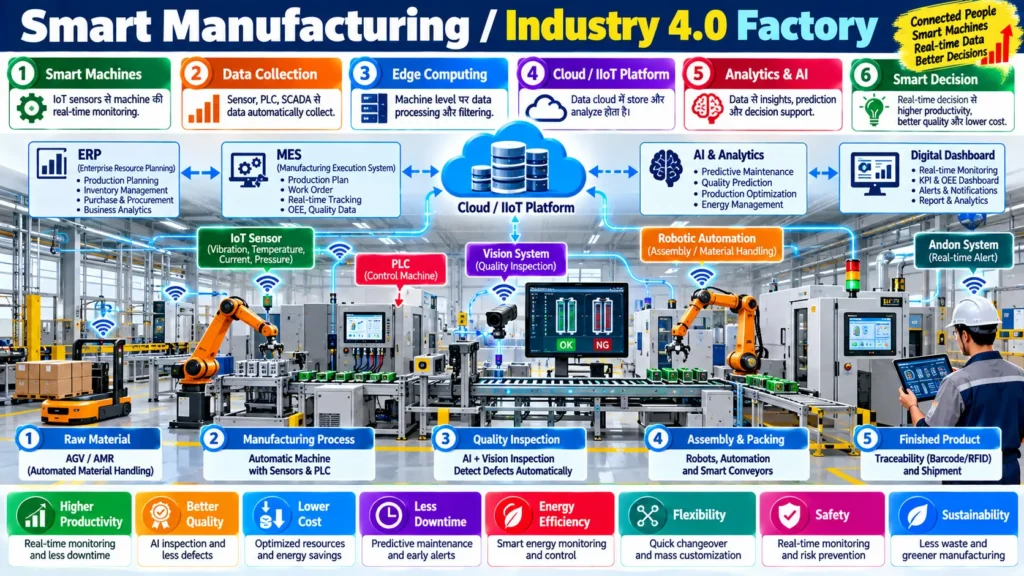
1. Industry 4.0 क्या है?
Direct Answer:
Industry 4.0 manufacturing का ऐसा approach है जिसमें machines, sensors, software, connectivity, automation और data analytics को integrate करके production processes को अधिक connected, visible और data-driven बनाया जाता है।
Interview Answer
“Industry 4.0 में connected machines, sensors, automation, data systems और analytics का उपयोग करके manufacturing process को अधिक intelligent और data-driven बनाया जाता है। Production Engineer के लिए इसका practical benefit real-time monitoring, faster problem identification, predictive maintenance और productivity improvement के रूप में देखा जा सकता है।”
Follow-up Question
Q. Production Engineer के लिए Industry 4.0 क्यों important है?
“क्योंकि इससे production data को real time या near-real time में monitor करके downtime, quality issues, productivity losses और process deviations को जल्दी identify करने में मदद मिल सकती है।”
2. IoT क्या है?
Direct Answer:
IoT यानी Internet of Things में machines, sensors और devices को network के माध्यम से connect करके data collect और exchange किया जाता है।
Manufacturing Example
एक production machine से sensor data collect किया जा सकता है, जैसे:
- Temperature
- Pressure
- Vibration
- Machine status
- Cycle count
- Running time
- Downtime
- Alarm status
यह data आगे monitoring या analysis system में उपयोग हो सकता है।
Interview Answer
“Manufacturing में IoT का उपयोग machines और sensors से process data collect करने तथा उसे monitoring और analysis के लिए available कराने में किया जा सकता है। इससे machine condition और production performance को अधिक continuously monitor करना possible होता है।”
3. MES क्या है?
MES यानी Manufacturing Execution System एक manufacturing software system है जो production execution और shop-floor information को manage और track करने में मदद करता है।
MES में organization के setup के अनुसार information जैसे:
- Production order
- Production quantity
- Work-in-progress
- Process status
- Machine status
- Operator information
- Quality records
- Traceability
- Production time
track की जा सकती है।
Interview Answer
“MES shop floor और higher-level production planning/business systems के बीच manufacturing execution information को manage करने में मदद करता है। Production Engineer के लिए इसका उपयोग production tracking, traceability, process status और performance monitoring में हो सकता है।”
4. Automation और Industry 4.0 में क्या Relation है?
Automation और Industry 4.0 एक ही चीज नहीं हैं।
Automation का focus machine/process को automatically perform या control कराने पर हो सकता है, जबकि Industry 4.0 में automation के साथ connectivity, data collection, integration और analytics भी महत्वपूर्ण होते हैं।
Example
एक automatic machine केवल operation perform कर रही है → Automation
Machine operation + sensor data + production data + dashboard + analysis → Connected/Smart Manufacturing approach
Interview Answer
“Automation Industry 4.0 का एक important component हो सकता है, लेकिन Industry 4.0 केवल automation तक सीमित नहीं है। इसमें connectivity, data, systems integration और analytics भी शामिल होते हैं।”
5. Digital Production Dashboard क्या है?
Direct Answer:
Digital production dashboard एक visual interface है जिसमें production और process के important KPIs को real-time या defined frequency पर monitor किया जा सकता है।
Dashboard पर कौन-कौन से KPIs दिख सकते हैं?
- Production Target vs Actual
- UPH
- OEE
- Downtime
- Rejection
- FPY
- Cycle Time
- Machine Status
- Production Loss
- Quality Trend
Interview Question
Q. Production Engineer के लिए Digital Dashboard का क्या benefit है?
“Dashboard से production performance को quickly visualize किया जा सकता है। Target और actual में gap, machine downtime या rejection trend जैसी abnormalities जल्दी identify करके Production Engineer priority के अनुसार action ले सकता है।”
6. Predictive Maintenance क्या है?
Direct Answer:
Predictive Maintenance में machine condition और operating data का उपयोग करके potential equipment problems को पहले identify करने और maintenance decision support करने का प्रयास किया जाता है।
Potential data examples:
- Vibration
- Temperature
- Current
- Pressure
- Motor condition
- Alarm history
- Operating hours
Interview Question
Q. Predictive Maintenance Production Engineer के लिए कैसे useful है?
“अगर machine condition data से abnormal trend पहले identify हो जाए, तो maintenance planning और downtime reduction में मदद मिल सकती है। इससे unexpected breakdown को reduce करने और equipment availability improve करने में support मिल सकता है।”
Important: Predictive maintenance का मतलब यह नहीं है कि machine breakdown कभी नहीं होगा। यह data-based early warning और maintenance decision-making को support करता है।
7. AI in Manufacturing क्या है?
Direct Answer:
Manufacturing में AI का उपयोग production और quality data को analyze करके patterns identify करने, predictions support करने, inspection automate करने और decision-making को improve करने के लिए किया जा सकता है।
Practical Applications
- Vision-based defect detection
- Predictive maintenance
- Demand forecasting
- Process anomaly detection
- Quality prediction
- Production optimization
- Energy optimization
- Intelligent scheduling
Interview Answer
“AI manufacturing में large volumes of production and process data को analyze करके patterns और abnormalities identify करने में मदद कर सकता है। उदाहरण के लिए machine condition monitoring, visual inspection और process anomaly detection में AI-based systems का उपयोग किया जा सकता है।”
8. Data-Driven Production क्या है?
Direct Answer:
Data-driven production में production decisions केवल अनुमान या experience पर depend करने के बजाय reliable production, quality, machine और process data के analysis पर आधारित होते हैं।
Example
अगर UPH लगातार कम हो रहा है, तो केवल operator को faster काम करने के लिए कहना data-driven approach नहीं है।
Data-driven approach:
UPH ↓ → Cycle Time Data → Downtime Data → Minor Stop Data → Manpower → Quality Loss → Major Loss → RCA → Action → Verification
Interview Answer
“मैं production problem को केवल observation से judge करने के बजाय available data से verify करना पसंद करूंगा। उदाहरण के लिए UPH कम होने पर cycle time, downtime, quality loss और process-wise performance को analyze करके major loss identify करूंगा और फिर corrective action की effectiveness KPI से verify करूंगा।”
9. अगर Digital Dashboard में OEE अचानक गिर जाए तो क्या करेंगे?
यह एक practical Industry 4.0 scenario है।
Answer Framework
Dashboard Alert → Data Verification → A/P/Q Analysis → Major Loss → RCA → Corrective Action → KPI Verification
Interview Answer
“सबसे पहले dashboard data और underlying data की validity verify करूंगा। इसके बाद OEE के Availability, Performance और Quality components को अलग-अलग analyze करूंगा। Major loss identify करके संबंधित team के साथ RCA और corrective action करूंगा। Action के बाद OEE और संबंधित loss trend को monitor करके improvement verify करूंगा।”
10. अगर IoT Sensor Machine में Abnormal Data दिखाए तो क्या करेंगे?
“सबसे पहले abnormal reading को verify करूंगा ताकि sensor/data issue और actual machine abnormality में difference किया जा सके। फिर applicable machine condition, process parameters और historical trend check करूंगा। आवश्यकता होने पर Maintenance/Automation team के साथ sensor और machine condition verify करूंगा। Actual issue confirm होने पर safe और approved procedure के अनुसार corrective action लिया जाएगा।”
यह answer दिखाता है कि candidate हर digital alert को blindly true नहीं मानता, बल्कि data validation भी समझता है।
11. Production Engineer को Industry 4.0 में Coding आना जरूरी है?
Interview Answer:
“हर Production Engineer के लिए advanced programming expert होना जरूरी नहीं है। लेकिन Industry 4.0 systems, production data, dashboards, automation, sensors और basic data analysis की understanding increasingly useful है। Role के अनुसार Excel, BI tools, SQL, Python, PLC या MES जैसे specific skills की आवश्यकता अलग हो सकती है।”
यह answer practical है क्योंकि Production Engineer की role company और job description के अनुसार बदल सकती है।
Industry 4.0 Interview Quick Revision
| Topic | Interview में याद रखें |
|---|---|
| Industry 4.0 | Connected + Data-driven Manufacturing |
| IoT | Sensors/Machines से connected data |
| MES | Manufacturing execution और shop-floor information |
| Automation | Automatic process/control |
| Digital Dashboard | Real-time/near-real-time KPI visibility |
| Predictive Maintenance | Condition data से early warning/maintenance support |
| AI | Data से patterns, prediction और intelligent analysis |
| Data-driven Production | Data → Analysis → Decision → Verification |
Industry 4.0 Scenario Answer Framework
Industry 4.0 से जुड़े practical questions के लिए यह formula याद रखें:
Data Collection → Data Validation → Visualization → Analysis → Decision → Action → KPI Verification
उदाहरण:
Machine Data → Verify → Dashboard → Identify Loss → RCA → Corrective Action → OEE/Downtime Verification
Production Engineer के लिए Industry 4.0 का सबसे Important Point
Interview में Industry 4.0 की definitions याद करने से ज्यादा महत्वपूर्ण यह समझना है कि technology को actual production problem से कैसे connect किया जाए।
अगर interviewer पूछे:
“Industry 4.0 आपके Production Engineer के role को कैसे improve कर सकता है?”
तो एक strong answer हो सकता है:
“Industry 4.0 technologies production data को अधिक connected और visible बना सकती हैं। इससे Production Engineer target, machine status, downtime, quality और process trends को बेहतर monitor कर सकता है। Data analysis के आधार पर abnormality जल्दी identify करके corrective action लिया जा सकता है और improvement को KPI के through verify किया जा सकता है।”
याद रखने वाली Chain
Machine → Sensor → Data → Dashboard → Analysis → Action → Improvement
यही chain traditional Production Engineer role को modern Data-Driven Production Engineer role से जोड़ती है।
Production Engineer Interview — 5-Minute Quick Revision
Interview से ठीक पहले पूरी किताब या पूरी interview guide revise करना practical नहीं होता। इसलिए interview room में जाने से पहले Production Engineer के लिए सबसे important Production, KPI, Lean, Quality, Problem Solving, Machine, Safety और Industry 4.0 concepts को एक बार जल्दी revise करें।
इस 5-minute revision का उद्देश्य definitions को detail में पढ़ना नहीं, बल्कि concept + formula + practical meaning को तुरंत recall करना है।
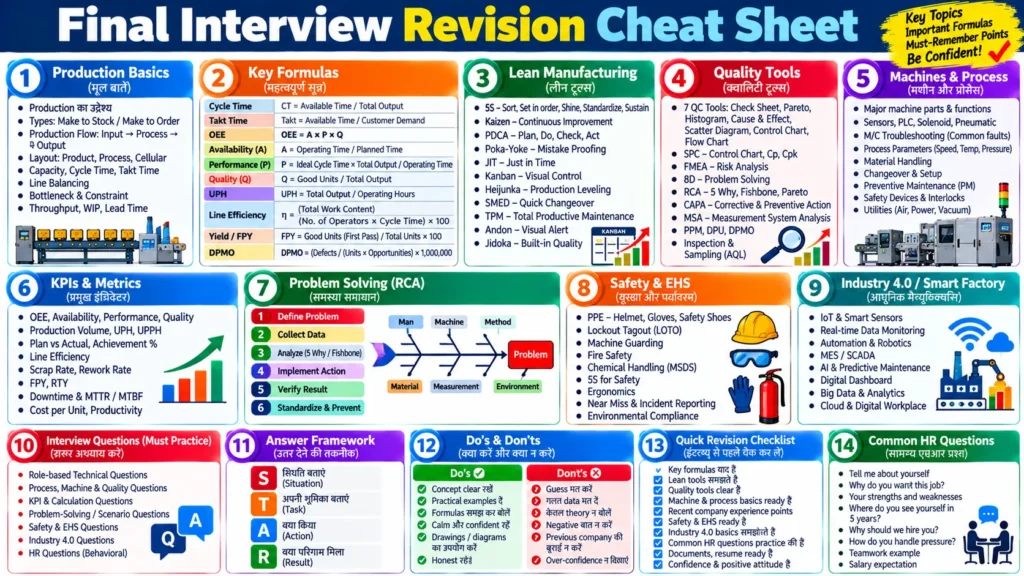
5-Minute Quick Revision Table
| Topic | याद रखें |
|---|---|
| Production | Right Quantity + Right Quality + Right Time + Right Cost + Safety |
| Productivity | Output ÷ Input |
| Cycle Time | Process को एक unit complete करने में लगने वाला actual/average time |
| Takt Time | Available Production Time ÷ Customer Demand |
| UPH | Units Produced ÷ Production Hours |
| UPPH | Output ÷ Man-Hours |
| OEE | Availability × Performance × Quality |
| Availability | Operating Time ÷ Planned Production Time × 100 |
| Performance | Ideal Cycle Time × Total Count ÷ Operating Time × 100 |
| Quality Rate | Good Count ÷ Total Count × 100 |
| FPY | First-Pass Good Units ÷ Total Units Entered × 100 |
| RTY | सभी process yields का multiplication |
| PPM | Defective Units ÷ Total Units × 1,000,000 |
| Kaizen | Continuous Improvement |
| 5S | Workplace Organization |
| Poka-Yoke | Error Proofing / Mistake Prevention |
| JIT | Right Material, Right Quantity, Right Time |
| Kanban | Visual Signal for Material/Production Flow |
| SMED | Quick Changeover |
| Jidoka | Abnormality पर process को रोककर defect को आगे जाने से रोकना |
| Heijunka | Production Leveling |
| RCA | Root Cause Analysis |
| 5 Why | Repeated “Why?” से evidence-based root cause तक पहुँचना |
| Fishbone | Possible causes को categories में analyze करना |
| Pareto | Major causes/losses को prioritize करना |
| PDCA | Plan → Do → Check → Act |
| CAPA | Corrective + Preventive/Systemic Action |
| FMEA | Potential Failure Modes और risks का proactive analysis |
| SPC | Statistical Process Control |
| Control Chart | Process variation को time के साथ monitor करना |
| PLC | Machine control logic |
| Sensor | Physical condition/input detect करना |
| Interlock | Defined unsafe condition में machine operation को रोकने वाला control |
| LOTO | Hazardous Energy Isolation/Lockout-Tagout |
| Near Miss | Incident की संभावित warning event |
| Industry 4.0 | Connected + Data-Driven Manufacturing |
| IoT | Machines/Sensors से connected data |
| MES | Manufacturing Execution और shop-floor information |
| Predictive Maintenance | Condition data के आधार पर maintenance decision support |
| AI in Manufacturing | Data-based prediction, inspection, anomaly detection आदि |
सबसे Important 10 Formulas
Interview से पहले इन formulas को जरूर revise करें:
- OEE = Availability × Performance × Quality
- Availability = Operating Time ÷ Planned Production Time × 100
- Performance = Ideal Cycle Time × Total Count ÷ Operating Time × 100
- Quality = Good Count ÷ Total Count × 100
- Cycle Time = Total Production Time ÷ Total Units
- Takt Time = Available Production Time ÷ Customer Demand
- UPH = Total Units ÷ Production Hours
- UPPH = Total Output ÷ Total Man-Hours
- FPY = First-Pass Good Units ÷ Total Units Entered × 100
- DPMO = Defects ÷ (Units × Opportunities per Unit) × 1,000,000
Problem-Solving की 10-Second Revision
अगर interviewer कोई production problem दे, तो तुरंत यह sequence याद करें:
Problem → Containment → Data → Analysis → RCA → Corrective Action → Result → Prevention → Standardization
उदाहरण:
Rejection ↑ → Defect Containment → Data → Pareto/Fishbone/5 Why → Root Cause → Corrective Action → FPY/Rejection Verification → CAPA → Standardization
KPI Question का Formula
अगर interviewer पूछे:
“आप किसी KPI को कैसे improve करेंगे?”
तो केवल “RCA करूंगा” मत बोलिए।
याद रखें:
KPI → Current Value → Target/Standard → Gap → Major Loss → RCA → Action → Result → Sustain
उदाहरण:
OEE = 65% → Target = 80% → A/P/Q Analysis → Major Loss → RCA → Action → OEE Verification → Standardization
Practical Scenario की Quick Revision
| Interview Scenario | आपका पहला Approach |
|---|---|
| Production Target Miss | Target vs Actual → Loss Analysis |
| UPH Low | Cycle Time + Downtime + Minor Stops |
| OEE Low | Availability + Performance + Quality |
| Rejection High | Containment → Data → RCA |
| Machine Breakdown | Safety → Alarm → Cause → Maintenance |
| Bottleneck | Process-wise Cycle Time → Constraint |
| Manpower Shortage | Skill Matrix → Critical Process → Redistribution |
| Material Shortage | Material Status → PPC/Stores Coordination |
| Parameter Variation | Data Trend → Machine/Process Check → RCA |
| Safety Issue | Make Safe → Contain → Report → Correct |
Interview Answer की Master Formula
अगर किसी technical या practical question का answer समझ न आए, तो इस structure को याद रखें:
What → Why → How → Example → Result
और experience-based question में:
Problem → Baseline → Root Cause → Action → Result → Standardization
यही दो frameworks आपके अधिकांश Production Engineer interview questions में काम आ सकते हैं।
Interview Room में जाने से पहले Final 60-Second Checklist
अपने आप से ये questions पूछें:
☐ क्या मैं अपना Self Introduction 60–90 seconds में दे सकता हूँ?
☐ क्या मैं अपने current/previous production experience को KPI के साथ explain कर सकता हूँ?
☐ क्या मुझे OEE, Cycle Time, Takt Time, UPH और UPPH के formulas याद हैं?
☐ क्या मैं 5S, Kaizen, Poka-Yoke, JIT, SMED और Jidoka को practical example के साथ समझा सकता हूँ?
☐ क्या मैं RCA, 5 Why, Fishbone, Pareto, CAPA और FMEA का difference बता सकता हूँ?
☐ क्या मैं machine problem का basic troubleshooting approach बता सकता हूँ?
☐ क्या मैं Production vs Quality conflict का scenario handle कर सकता हूँ?
☐ क्या मैं Safety vs Production Target scenario का professional answer दे सकता हूँ?
☐ क्या मैं अपने resume में लिखे हर project और achievement को explain कर सकता हूँ?
☐ क्या मेरे बताए हुए numbers वास्तविक हैं और मैं बता सकता हूँ कि उन्हें कैसे measure किया गया?
☐ क्या मुझे जिस company में interview है, उसके product और manufacturing process की basic understanding है?
Final 5-Minute Memory Map
Production → Productivity → Cycle/Takt → KPI/OEE → Lean → Quality → RCA → Machine → Safety → Industry 4.0 → HR
और experience-based answer के लिए:
Problem → Data → Root Cause → Action → Result → Prevention
याद रखें, Production Engineer interview में केवल definitions याद होना पर्याप्त नहीं है। Interviewer यह देखना चाहता है कि आप shop-floor problem को समझकर data से analyze कर सकते हैं, root cause identify कर सकते हैं, सही action ले सकते हैं और improvement को measurable KPI से verify कर सकते हैं।
Production Engineer Interview Checklist
Interview से पहले candidate को केवल questions पढ़ना ही नहीं चाहिए, बल्कि यह भी check करना चाहिए कि वह important technical concepts, practical production scenarios और HR questions को बिना hesitation explain कर सकता है या नहीं।
नीचे दी गई checklist को interview से पहले एक बार पूरा review करें। जिस topic का answer confidently नहीं दे सकते, उसे दोबारा revise करें।
1. Technical Interview Checklist
Production & KPI
☐ OEE — Availability × Performance × Quality
☐ Cycle Time — Process को एक unit complete करने में लगने वाला time
☐ Takt Time — Customer demand के अनुसार required production pace
☐ UPH — Units Per Hour
☐ UPPH — Units Per Person-Hour
☐ FPY — First Pass Yield
☐ RTY — Rolled Throughput Yield
☐ Productivity — Output ÷ Input
☐ Bottleneck — Process constraint/major capacity limitation
☐ Line Balancing — Work content को stations के बीच balance करना
Lean Manufacturing
☐ 5S
☐ Kaizen
☐ Poka-Yoke
☐ JIT
☐ Kanban
☐ SMED
☐ Jidoka
☐ Heijunka
☐ Seven Wastes
☐ Visual Management
Quality & Problem Solving
☐ RCA
☐ 5 Why
☐ Fishbone Diagram
☐ Pareto Analysis
☐ PDCA
☐ CAPA
☐ FMEA
☐ SPC
☐ Control Chart
☐ Process Capability — Cp/Cpk
☐ Rejection & Defect Analysis
☐ PPM / DPMO
Machine & Automation
☐ PLC Basics
☐ Sensors
☐ Proximity Sensor
☐ Photoelectric Sensor
☐ Solenoid Valve
☐ Pneumatic Cylinder
☐ HMI
☐ Machine Interlock
☐ Machine Parameter
☐ Basic Machine Troubleshooting
☐ Preventive Maintenance
☐ Downtime Analysis
Safety
☐ PPE
☐ LOTO
☐ Machine Guarding
☐ Interlock
☐ Emergency Stop
☐ Near Miss
☐ Unsafe Act
☐ Unsafe Condition
☐ Safety SOP
☐ Production Target vs Safety Scenario
Industry 4.0
☐ Industry 4.0
☐ IoT
☐ MES
☐ Digital Production Dashboard
☐ Predictive Maintenance
☐ AI in Manufacturing
☐ Data-Driven Production
2. Practical Interview Checklist
Technical definitions याद होना पर्याप्त नहीं है। इन practical scenarios के answers भी तैयार रखें:
☐ Production Target Miss
☐ UPH Suddenly Low
☐ OEE Low
☐ Machine Breakdown
☐ Recurring Machine Breakdown
☐ High Rejection
☐ Sudden Defect Increase
☐ Bottleneck Identification
☐ Cycle Time Above Standard
☐ Manpower Shortage
☐ Material Shortage
☐ High Downtime
☐ Production vs Quality Conflict
☐ Operator Not Following SOP
☐ Machine Parameter Variation
☐ Customer Demand Suddenly Increases
☐ Safety Issue During Production
☐ Safety Interlock Problem
☐ Near Miss
☐ Improvement Result Not Sustained
3. Experience-Based Checklist
अगर आप Experienced Production Engineer हैं, तो इन questions के answers अपने real experience और actual data के साथ तैयार रखें:
☐ आपका current/previous production role क्या था?
☐ Daily production target कितना था?
☐ कौन-कौन से KPIs monitor करते थे?
☐ आपने OEE कैसे monitor/improve किया?
☐ आपने UPH या productivity में क्या improvement किया?
☐ आपने rejection कैसे reduce किया?
☐ आपने machine downtime कैसे control किया?
☐ आपने कोई Kaizen किया?
☐ आपने कोई Poka-Yoke implement किया?
☐ आपने RCA में कौन-से tools use किए?
☐ आपने कोई cost/productivity improvement किया?
☐ आपकी personal contribution क्या थी?
☐ Improvement का before/after data क्या था?
☐ Improvement को कैसे verify किया?
☐ Improvement को कैसे sustain किया?
☐ क्या आपका project SOP/WI/Control Plan में standardize हुआ?
Golden Rule:
Resume में जो भी achievement लिखी है, उसके लिए Problem → Baseline → Root Cause → Your Action → Result → Standardization explain करने के लिए तैयार रहें।
4. HR Interview Checklist
☐ Tell Me About Yourself
☐ Why Production Engineering?
☐ Why Should We Hire You?
☐ Your Strengths
☐ Your Weakness
☐ Why Do You Want to Change Your Job?
☐ Why Do You Want to Join Our Company?
☐ How Do You Handle Pressure?
☐ How Do You Handle Team Conflict?
☐ Your Biggest Achievement
☐ Your Career Goal
☐ Where Do You See Yourself in 5 Years?
☐ Expected Salary
☐ Notice Period / Joining Availability
5. Industry-Specific Checklist
Interview जिस industry के लिए है, उसके relevant topics भी revise करें।
Automobile
☐ Cycle Time
☐ Takt Time
☐ Line Balancing
☐ JIT
☐ Kanban
☐ Poka-Yoke
☐ Automotive Quality
Electronics / Battery
☐ Process Parameters
☐ Traceability
☐ ESD
☐ Automation
☐ Functional Testing
☐ Leakage Testing
☐ Process Quality
Machining
☐ CNC
☐ Cutting Parameters
☐ Tool Life
☐ Cycle Time
☐ SPC
☐ Cp/Cpk
☐ Dimensional Quality
Assembly
☐ Line Balancing
☐ Torque Control
☐ Poka-Yoke
☐ Standard Work
☐ Ergonomics
☐ Assembly Quality
Final Self-Assessment
Interview से पहले खुद से ये 10 questions पूछें:
☐ क्या मैं अपना Self Introduction 60–90 seconds में confidently दे सकता हूँ?
☐ क्या मैं अपने Production Experience को KPI और measurable results के साथ explain कर सकता हूँ?
☐ क्या मैं OEE, Cycle Time और Takt Time के formulas explain कर सकता हूँ?
☐ क्या मैं किसी production problem के लिए RCA approach बता सकता हूँ?
☐ क्या मैं किसी rejection problem को Containment → Data → RCA → Corrective Action → Verification से explain कर सकता हूँ?
☐ क्या मैं Lean tools को practical examples के साथ समझा सकता हूँ?
☐ क्या मैं machine/automation problem का basic troubleshooting approach बता सकता हूँ?
☐ क्या मैं Safety और Production Target के conflict को professionally handle कर सकता हूँ?
☐ क्या मैं अपने resume के हर technical point और achievement को defend कर सकता हूँ?
☐ क्या मैं जिस industry/company के लिए interview दे रहा हूँ, उसके basic product → process → machine → quality → KPI को समझता हूँ?
Interview Readiness Rule
अगर आप किसी topic को देखकर केवल उसकी definition बता सकते हैं, तो preparation अभी पूरी नहीं हुई है।
हर important topic के लिए कम से कम यह 5-step answer तैयार रखें:
Definition → Why Important → Formula/Method → Practical Example → Interview Scenario
और experience-based questions के लिए:
Problem → Data → Root Cause → Action → Result → Prevention
यही checklist Production Engineer interview की final revision को structured और practical बनाती है।
Production Engineer Interview Preparation FAQs

नमस्कार! मेरा नाम Anshu Kumar है और मैं Krishnji.com का Founder एवं Technical Content Writer हूँ। मैं Manufacturing Industry में Assistant Engineer के रूप में कार्यरत हूँ और Quality Management, Production, Root Cause Analysis (RCA), 7 QC Tools, Lean Manufacturing, Six Sigma, Kaizen, 5S, TPM, SPC, ISO Standards, Science तथा Continuous Improvement जैसे विषयों पर व्यावहारिक अनुभव रखता हूँ।